
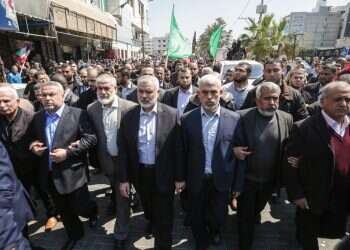
Failed financial gambit: Iran underpaid Hamas $58M
New intelligence documents reveal Hamas leader Yahya Sinwar's frustration with Iran's limited financial support, diplomatic strategy against Israel, and coordination with Qatar.
Israel Hayom is a media organization founded on the belief that the Israeli public deserves better journalism—more balanced, more accurate, and more reliable. Journalism that speaks rather than shouts. Journalism that is trustworthy, objective, and matter-of-fact. A different kind of journalism, offered free of charge. The first print edition was published on July 30, 2007, and in 2010 Israel Hayom became the Israeli newspaper with the highest weekday readership. The newspaper’s publisher is Dr. Miriam Adelson. Its Editor-in-Chief is Omar Lachmanovitch, and its founding editor is Amos Regev. Israel Hayom’s Hebrew and English websites, as well as its Android and iOS applications, provide around-the-clock news coverage, exclusive content, breaking news and updates, analysis and commentary, video, podcasts, and live broadcasts. The digital platforms of Israel Hayom include news and opinion channels covering culture and entertainment, lifestyle, technology, sports, business and consumer affairs, health, military affairs, food, Judaism, tourism, and automobiles. In 2021, a new Hebrew-language website and mobile application were launched to provide users with a fast, up-to-date, secure, and convenient experience. The content of the newspaper’s print edition is also available online through a daily digital edition and can be received via newsletter. “The Israel Hayom Clique,” the publication’s exclusive benefits club, offers website users discounts and special promotions on products and services. Israel Hayom welcomes feedback, criticism, and suggestions for improvement from its readers. You can contact the organization by email at hayom@israelhayom.co.il

New intelligence documents reveal Hamas leader Yahya Sinwar's frustration with Iran's limited financial support, diplomatic strategy against Israel, and coordination with Qatar.


The port handles approximately 90% of Iran’s imports. The explosion was heard as far as 50 kilometers (about 31 miles) away, and the force of the blast shattered windows in buildings within a radius of several kilometers. As of now, the cause of the explosion remains unknown.

The agenda is expected to include the continuation of Israeli-Turkish negotiations on Syria, mediated by Azerbaijan, discussions on Azerbaijan potentially joining the Abraham Accords, and further deepening of bilateral relations between the two countries.

Palestinian Authority President Mahmoud Abbas launched a scathing attack on the terrorist organization during a rare public condemnation at a central Fatah Council conference in Ramallah.

The trip follows "technical talks" held in Baku between Israeli and Turkish delegations. Bilateral cooperation between Israel and Azerbaijan is expected to be a key focus of the discussions.

An international official commented on the upcoming "technical discussions" between Washington and Tehran, stating that the United States will reject Iran's proposal for Russian and Chinese oversight. The US is expected to demand the removal of advanced centrifuges, used for rapid enrichment, from Iranian territory.

The official stressed that despite the political difficulty that such a deal would create, Prime Minister Benjamin Netanyahu would not hesitate to act, even with President Donald Trump in the White House.

A non-governmental Israeli source spoke with a senior American official who said: “Israel need not be concerned about the progress in talks with Iran.” According to the official, once the Americans present their full list of demands, the negotiations are expected to collapse.

A Yemeni economic analyst estimated that Thursday night’s attack on the Ras Issa fuel port caused roughly $700 million in damage to the Houthis.

From Iran’s perspective, the talks appear to be a resounding success. The Americans, at least at this stage, have dropped several of their key preconditions discussed prior to negotiations