


The establishment of the Emirate of Transjordan, later to become the Kingdom of Jordan, by the British Mandate authorities in April 1921 created an artificial state that, like its Arab counterparts Iraq, Syria and Lebanon, lacked historical roots of its own.
Until then, Transjordan had been part of the British Mandate for Palestine. Some argue that the British, anticipating a conflict between Jews and Arabs over the establishment of a Jewish national home in the Land of Israel, intended to resolve such a conflict by compensating the local Arab population with territory east of the Jordan River.
Much water has flowed down the Jordan River since then. The Kingdom of Jordan was established and gained independence, and to this day, its ties with Israel remain a cornerstone of its national security. This was true under King Abdullah I, the kingdom's founder, who forged a strategic alliance with David Ben-Gurion against their common enemy, the Palestinian national movement, which was seen as a threat to both Israel and Jordan.
Abdullah went to war against us in May 1948, seeking to seize the territories earmarked for a Palestinian state whose establishment he opposed. But as Golda Meir explained to him during their meeting on the day Israel declared independence, those who go to war cannot always control its course. We thus found ourselves fighting some of the fiercest battles of the war against the Jordanian Arab Legion in Jerusalem, Latrun and Gush Etzion. After the war, the two countries held peace talks. Israel was in no hurry to sign an agreement that would have required it to relinquish its territorial gains during the war. In any event, the king was assassinated by a Palestinian gunman in July 1951 because of his peace contacts with Israel.
The same pattern emerged under Abdullah's grandson, King Hussein, who came to warn Meir in September 1973 of Egypt and Syria's intentions to attack Israel, but who six years earlier had joined Egyptian President Gamal Abdel Nasser in the Six-Day War against us. In the intervening years, in September 1970, Israel came to Hussein's aid after Syrian forces invaded Jordan.
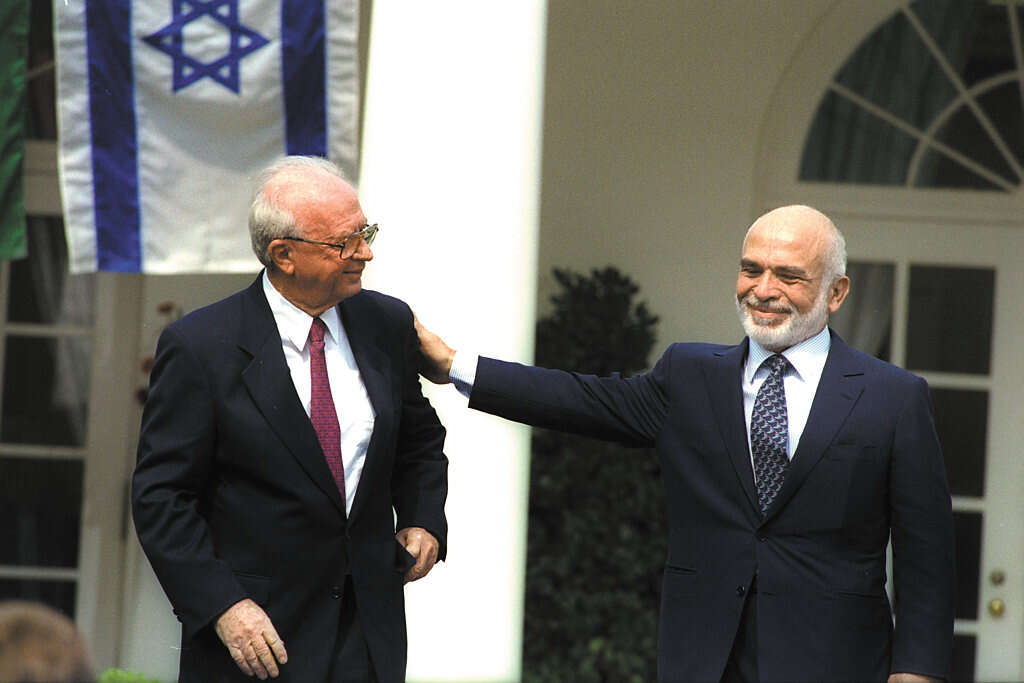
The two countries thus maintained a state of neither peace nor war, engaging in dialogue and close strategic and security cooperation behind the scenes.
In 1993, a turning point came. Following the Oslo Accords, the Jordanians felt that we had betrayed them by aligning ourselves with the Palestinians in a way that could jeopardize Jordan's security. The result was a peace treaty in October 1994. The treaty failed to meet Jordanian expectations that the Palestinian issue would disappear from the agenda. After all, nearly two-thirds of the kingdom's population is of Palestinian origin. Nor did it fulfill Israel's hopes for a warm peace with Jordan. Despite these disappointments, however, security cooperation between the two countries endured and deepened.
Today, Jordan is being swept up in the same wave of anti-Israel sentiment spreading across the Arab and Muslim world. In Israel, meanwhile, domestic political considerations take precedence, and Israeli statements and actions are often perceived in Jordan as potential threats to its security. Yet the real challenges facing Jordan lie elsewhere: the threat posed by Iran and its proxies in Iraq and Yemen, as well as the challenges posed by Islamic State and the Islamist regime of Ahmed al-Sharaa in Syria.
Was the Israeli-Jordanian peace treaty a mistake? Absolutely not. Israel is making two mistakes: first, by failing to hold Jordan accountable for intolerable and unforgivable statements and actions; and second, by failing to seek opportunities to improve and advance relations with the kingdom wherever possible.
Israel and Jordan share an interest in maintaining their security cooperation, which provides protection for Jordan while ensuring a quiet eastern border for Israel. The task facing any new Israeli government, therefore, is to rebuild the peace with Jordan from the wreckage, without unrealistic expectations, standing firm on our interests and rights while respecting the other side.


