Unless Israel draws concrete red lines in Syria and the eastern Mediterranean, the Turkish army and navy will further encroach upon Israel's northern and maritime borders. Israel could find itself facing Turkish tanks on the Golan Heights and Turkish frigates off the coast of Caesarea.
This is the warning I heard this week from a very senior Israeli intelligence official. The warning echoes the alarm expressed in the 2025 Nagel Commission report (which evaluated Israel's security budget and force buildup) about the Turkish drive toward an Islamist-jihadist regional order with Ottoman-era hegemonic ambitions.
Israel must be prepared, the commission's report cautioned, for direct confrontation with Ankara and with Syrian proxies and armies aligned with Turkey. "The threat from Syria could evolve into something even more dangerous than the Iranian threat," the report stated.
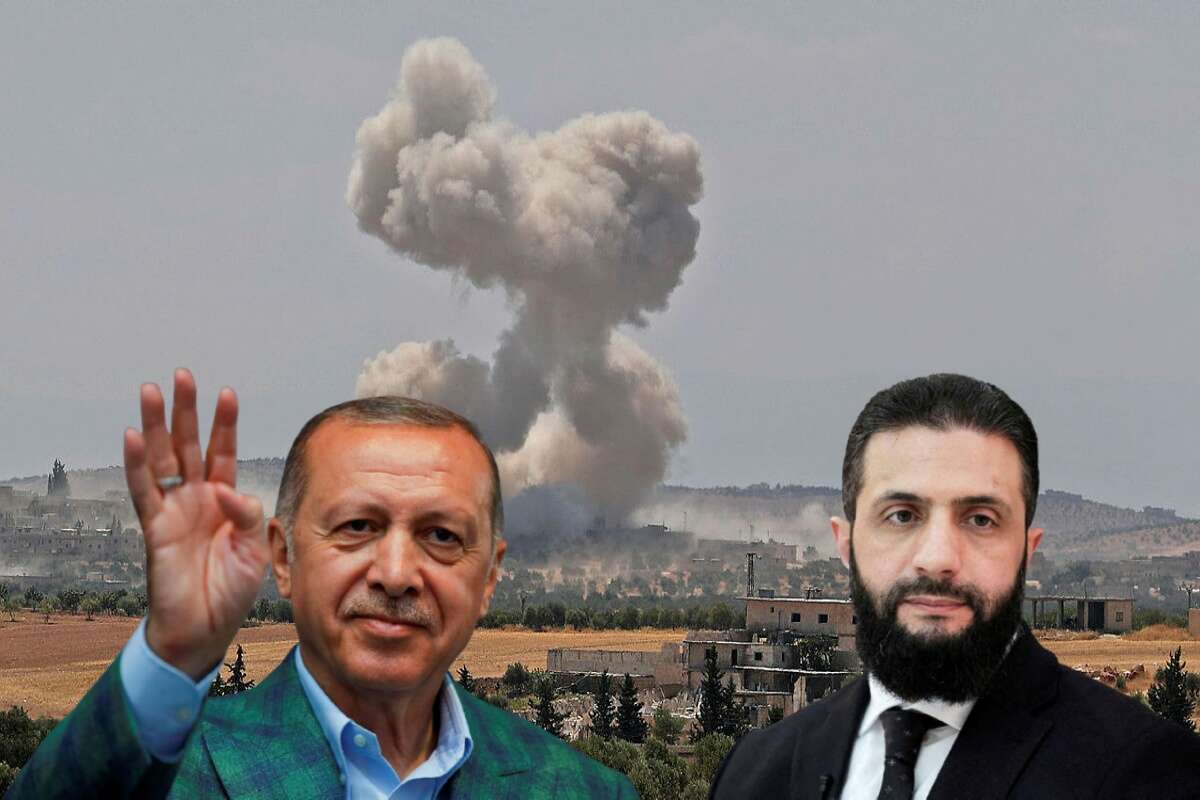
This threatening reality explains the Israeli air strike several days ago on an airbase near Idlib in northern Syria, where the Turks apparently were setting up a radar and air-defense system that was meant to interfere with the IAF's operations in the north.
The Israeli strike sent a stark signal to Turkey's radical Islamist dictator Recep Tayyip Erdoğan and his Syrian satrap, the former ISIS terrorist named Ahmed al-Sharaa (a.k.a. Mohammed al-Julani), to back off.
Understand: Erdoğan is a true-blue believing antisemite of the old school, who considers classic antisemitic myths like the Protocols of the Elders of Zion (where Jews control the global banking and media conglomerates) as truth. He honestly hates Jews and Israelis, and he openly seeks to lead a pan-Islamic coalition to crush Israel – while remaining a member of NATO.
Erdoğan is anchoring a Sunni alliance of Saudi Arabia, Pakistan, and Qatar (with some Egyptian role too) that has a malodorous anti-American and anti-Israeli scent. Erdoğan has even drafted a model constitution for an Islamic confederation meant to replace NATO. According to US President Trump, Erdoğan's military was prepared to join Iran's war against Israel this year until Trump "asked" Erdoğan not to do so.
But that has not stopped Erdoğan from siding with Russia against the West in defense of Iran and in support of the Iranian economy and Iranian war effort, and from hosting Hamas military headquarters. All the while, he petitions gullible Europeans for goodies, and lobbies his friend US President Donald Trump for engines for Turkey's homegrown fighter jet and for advanced American F-35 fighter jets.
Trump and his special envoy to Turkey and Syria Tom Barrack (who is wildly solicitous towards Erdoğan and Julani) have stuffed their mouths with cotton balls and have nothing to say about Erdoğan's much-too-close alignment with Russia, China, and Iran; Erdoğan's long-term military occupation of northern Cyprus and northern Syria; and the diplomatic and military war he is waging (for the moment, mainly behind the scenes) against Israel.
Israel has not declared and does not want to consider Turkey an enemy country, but it cannot ignore Turkey's military buildup and its encroachment – nay, its essential takeover of Syria and attempt to extend its military reach to Israel's borders.
This week's Israeli strike was designed to push back against Turkish air intrusion, and Israel will certainly strike again if Erdoğan insists on expanding his military presence in Syria or attempts to rebuild the Syrian air force.
But the more immediate Turkish threat comes from its large navy, since Erdoğan repeatedly threatens to wage war with Israel over gas fields in the Mediterranean.
The Turkish navy has tens of frigates, destroyers, and amphibious landing craft, as well as 12 submarines. It is now building six more submarines along with 24 new frigates and destroyers.
By comparison, the too-small Israeli navy has 15 missile ships, six submarines, and a dozen cruisers. Israel will soon add naval helicopters to its defensive arsenal. It is no surprise that the Nagel Commission recommended a massive build-up of the Israeli navy as a priority expenditure.
At the moment, NATO cannot afford a complete rupture with a country that controls the Turkish Straits and hosts US nuclear weapons. But at the very least, a "reciprocity standard" should be applied to Turkey. Contracts with that country must be tied to its foreign policy and military conduct.
Human rights standards should pertain to Turkey too. Erdoğan has jailed more journalists, judges, generals, and academics than any other country in the world, including China. He is building 40,000 new jail cells to handle the overload. He is creating an authoritarian system to suit his imperial purposes.
So, Erdoğan needs to be cut down to size, and his madly ferocious foreign and military policies put in a box. American and European leaders who prioritize stability in the region ought to weigh in against Erdoğan's overly ambitious and aggressive schemes.
They should not be censuring Israel when it necessarily acts to drive Erdoğan back from the brink.
Remember: The past three years of devastating enemy attacks on Israel taught Israelis an important lesson – which is the need to maintain a proactive defense posture including strategic ascendancy against enemies near and far.
Consequently, Israel will not return to the containment policies of recent decades that prioritized restraint and diplomacy over enemy degradation and military triumph. This approach allowed enemies to develop attack capabilities under the cover of diplomatic breathing time; what some Western officials mistakenly called periods of "stability."
That approach blew up in Israel's face, with terror and invasion from the West Bank and Gaza and from Syria and Lebanon, and with the march of Iran's nuclear bomb program to near completion and Iran's ballistic missile array to near-annihilation-of-Israel potential.
The lessons Israel has learned apply to Turkey too. From Idlib to Erbil, Israel will attack, if necessary, not defend. It will insist on jihadist-free buffer zones along its borders with Lebanon and Syria. It will not tolerate the placement on its doorstep of equilibrium-breaking strategic weapon systems nor abide the advance of threatening foreign armies and navies.