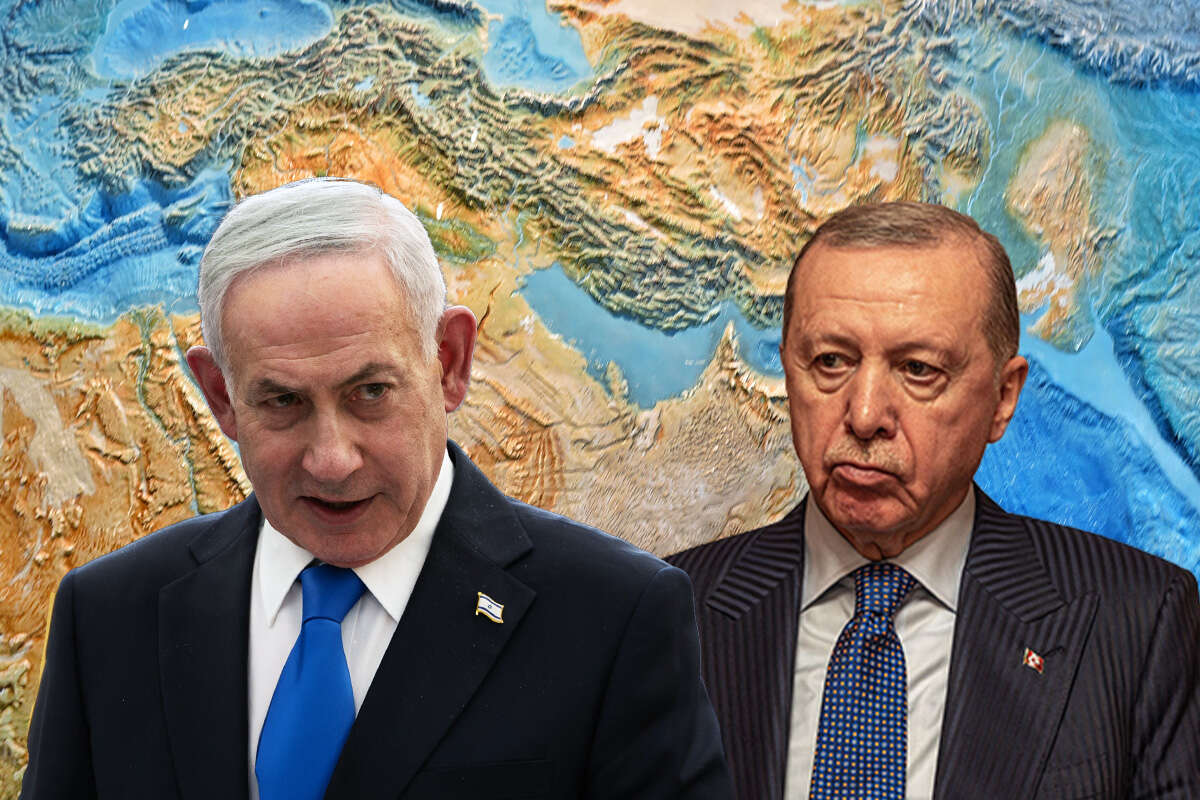
Eighteen days before October 7, 2023, Turkey's former intelligence chief and his successor sat with Recep Tayyip Erdogan across from Benjamin Netanyahu. Hakan Fidan was now foreign minister; Ibrahim Kalın ran MİT, Turkey's national intelligence service. Energy, technology, artificial intelligence and cybersecurity were on the table. Three years earlier, both men had sat beside Erdogan with Hamas leader Ismail Haniyeh - Fidan then running MİT, Kalın serving as Erdogan's spokesman. Ankara's Israel and Hamas files met at the apex of the Turkish state.
The Hamas file was operational. Musa Akkari, a veteran of Hamas's Qassam Brigades freed in the 2011 Shalit prisoner exchange, recounted that Erdogan dispatched a government aircraft to bring him and nine others from Egypt to Ankara and pledged to protect them "as we protect our own children". U.S. Treasury sanctions identified Turkey-based Zaher Jabarin as Hamas's finance chief and liaison to Iran's Quds Force, Redin Exchange as a conduit for $10 million to the Brigades, and a covert investment portfolio exceeding $500 million that included Turkish companies and operatives. Ankara also supplied legal cover: Haniyeh held Turkish citizenship, roughly a dozen Hamas figures in Istanbul had received or were awaiting Turkish identity papers, and trade records showed Hamas financier Hisham Younis Qafisheh naturalised as Haşmet Aslan. A Hamas document recovered from the home of Hamza Abu Shanab, an aide to Gaza leader Yahya Sinwar, envisaged cells, safe houses, sabotage, assassinations and kidnappings from Turkish soil.
MİT could not plausibly have missed it. The service combined statutory reach across the Turkish state with signals, cyber, foreign and counterintelligence capabilities and direct presidential access; it had already mapped Iranian cells and dismantled ISIS financing with allied services. Sinwar could conceal the final battle plan without concealing the enterprise. Turkish ignorance would require MİT to have mapped Iran and ISIS but not Hamas, met Hamas leaders without mapping their networks and absorbed years of allied warnings without producing a Turkish intelligence picture.
Erdogan later gave the policy its name: Hamas was not a terrorist organisation but a legitimate resistance movement and political actor. Ankara had already made the operative choice: Hamas's Turkish apparatus would not be dismantled as enemy infrastructure. That choice came before whatever MİT knew of the final attack.
On September 9, 2023, the United States, India, Saudi Arabia, the United Arab Emirates and European partners unveiled the India-Middle East-Europe Economic Corridor (IMEC), connecting India through the Gulf and Israel to Europe while bypassing Turkey. Erdogan understood immediately: "There can be no corridor without Turkey." Eleven days later, Saudi Crown Prince Mohammed bin Salman said normalisation with Israel was drawing closer "every day"; two days after that, Netanyahu told the United Nations that Israel stood on the cusp of a peace capable of transforming the Middle East.
Together, those developments threatened Ankara's gate power. IMEC could fuse Indian scale, Gulf capital and Israeli access to Europe under American sponsorship without Turkey, while Saudi-Israeli normalisation would weaken the Palestinian veto over regional integration. A functioning Palestinian state requires one authority able to govern, monopolise force and enforce an agreement, and would reduce Turkish leverage further; Hamas preserves the fragmentation that gives Ankara access to Palestinian politics, pressure on Israel, competition with Cairo, Riyadh and Abu Dhabi, and a mediating role whenever the region fractures.
October 7 broke both trajectories. Saudi-Israeli normalisation froze, IMEC lost its political foundation, the Palestinian veto re-emerged and Ankara returned to the diplomatic centre; within two weeks, Fidan was proposing Turkey as a guarantor of an Israeli-Palestinian settlement. Turkey did not need to want the massacre to benefit from what it destroyed. On October 20, Fidan, after thirteen years running MİT, said Ankara had understood that the pre-war regional architecture was unsustainable and that a crisis would eventually erupt. Ankara expected the regional rupture, knew Hamas's Turkish apparatus and had the means to penetrate it.
Israel knew Hamas's Turkish apparatus while restoring full diplomatic relations with Ankara, meeting Erdogan and placing cybersecurity on the bilateral agenda. It also sustained Hamas through years of Qatari financing for Gaza; Qatargate later raised suspicions that Qatari money and influence reached the prime minister's inner circle. Jerusalem believed money, access and intermediaries could contain Hamas. Instead, Doha gained leverage, Ankara preserved Hamas and Hamas gained capacity.
A State Commission of Inquiry, appointed by the President of the Supreme Court, not the government it examines, will investigate that pre-October 7 architecture, not merely the breached fence, the warnings of October 6 or the units that failed the next morning. Its remit will include the Turkish and Qatari files and their intersection, the policy of managing Hamas, and what Israel knew before the attack. Mossad and Military Intelligence reviews already contain classified findings on external actors and liaison relationships; the Commission will inherit a far broader record.
Israel learned the Turkish-Qatari lesson in blood and too late. It now bars Turkish and Qatari forces from Gaza and rejects Ankara and Doha as custodians of the postwar order. Hamas's former hosts will not oversee Gaza's future.
The same lesson transformed Israel's Turkish file. Intelligence collection on Turkey increased, Turkish-based Hamas entered Israeli operational planning, and in December 2023 Ronen Bar, then head of Shin Bet, Israel's domestic security service, named Lebanon, Qatar and Turkey as theatres in which Israel would reach Hamas leaders. The September 2025 strike in Doha turned doctrine into precedent. Foreign sanctuary no longer conferred immunity.
The expanded collection also exposed the risks inside MİT's liaison relationships. In 2025, Sir Richard Moore, then chief of Britain's MI6, described Fidan and Kalın as "consummate professionals and firm friends". That closeness magnifies exposure when threat hierarchies diverge. Even tasking is intelligence: a collection requirement reveals a service's targets, gaps and priorities. Tasking MİT on an actor Ankara intends to preserve can compromise the collector before MİT answers.
Israel shared classified intelligence and concrete cases of Turkish practice cutting against partners' own interests. MİT warned Iran's Revolutionary Guards about Kurdish fighters moving toward Iran; the same Turkish operating environment connected Hamas finance to Foxtrot, a Swedish criminal network serving Iranian intelligence, while Turkey-based New Way Group Global served Russian military intelligence, the GRU. Turkey was the intersection. Among the services briefed, liaison practice has changed accordingly: cooperation with Ankara and exposure to Ankara are now treated as separate decisions, with sources, targets and collection requirements compartmented.
Israel now treats Hamas and Iran, Syria and Cyprus, the Aegean and Libya, Russia and NATO, diplomacy and intelligence as one Turkish strategic system. In Syria, assessment became denial when Israel struck airbases Ankara had surveyed before Turkey could turn them into military depth. Turkish occupied northern Cyprus sits on the same operational map: Turkey's nearest military-intelligence platform to Israel's Eastern Mediterranean theatre. If Ankara weaponises the occupied north, restoring Cypriot sovereignty becomes an Israeli security objective and ending Turkish military control an Israeli-Greek-Cypriot mission.
NATO's Article 5 collective defence guarantee does not redraw that map. Turkish citizenship does not extend NATO protection to Hamas, and Turkish occupation does not extend NATO territory to northern Cyprus. Striking Hamas on Turkish soil is an operational option; Ankara cannot manufacture Alliance immunity with Turkish passports or Turkish flags.
Whether MİT knew the hour of the attack was never the threshold. Turkey knew Hamas operationally; Jerusalem knew of its Turkish apparatus; and October 7 destroyed the regional order whose emergence Ankara had every reason to prevent. Israel is now rebuilding that order with its partners around an architecture that no longer runs through Ankara.
Shay Gal is Founder and Principal of Line of State, a strategic practice working with governments, institutions and decision-makers on strategy, risk, access and security in high-stakes environments. He is on X at @ShayGal84.