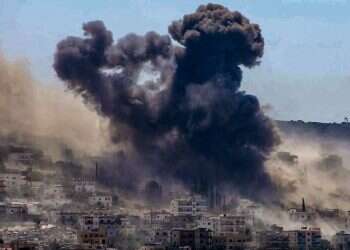
The past 24 hours show that Israel and Iran are on the brink of a direct military confrontation. First came the Israeli strike in Damascus, which triggered a missile launch toward Israel on Sunday afternoon. Sunday night and early Monday, Israel retaliated by attacking Iranian targets in Syria.
The Israeli strike that began the latest flare-up, which targeted Iranian assets in Syria, was highly unusual because it was carried out during the day.This suggests that the targets were of high value. Otherwise, Israel would have preferred to attack at night, when the risk of collateral damage and casualties is much lower.
The fact that Prime Minister Benjamin Netanyahu was visiting Chad when the attack took place only underscores the importance of those targets and the urgency involved. Just minutes after the strike, Israel's Iron Dome system intercepted a medium-range missile fired at the Golan Heights. The short interval between the attack and the retaliation suggests that someone was just waiting for an opportunity.
Since Syrian forces only fired surface-to-air missiles against the Israeli aircraft, it is safe to assume that some other entity fired the rocket toward Israel.
In February last year, Iran sent an unmanned aerial vehicle toward Israel that was intercepted just minutes after entering Israeli airspace. Israel retaliated by targeting several Iranian assets, during which Syrian air defense managed to down an Israeli F-16.
In the wake of that flare-up, Israel significantly increased its attacks on Iranian targets in Syria, even though it knew Iran was looking for revenge, which came soon. Iran fired 30 rockets, four of which hit Israeli territory without causing casualties or damage. Israel then launched a massive strike against dozens of Iranian assets in Syria, as well as against Syrian air defense forces. Since that escalation, Iran has chosen not to engage Israel directly.
In September, Syrian air defense shot down a Russian Ilyushin 20 military plane off the Syrian coast after mistaking it for an Israeli jet. In the immediate aftermath of that incident, Israeli action in Syria decreased significantly. But over the past several weeks, Israeli military action against Iranian targets has intensified. Netanyahu even took responsibility for those actions.
The latest tit-for-tat suggests Iran is no longer going to remain passive to Israeli action. It is safe to assume that the recent escalation is not over yet.
This is the first time that new IDF Chief of Staff Lt. Gen. Aviv Kochavi has had to deal with such an escalation. In this matchup with Quds Force commander Maj. Gen. Qassem Soleimani, Kochavi will have to be extra careful not to step on Russian toes.
It took months for Moscow to calm down after the incident last September, and now Israel and Russia have a more comprehensive mechanism for deescalation. Israel must make sure the arrangement with Russia remains strong, as it is of paramount importance.
Although it is unlikely that the latest escalation will not spiral out of control, the IDF is not going to take any chances and will most likely remain on high alert in the near future to prepare for any Iranian response, which could also come from various Iranian proxies, including Hezbollah.
So tension in the north will remain a constant fixture for the foreseeable future and might very well play a major role in the election campaign.