

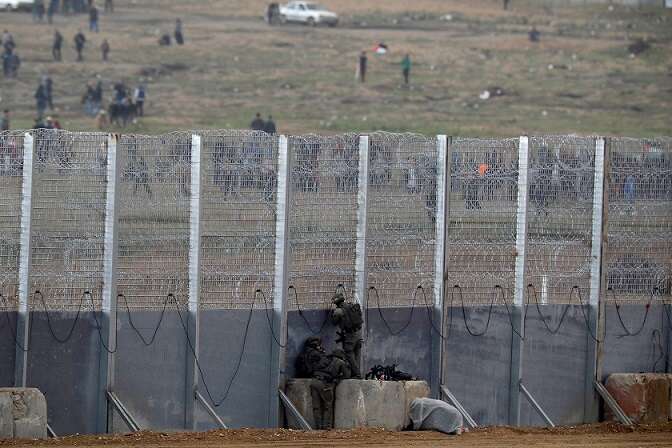
One of the questions about the ongoing conflict between Israel and Hamas is whether we are fighting or negotiating. Many wonder how negotiations can be carried on while two sides that have no common ground are both employing force. Doesn't the use of violence contradict political negotiations and doesn't the use of military force go against diplomacy?
The facts are clear. Neither side in the conflict recognizes the other's right to exist and therefore they supposedly cannot be negotiating. Today negotiations are taking place with Egypt as a mediator and in the past messages were sent via U.N. Middle East envoy Nickolay Mladenov. At the same time, rockets are being fired from Gaza at Israeli communities along the border and even farther into Israel and the IDF responds with airstrikes on Hamas and Islamic Jihad facilities. What is the rationale for holding negotiations while employing force and what is the reasoning for using violence and causing damage and a blockade while money and goods continue to flow into the Gaza Strip?
An insight from the field of strategic thinking can help us: the classic differentiation between war and diplomacy, which was accepted since the 19th century, has been challenged in our time. Current negotiations with Hamas can be described as "diplomacy of violence," a term coined by Nobel Prize laureate Thomas Schelling. Schelling was referring to the wars of limited scope that the U.S. waged in Vietnam or Korea but it is also relevant to conflicts such as the one around Gaza.
The way Israel sees it, defeating Hamas is not a diplomatic goal. Containing Hamas or ousting Hamas from Gaza would mean transferring power to Palestinian Authority President Mahmoud Abbas or Israel taking responsibility for governing Gaza. The first option necessarily means strengthening Abbas' Fatah movement and thereby increasing international pressure for a Palestinian state bordering Israel on either side. The second option means the IDF managing the lives of a million and a half Palestinians. Neither result is in Israel's interest,and Hamas is aware of that and allows itself to challenge Jerusalem. Since Hamas' very essence entails an ongoing war on the Jewish state, it cannot allow itself to forgo violent conflict. As it loses legitimacy in Gaza and among Arab states like Egypt and Saudi Arabia and is under pressure by Ramallah – which is withholding funds to Gaza Hamas is trying to use the conflict to keep itself alive. Since containing Hamas is not a diplomatic goal, limited participation in the conflict is forced upon Israel.
In a limited conflict such as this one, diplomatic talks are carried on as violence is perpetrated and there are rules to these violent talks. Despite the government's denials, we have seen that rockets aimed at central Israel (Tel Aviv and the Sharon region) result in a much more massive retaliation than rocket fire on Gaza-adjacent communities. Hamas understands the rules: it hasn't increased its rocket fire on central Israel because it doesn't want to force Israel into heavy responses. Indeed, in its strikes on military and civilian infrastructure in Gaza, the IDF operated with surgical precision and avoided heavy civilian casualties by using a policy of warning Gaza residents before IAF strikes. The ceasefire agreements are also an integral part of "violent negotiations."
Can violent negotiations be held over a long stretch of time? Looking back, we could say that this mechanism has been in place for over a decade. Since Hamas seized power in Gaza in 2007, the IDF has carried out three major operations in Gaza: Cast Lead in 2008; Pillar of Defense in 2012; and Protective Edge, which began on July 8, 2014 and went on until August. The IDF adopted the term "between-wars war" to describe this type of violence, or "mowing the lawn." When there is no way of opening up diplomatic negotiations or waging a decisive war, the only option is diplomacy of violence.


