Israel Hayom is a media organization founded on the belief that the Israeli public deserves better journalism—more balanced, more accurate, and more reliable. Journalism that speaks rather than shouts. Journalism that is trustworthy, objective, and matter-of-fact. A different kind of journalism, offered free of charge. The first print edition was published on July 30, 2007, and in 2010 Israel Hayom became the Israeli newspaper with the highest weekday readership. The newspaper’s publisher is Dr. Miriam Adelson. Its Editor-in-Chief is Omar Lachmanovitch, and its founding editor is Amos Regev. Israel Hayom’s Hebrew and English websites, as well as its Android and iOS applications, provide around-the-clock news coverage, exclusive content, breaking news and updates, analysis and commentary, video, podcasts, and live broadcasts. The digital platforms of Israel Hayom include news and opinion channels covering culture and entertainment, lifestyle, technology, sports, business and consumer affairs, health, military affairs, food, Judaism, tourism, and automobiles. In 2021, a new Hebrew-language website and mobile application were launched to provide users with a fast, up-to-date, secure, and convenient experience. The content of the newspaper’s print edition is also available online through a daily digital edition and can be received via newsletter. “The Israel Hayom Clique,” the publication’s exclusive benefits club, offers website users discounts and special promotions on products and services. Israel Hayom welcomes feedback, criticism, and suggestions for improvement from its readers. You can contact the organization by email at hayom@israelhayom.co.il

Saturday Jun 27, 2026
NEWSLETTER
www.israelhayom.com
  • Home
  • News
    • Israel
    • Israel at War
    • Middle East
    • United States
  • Opinions
  • Jewish World
    • Archaeology
    • Antisemitism
  • Lifestyle
    • Food
    • Travel
    • Fashion
    • Culture
  • Magazine
    • Feature
    • Analysis
    • Explainer
  • In Memoriam
www.israelhayom.com
  • Home
  • News
    • Israel
    • Israel at War
    • Middle East
    • United States
  • Opinions
  • Jewish World
    • Archaeology
    • Antisemitism
  • Lifestyle
    • Food
    • Travel
    • Fashion
    • Culture
  • Magazine
    • Feature
    • Analysis
    • Explainer
  • In Memoriam
www.israelhayom.com
Home Analysis

Are we fighting or talking in Gaza?

Israel has no interest in bolstering the PA or taking over Gaza. Hamas, meanwhile, is losing legitimacy and using the conflict to keep itself alive. With neither direct talks nor a full-scale war an option, "diplomacy of violence" is the only option.

by  Prof. Shmuel Sandler
Published on  04-11-2019 12:12
Last modified: 09-23-2019 08:37
Are we fighting or talking in Gaza?Reuters

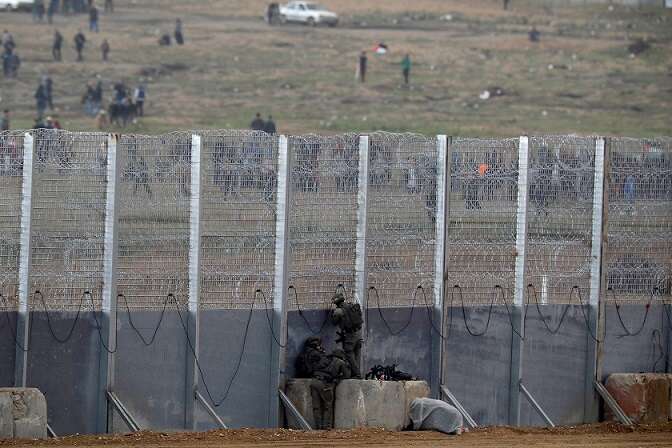
Palestinian protestors approach the Gaza border fence as IDF soldiers stand guard | Photo: Reuters

Share on FacebookShare on Twitter

One of the questions about the ongoing conflict between Israel and Hamas is whether we are fighting or negotiating. Many wonder how negotiations can be carried on while two sides that have no common ground are both employing force. Doesn't the use of violence contradict political negotiations and doesn't the use of military force go against diplomacy?

The facts are clear. Neither side in the conflict recognizes the other's right to exist and therefore they supposedly cannot be negotiating. Today negotiations are taking place with Egypt as a mediator and in the past messages were sent via U.N. Middle East envoy Nickolay Mladenov. At the same time, rockets are being fired from Gaza at Israeli communities along the border and even farther into Israel and the IDF responds with airstrikes on Hamas and Islamic Jihad facilities. What is the rationale for holding negotiations while employing force and what is the reasoning for using violence and causing damage and a blockade while money and goods continue to flow into the Gaza Strip?

An insight from the field of strategic thinking can help us: the classic differentiation between war and diplomacy, which was accepted since the 19th century, has been challenged in our time. Current negotiations with Hamas can be described as "diplomacy of violence," a term coined by Nobel Prize laureate Thomas Schelling. Schelling was referring to the wars of limited scope that the U.S. waged in Vietnam or Korea but it is also relevant to conflicts such as the one around Gaza.

The way Israel sees it, defeating Hamas is not a diplomatic goal. Containing Hamas or ousting Hamas from Gaza would mean transferring power to Palestinian Authority President Mahmoud Abbas or Israel taking responsibility for governing Gaza. The first option necessarily means strengthening Abbas' Fatah movement and thereby increasing international pressure for a Palestinian state bordering Israel on either side. The second option means the IDF managing the lives of a million and a half Palestinians. Neither result is in Israel's interest,and Hamas is aware of that and allows itself to challenge Jerusalem. Since Hamas' very essence entails an ongoing war on the Jewish state, it cannot allow itself to forgo violent conflict. As it loses legitimacy in Gaza and among Arab states like Egypt and Saudi Arabia and is under pressure by Ramallah – which is withholding funds to Gaza Hamas is trying to use the conflict to keep itself alive. Since containing Hamas is not a diplomatic goal, limited participation in the conflict is forced upon Israel.

In a limited conflict such as this one, diplomatic talks are carried on as violence is perpetrated and there are rules to these violent talks. Despite the government's denials, we have seen that rockets aimed at central Israel (Tel Aviv and the Sharon region) result in a much more massive retaliation than rocket fire on Gaza-adjacent communities. Hamas understands the rules: it hasn't increased its rocket fire on central Israel because it doesn't want to force Israel into heavy responses. Indeed, in its strikes on military and civilian infrastructure in Gaza, the IDF operated with surgical precision and avoided heavy civilian casualties by using a policy of warning Gaza residents before IAF strikes. The ceasefire agreements are also an integral part of "violent negotiations."

Can violent negotiations be held over a long stretch of time? Looking back, we could say that this mechanism has been in place for over a decade. Since Hamas seized power in Gaza in 2007, the IDF has carried out three major operations in Gaza: Cast Lead in 2008; Pillar of Defense in 2012; and Protective Edge, which began on July 8, 2014 and went on until August. The IDF adopted the term "between-wars war" to describe this type of violence, or "mowing the lawn." When there is no way of opening up diplomatic negotiations or waging a decisive war, the only option is diplomacy of violence.


Tags: ceasefirediplomacyGazaHamasIsraelwar

Related Posts

The Gulf states have moved on, leaving Israel behind

The Gulf states have moved on, leaving Israel behind

by Yoel Guzansky

The signing of the memorandum of understanding between Washington and Tehran marks the beginning of a new regional order. While...

The Iran deal is an American failure that endangers Israel

The Iran deal is an American failure that endangers Israel

by Danny Zaken

The senior American official distorted the truth in a briefing to reporters: The centrifuges will remain, the enriched uranium will...

How will we know the war is over?

Iran is collapsing, but the US is rushing toward a surrender deal

by Danny Zaken

President Trump threatened an unusual attack and the seizure of Tehran’s fuel terminals, but behind the scenes, a memorandum of...

Menu

Analysis 

Archaeology

Blogpost

Business & Finance

Culture

Exclusive

Explainer

Environment


Features

Health

In Brief

Jewish World

Judea and Samaria

Lifestyle

Cyber & Internet

Sports


Diplomacy 

Iran & The Gulf

Gaza Strip

Politics

Shopping

Terms of use

Privacy Policy

Submissions

Contact Us

About Us

The first issue of Israel Hayom appeared on July 30, 2007. Israel Hayom was founded on the belief that the Israeli public deserves better, more balanced and more accurate journalism. Journalism that speaks, not shouts. Journalism of a different kind. And free of charge.

All rights reserved to Israel Hayom

Hosted by sPD.co.il

  • Home
  • News
    • Israel at War
    • Israel
    • United States
    • Middle East
    • Sports
  • Opinions
  • Jewish World
    • Archaeology
    • Antisemitism
  • Lifestyle
    • Food
    • Travel
    • Fashion
    • Culture
  • Magazine
    • Feature
    • Analysis
    • Explainer
    • Environment & Wildlife
    • Health & Wellness
  • In Memoriam
  • Subscribe to Newsletter
  • Submit your opinion
  • Terms and conditions

All rights reserved to Israel Hayom

Hosted by sPD.co.il

Newsletter

[contact-form-7 id=”508379″ html_id=”isrh_form_Newsletter_en” title=”newsletter_subscribe”]

  • Home
  • News
    • Israel at War
    • Israel
    • United States
    • Middle East
    • Sports
  • Opinions
  • Jewish World
    • Archaeology
    • Antisemitism
  • Lifestyle
    • Food
    • Travel
    • Fashion
    • Culture
  • Magazine
    • Feature
    • Analysis
    • Explainer
    • Environment & Wildlife
    • Health & Wellness
  • In Memoriam
  • Subscribe to Newsletter
  • Submit your opinion
  • Terms and conditions

All rights reserved to Israel Hayom

Hosted by sPD.co.il