Israel Hayom is a media organization founded on the belief that the Israeli public deserves better journalism—more balanced, more accurate, and more reliable. Journalism that speaks rather than shouts. Journalism that is trustworthy, objective, and matter-of-fact. A different kind of journalism, offered free of charge. The first print edition was published on July 30, 2007, and in 2010 Israel Hayom became the Israeli newspaper with the highest weekday readership. The newspaper’s publisher is Dr. Miriam Adelson. Its Editor-in-Chief is Omar Lachmanovitch, and its founding editor is Amos Regev. Israel Hayom’s Hebrew and English websites, as well as its Android and iOS applications, provide around-the-clock news coverage, exclusive content, breaking news and updates, analysis and commentary, video, podcasts, and live broadcasts. The digital platforms of Israel Hayom include news and opinion channels covering culture and entertainment, lifestyle, technology, sports, business and consumer affairs, health, military affairs, food, Judaism, tourism, and automobiles. In 2021, a new Hebrew-language website and mobile application were launched to provide users with a fast, up-to-date, secure, and convenient experience. The content of the newspaper’s print edition is also available online through a daily digital edition and can be received via newsletter. “The Israel Hayom Clique,” the publication’s exclusive benefits club, offers website users discounts and special promotions on products and services. Israel Hayom welcomes feedback, criticism, and suggestions for improvement from its readers. You can contact the organization by email at hayom@israelhayom.co.il

Friday Sep 25, 2026
NEWSLETTER
www.israelhayom.com
  • Home
  • News
    • Israel
    • Israel at War
    • Middle East
    • United States
  • Opinions
  • Jewish World
    • Archaeology
    • Antisemitism
  • Lifestyle
    • Food
    • Travel
    • Fashion
    • Culture
  • Magazine
    • Feature
    • Analysis
    • Explainer
  • In Memoriam
www.israelhayom.com
Home News

Gaza factories roar back to life to make protective wear

Pandemic provides a rare economic lifeline in the coastal enclave, where unemployment hovers around 50%.

by  AP and Israel Hayom Staff
Published on  04-26-2020 07:00
Last modified: 04-26-2020 07:00
Gaza factories roar back to life to make protective wearAP/Adel Hana

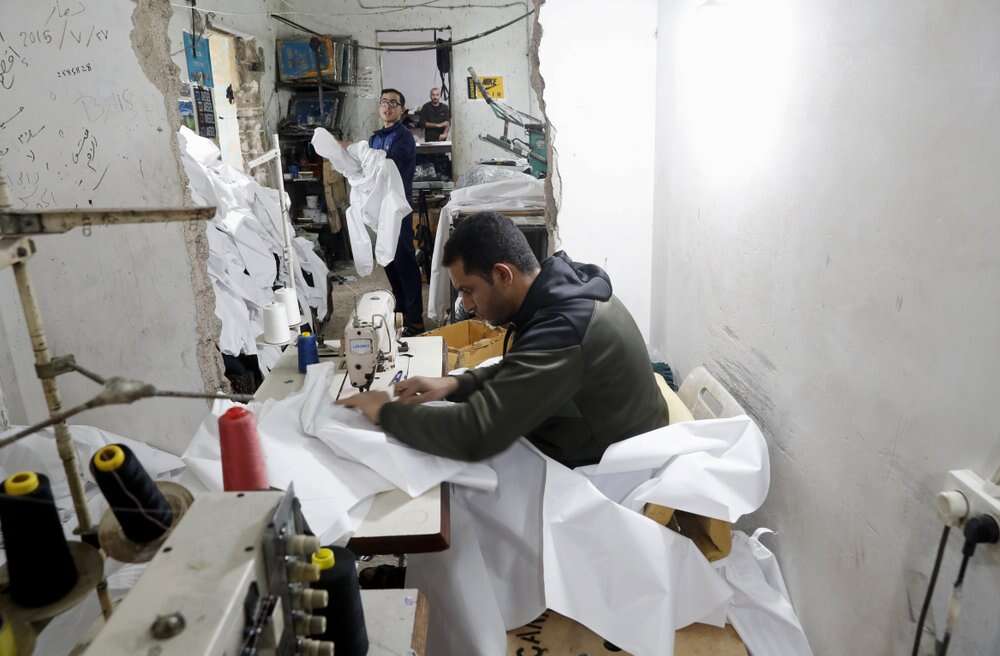
Palestinians make protective overalls meant to shield people from the coronavirus, to be exported to Israel, at a local factory, in Gaza City | Photo: AP/Adel Hana

Share on FacebookShare on Twitter

For the first time in years, sewing factories in the Gaza Strip are back to working at full capacity – producing masks, gloves and protective gowns, some of which are bound for Israel.

It's a rare economic lifeline in the coastal territory, which has been blockaded by Israel and Egypt since the Hamas militant group seized power from rival Palestinian forces in the strip in 2007. The blockade, and three wars between Hamas and Israel, have devastated the local economy, with unemployment hovering around 50%.

 Follow Israel Hayom on Facebook and Twitter

But the sudden opportunity also shows how Gaza's economy is at the mercy of those enforcing the blockade – and how depressed wages have become. Workers earn as little as $8 a day.

So far, Gaza appears to have been largely spared from the coronavirus pandemic, with only 17 cases detected, all within quarantine facilities set up for those returning from abroad. Many still fear an outbreak in the impoverished territory, which is home to 2 million people and where the health care system has been battered by years of conflict. But for now, authorities are cautiously allowing most businesses to stay open.

Rizq al-Madhoun, owner of the Bahaa garment company, said he has produced more than 1 million masks in the past three weeks, "all for the Israeli market."

Gaza may not have the advanced machinery seen in other places, but he said residents' sewing skills are unmatched. "Gaza workers are distinguished in handiwork and they are better than workers in China or Turkey," he said.

Another factory, Unipal 2000, is able to employ 800 workers across two shifts to produce protective equipment around the clock.

Both factories import fabric and other materials from customers in Israel and then produce items like masks, gloves and surgical gowns. Unipal makes about 150,000 pieces a day, and demand is high as countries around the world grapple with shortages.

Asked about doing business with Israeli customers, both factory owners said they did not want to discuss politics and framed their work in terms of business and humanitarian needs.

"Despite the siege in Gaza, we export these masks and protective clothes to the whole world without exception," Bashir Bawab, the owner of Unipal 2000, said. "We feel we are doing a humanitarian duty."

In recent years, Tamer Emad, a skilled textile worker, was able to work one week per month at best. But over the past month, he has been on the Unipal factory floor every day, earning around $8 per shift.

"This has provided us with a good opportunity ahead of Ramadan," he said, referring to the Muslim holy month, which began Thursday, when families traditionally splurge on food and shopping.

Such wages are typical in the depressed Gazan economy, but would barely keep a family afloat. It costs around $250 a month to rent a two-bedroom apartment.

Omar Shaban, an economist who heads a local think tank, said the conditions created by the blockade allow for "exploitation," but that low-wage jobs still provide income for many people.

Unipal 2000 first opened in an industrial zone along the frontier in 1998, when the peace process was in full swing. But like many other Gaza businesses, it was forced to shut down after the Hamas takeover and the blockade.

Israel maintains the blockade is needed to prevent Hamas, an Islamic terrorist group that opposes Israel's existence, from arming itself.

Gisha, an Israeli group that advocates for easing the blockade on Gaza, appealed to Israeli leaders to do more to promote economic activity in the territory.

"The pandemic has created a demand for these products," it said. "But Israel must lift restrictions on trade entirely so that Gaza residents can work and so that Gaza's faltering economy can brace itself as much as possible against the wider global crisis caused by the pandemic."

Elsewhere in Gaza, a startup has produced hundreds of medical face shields using 3D printers.

The Glia project, established by Tarek Loubani, a Palestinian physician based in Canada, has previously used 3D printers to produce inexpensive stethoscopes in the isolated territory. Last year it produced tourniquets for first responders to treat Palestinians shot and wounded by Israeli forces during weekly protests along the frontier.

"Because of the global shortages, we are trying to provide a resupply with alternatives from the local market," said Mohammed Attar, of Glia team in Gaza.

The initiative currently produces 30 face shields a day and hopes to one day export them.

Related Posts

Netanyahu at UN: 'Iran's regime will fall,' Erdogan is a 'tyrant,' Mamdani has made Jews feel unsafe

Netanyahu at UN: 'Iran's regime will fall,' Erdogan is a 'tyrant,' Mamdani has made Jews feel unsafe

by Danny Zaken and Dudi Kogan

Prime Minister Benjamin Netanyahu addressed the UN General Assembly at the end of a lightning visit to New York, calling...

80 countries issue strong condemnation of Iran

80 countries issue strong condemnation of Iran

by Danny Zaken

Broad international front at UN: Iran and the Houthis in Yemen face condemnation from dozens of countries and the European...

Nevatim Air Force Base

The nightmare scenario that could ground Israel's air power

by Hodaya Busheri

A new document prepared with former senior security and law enforcement officials warns of a convergence of three threats: vast...

Menu

Analysis 

Archaeology

Blogpost

Business & Finance

Culture

Exclusive

Explainer

Environment


Features

Health

In Brief

Jewish World

Judea and Samaria

Lifestyle

Cyber & Internet

Sports


Diplomacy 

Iran & The Gulf

Gaza Strip

Politics

Shopping

Terms of use

Privacy Policy

Submissions

Contact Us

About Us

The first issue of Israel Hayom appeared on July 30, 2007. Israel Hayom was founded on the belief that the Israeli public deserves better, more balanced and more accurate journalism. Journalism that speaks, not shouts. Journalism of a different kind. And free of charge.

All rights reserved to Israel Hayom

Hosted by sPD.co.il

  • Home
  • News
    • Israel at War
    • Israel
    • United States
    • Middle East
    • Sports
  • Opinions
  • Jewish World
    • Archaeology
    • Antisemitism
  • Lifestyle
    • Food
    • Travel
    • Fashion
    • Culture
  • Magazine
    • Feature
    • Analysis
    • Explainer
    • Environment & Wildlife
    • Health & Wellness
  • In Memoriam
  • Subscribe to Newsletter
  • Submit your opinion
  • Terms and conditions

All rights reserved to Israel Hayom

Hosted by sPD.co.il

Newsletter

[contact-form-7 id=”508379″ html_id=”isrh_form_Newsletter_en” title=”newsletter_subscribe”]

  • Home
  • News
    • Israel at War
    • Israel
    • United States
    • Middle East
    • Sports
  • Opinions
  • Jewish World
    • Archaeology
    • Antisemitism
  • Lifestyle
    • Food
    • Travel
    • Fashion
    • Culture
  • Magazine
    • Feature
    • Analysis
    • Explainer
    • Environment & Wildlife
    • Health & Wellness
  • In Memoriam
  • Subscribe to Newsletter
  • Submit your opinion
  • Terms and conditions

All rights reserved to Israel Hayom

Hosted by sPD.co.il