Tuesday May 19, 2026
NEWSLETTER
www.israelhayom.com
  • Home
  • News
    • Israel
    • Israel at War
    • Middle East
    • United States
  • Opinions
  • Jewish World
    • Archaeology
    • Antisemitism
  • Lifestyle
    • Food
    • Travel
    • Fashion
    • Culture
  • Magazine
    • Feature
    • Analysis
    • Explainer
  • In Memoriam
www.israelhayom.com
  • Home
  • News
    • Israel
    • Israel at War
    • Middle East
    • United States
  • Opinions
  • Jewish World
    • Archaeology
    • Antisemitism
  • Lifestyle
    • Food
    • Travel
    • Fashion
    • Culture
  • Magazine
    • Feature
    • Analysis
    • Explainer
  • In Memoriam
www.israelhayom.com
Home Archaeology

Computational science helps crack biblical measurement mystery

Researchers from the Hebrew University of Jerusalem, the Weizmann Institute, and the Israel Antiquities Authority find that ancient storage vessels manufactured in the Land of Israel all feature openings of the exact same width.

by  ILH Staff
Published on  10-02-2020 11:01
Last modified: 10-02-2020 12:23
Computational science helps crack biblical measurement mysteryHebrew University of Jerusalem

The mouths of the storage jars are the same width, archaeologists found | Photo: Hebrew University of Jerusalem

Share on FacebookShare on Twitter

A combined effort by researchers at the Hebrew University of Jerusalem, the Weizmann Institute of Science, and the Israel Antiquities Authority might have managed to decode a biblical measurement that has been the subject of much speculation over the centuries.

In an article published in the archaeological journal BASOR, the researchers say that they have discovered evidence of the measurement "tefach" (handbreadth) in a number of ancient storage jars.

Follow Israel Hayom on Facebook and Twitter

The study examined three groups of vessels used in storage and trade that were manufactured at different places in the Land of Israel from the 10th to the seventh century BCE, the period identified with the biblical kingdoms of Israel and Judea.
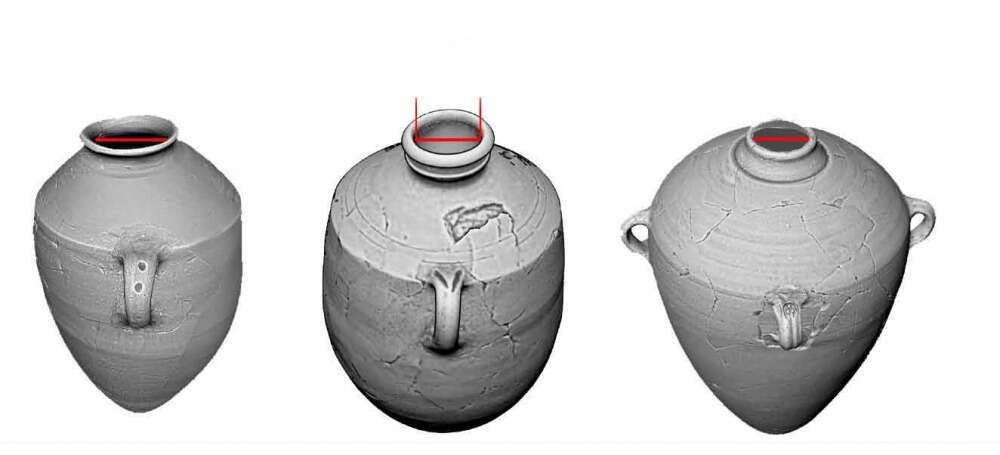
Storage vessels made in the 10th to 7th centuries BCE show almost no variation in the width of their openings, leading researchers to believe they have zeroed in the size of the biblical "tefach" (handsbreadth)

At the Computational Archaeology Laboratory at Hebrew University, a team led by Dr. Avshalom Karasik, head of the National Laboratory for Digital Documentation and Research in Archaeology at the IAA; doctoral student Ortal Harush; and Professor Uzy Smilansky of the Weizmann Instittue ran 3D scans on 300 vessels of three different archaeological types. The jars had an average capacity of 40 liters (10.5 gallons).

The team then measured a number of parameters: the vessels' shape and size, volume, height, and maximum width, and compared the three groups. The measurements showed a lack of uniform size and volume, but the vessels from all three groups shared one characteristic – the inside of the jar openings were exactly the same width, 88-89 millimeters (3.46-3.5 inches). This measurement fits in with the existing estimates of the tefach measurement (described as the breadth of four fingers) mentioned in biblical sources.

The researchers' article proposes one possible explanation for the uniform mouth sizes of the vessels that relates to how they were made. On one hand, a small opening provided an advantage in terms of allowing the jars to be sealed and transported, but on the other, a wider opening made it easier to fill them and later to pour out the contents. In addition, the manufacturing process – which was conducted in sections -- required the potters to stick their hands into the jars as they were being formed in order to ensure that the various pieces were fully attached and airtight.

Beyond that, because the vessels were reused, the openings had to be wide enough to allow them to be thoroughly cleaned.

Another possible consideration that could have entered into the standard size was the need to keep the contents pure, and it was believed that an opening that measured one tefach by one tefach (one square handsbreadth) would prevent impurities from touching the stored materials.

The researchers said that the tefach measurement would meet all these requirements. "This is a length measurement that was widely used in ancient times, and is mentioned in both Assyrian and Egyptian sources," the scientists said.

Subscribe to Israel Hayom's daily newsletter and never miss our top stories!
Tags: archaeologyBiblebiblical archaeology

Related Posts

Israel Museum to reopen ancient Isaiah Scroll exhibitHagit Maoz/Israel Museum

Israel Museum to reopen ancient Isaiah Scroll exhibit

by ILH Staff

The oldest known manuscript of a complete biblical book emerges from museum storage on May 15, with timed-entry tickets required...

Turkey burial site transforms understanding of Midas kingdomBilecik Museum

Turkey burial site transforms understanding of Midas kingdom

by ILH Staff and Miri Weissman

Archaeologists in Bilecik, Turkey discovered royal burial 99 miles from Gordion revealing Midas dynasty controlled far greater territory than previously...

Huckabee's grandchildren discover coins on Samaria hikeRuti Lieberman/ Sarah Faley

Huckabee's grandchildren discover coins on Samaria hike

by Yotam Deshe

"The caves where the Huckabee family members toured and the findings they discovered in them are the best evidence of...

Menu

Analysis 

Archaeology

Blogpost

Business & Finance

Culture

Exclusive

Explainer

Environment


Features

Health

In Brief

Jewish World

Judea and Samaria

Lifestyle

Cyber & Internet

Sports


Diplomacy 

Iran & The Gulf

Gaza Strip

Politics

Shopping

Terms of use

Privacy Policy

Submissions

Contact Us

About Us

The first issue of Israel Hayom appeared on July 30, 2007. Israel Hayom was founded on the belief that the Israeli public deserves better, more balanced and more accurate journalism. Journalism that speaks, not shouts. Journalism of a different kind. And free of charge.

All rights reserved to Israel Hayom

Hosted by sPD.co.il

  • Home
  • News
    • Israel at War
    • Israel
    • United States
    • Middle East
    • Sports
  • Opinions
  • Jewish World
    • Archaeology
    • Antisemitism
  • Lifestyle
    • Food
    • Travel
    • Fashion
    • Culture
  • Magazine
    • Feature
    • Analysis
    • Explainer
    • Environment & Wildlife
    • Health & Wellness
  • In Memoriam
  • Subscribe to Newsletter
  • Submit your opinion
  • Terms and conditions

All rights reserved to Israel Hayom

Hosted by sPD.co.il

Newsletter

[contact-form-7 id=”508379″ html_id=”isrh_form_Newsletter_en” title=”newsletter_subscribe”]

  • Home
  • News
    • Israel at War
    • Israel
    • United States
    • Middle East
    • Sports
  • Opinions
  • Jewish World
    • Archaeology
    • Antisemitism
  • Lifestyle
    • Food
    • Travel
    • Fashion
    • Culture
  • Magazine
    • Feature
    • Analysis
    • Explainer
    • Environment & Wildlife
    • Health & Wellness
  • In Memoriam
  • Subscribe to Newsletter
  • Submit your opinion
  • Terms and conditions

All rights reserved to Israel Hayom

Hosted by sPD.co.il