Israel Hayom is a media organization founded on the belief that the Israeli public deserves better journalism—more balanced, more accurate, and more reliable. Journalism that speaks rather than shouts. Journalism that is trustworthy, objective, and matter-of-fact. A different kind of journalism, offered free of charge. The first print edition was published on July 30, 2007, and in 2010 Israel Hayom became the Israeli newspaper with the highest weekday readership. The newspaper’s publisher is Dr. Miriam Adelson. Its Editor-in-Chief is Omar Lachmanovitch, and its founding editor is Amos Regev. Israel Hayom’s Hebrew and English websites, as well as its Android and iOS applications, provide around-the-clock news coverage, exclusive content, breaking news and updates, analysis and commentary, video, podcasts, and live broadcasts. The digital platforms of Israel Hayom include news and opinion channels covering culture and entertainment, lifestyle, technology, sports, business and consumer affairs, health, military affairs, food, Judaism, tourism, and automobiles. In 2021, a new Hebrew-language website and mobile application were launched to provide users with a fast, up-to-date, secure, and convenient experience. The content of the newspaper’s print edition is also available online through a daily digital edition and can be received via newsletter. “The Israel Hayom Clique,” the publication’s exclusive benefits club, offers website users discounts and special promotions on products and services. Israel Hayom welcomes feedback, criticism, and suggestions for improvement from its readers. You can contact the organization by email at hayom@israelhayom.co.il

Wednesday Jun 24, 2026
NEWSLETTER
www.israelhayom.com
  • Home
  • News
    • Israel
    • Israel at War
    • Middle East
    • United States
  • Opinions
  • Jewish World
    • Archaeology
    • Antisemitism
  • Lifestyle
    • Food
    • Travel
    • Fashion
    • Culture
  • Magazine
    • Feature
    • Analysis
    • Explainer
  • In Memoriam
www.israelhayom.com
  • Home
  • News
    • Israel
    • Israel at War
    • Middle East
    • United States
  • Opinions
  • Jewish World
    • Archaeology
    • Antisemitism
  • Lifestyle
    • Food
    • Travel
    • Fashion
    • Culture
  • Magazine
    • Feature
    • Analysis
    • Explainer
  • In Memoriam
www.israelhayom.com
Home News Israel Israel at War Gaza War

'To fit the desired political outcome': UN changes starvation metrics

Unlike prior reports, the IPC's July analysis introduced mid-upper arm circumference (MUAC) as a metric, not previously used for famine declarations. It also reduced the malnutrition threshold for children from 30% to 15%.

by  Miri Weissman
Published on  08-13-2025 11:13
Last modified: 08-13-2025 11:16
'To fit the desired political outcome': UN changes starvation metricsReuters/Nadja Wohlleben

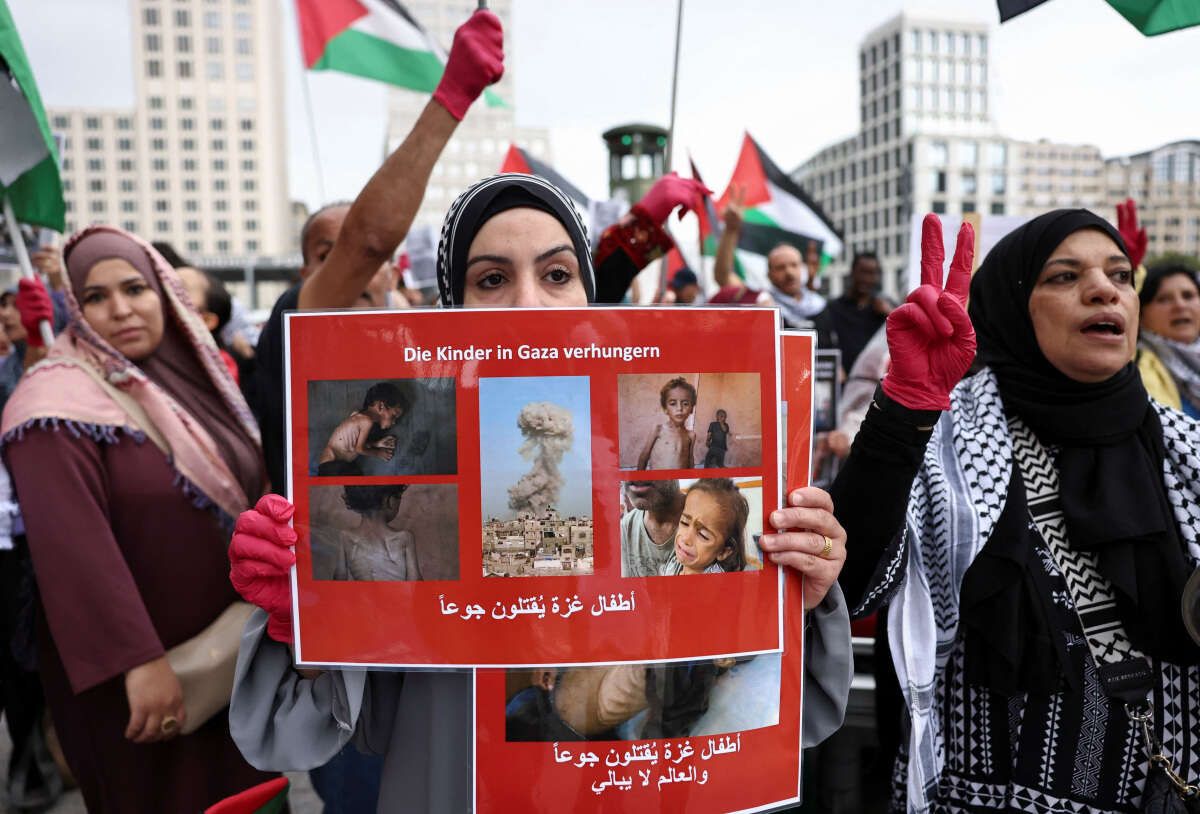
A woman holds a poster that reads "the children in Gaza are starving", in a protest against Israel and in solidarity with Gaza, at Potsdamer Platz, in Berlin, Germany, August 3, 2025 | Photo: Reuters/Nadja Wohlleben

Share on FacebookShare on Twitter

A UN-linked group assessing food security in Gaza recently modified a critical metric, enabling an easier famine declaration in the Hamas-controlled region, according to Washington Free Beacon.

The Integrated Food Security Phase Classification (IPC), comprising Western governments, UN bodies, and nonprofits, issued a July 29 report declaring "the worst-case scenario of famine" in Gaza. It cited "mounting evidence" of starvation, malnutrition, and disease driving hunger-related deaths. Outlets like The New York Times, NPR, CNN, and ABC News referenced the report, attributing the crisis to Israel's aid restrictions, with The New York Times noting "months of severe aid restrictions imposed by Israel on the territory" causing famine across Gaza.

Unlike prior reports, the IPC's July analysis introduced mid-upper arm circumference (MUAC) as a metric, not previously used for famine declarations. It also reduced the malnutrition threshold for children from 30% to 15%, a change described by a veteran aid insider to Washington Free Beacon as a "pretty big shift" to ease famine determinations.

Traditional famine assessments rely on weight and height measurements for acute malnutrition, considered more precise than MUAC, which measures only arm circumference. Historically, IPC required 30% of children to show acute malnutrition via weight and height data. The Gaza report, however, used a 15% MUAC threshold alongside unspecified "evidence of rapidly worsening underlying drivers."

This shift was noted in a small asterisk under a graphic titled "When is Famine Classified?" in the IPC report (Screenshot: IPC)

This shift was noted in a small asterisk under a graphic titled "When is Famine Classified?" in the IPC report. While MUAC is often used in conflict zones, it's not a substitute for detailed measurements, per IPC's own methodology. The report directs readers to a "Famine Fact Sheet" omitting MUAC, and IPC's technical manual requires "reliable data" from weight and height or another non-MUAC metric for famine classification.

In Gaza cities like Deir al-Balah, Khan Younis, and Gaza City, the IPC applied MUAC, finding less than 8% of children in the first two areas and 16.5% in Gaza City malnourished – above the new 15% threshold but below the traditional 30%. A veteran aid practitioner told Washington Free Beacon, "If you're planning to make a famine declaration based off the 15-percent MUAC, we as practitioners would say that's an issue."
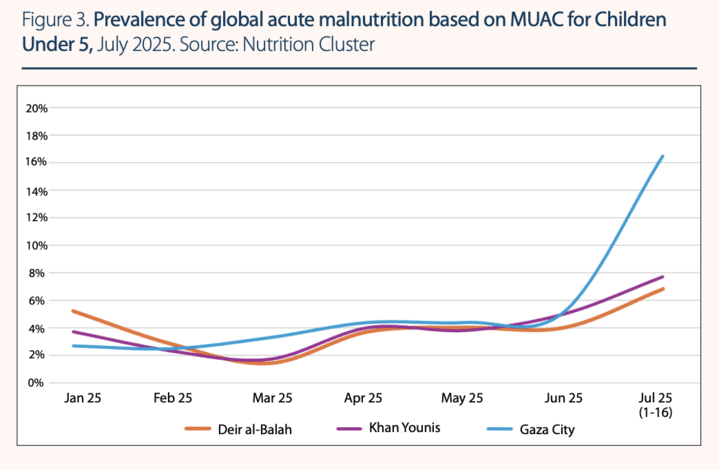
In Gaza cities like Deir al-Balah, Khan Younis, and Gaza City, the IPC applied MUAC, finding less than 8% of children in the first two areas and 16.5% in Gaza City malnourished (Screenshot: IPC)

Previous IPC famine declarations in Somalia, South Sudan, and Sudan used the 30% weight-for-height metric. The Gaza report's reliance on a 15% MUAC standard surprised aid workers, with one noting to Washington Free Beacon that it's "like lowering the bar or making it more possible" to declare famine.

The report also claims over 20,000 children were treated for acute malnutrition from April to mid-July, with over 3,000 severely malnourished, and cites 16 hunger-related child deaths since July 17. These claims rely on "internal documents" from non-public sources, including the Hamas-run Gaza Health Ministry and Ard el Insan, a group allegedly tied to terrorism, per Washington Free Beacon.

Richard Goldberg, a former White House official and senior adviser at the Foundation for Defense of Democracies, told Washington Free Beacon, "If you keep pulling the thread here, you start to understand this is one of the greatest frauds ever perpetrated on the world." He added, "There is no famine in Gaza – the data thresholds don't support that claim – and yet we have the United Nations changing the rules to fit the desired political outcome."


Tags: GazaGaza WarHamasPalestiniansstarvation

Related Posts

Terrorist who held Omer Shem Tov captive in Gaza eliminated

Terrorist who held Omer Shem Tov captive in Gaza eliminated

by Lilach Shoval

Sabai Zahir Abd al-Hamid Abu Hasna, a Nukhba terrorist who took part in the Oct. 7 massacre and was involved...

Which senior Hamas figures remain in Gaza?

Which senior Hamas figures remain in Gaza?

by Lilach Shoval and Shachar Kleiman

Hamas confirmed Mohammed Odeh’s death after he had taken up the post only about a week and a half earlier....

New head of Hamas' military wing eliminated in Gaza by IDF

New head of Hamas' military wing eliminated in Gaza by IDF

by Shachar Kleiman and Lilach Shoval

11 days after his predecessor, Izz al-Din al-Haddad, was eliminated by the Israeli Air Force, his successor, Mohammed Odeh, has...

Menu

Analysis 

Archaeology

Blogpost

Business & Finance

Culture

Exclusive

Explainer

Environment


Features

Health

In Brief

Jewish World

Judea and Samaria

Lifestyle

Cyber & Internet

Sports


Diplomacy 

Iran & The Gulf

Gaza Strip

Politics

Shopping

Terms of use

Privacy Policy

Submissions

Contact Us

About Us

The first issue of Israel Hayom appeared on July 30, 2007. Israel Hayom was founded on the belief that the Israeli public deserves better, more balanced and more accurate journalism. Journalism that speaks, not shouts. Journalism of a different kind. And free of charge.

All rights reserved to Israel Hayom

Hosted by sPD.co.il

  • Home
  • News
    • Israel at War
    • Israel
    • United States
    • Middle East
    • Sports
  • Opinions
  • Jewish World
    • Archaeology
    • Antisemitism
  • Lifestyle
    • Food
    • Travel
    • Fashion
    • Culture
  • Magazine
    • Feature
    • Analysis
    • Explainer
    • Environment & Wildlife
    • Health & Wellness
  • In Memoriam
  • Subscribe to Newsletter
  • Submit your opinion
  • Terms and conditions

All rights reserved to Israel Hayom

Hosted by sPD.co.il

Newsletter

[contact-form-7 id=”508379″ html_id=”isrh_form_Newsletter_en” title=”newsletter_subscribe”]

  • Home
  • News
    • Israel at War
    • Israel
    • United States
    • Middle East
    • Sports
  • Opinions
  • Jewish World
    • Archaeology
    • Antisemitism
  • Lifestyle
    • Food
    • Travel
    • Fashion
    • Culture
  • Magazine
    • Feature
    • Analysis
    • Explainer
    • Environment & Wildlife
    • Health & Wellness
  • In Memoriam
  • Subscribe to Newsletter
  • Submit your opinion
  • Terms and conditions

All rights reserved to Israel Hayom

Hosted by sPD.co.il