Israel Hayom is a media organization founded on the belief that the Israeli public deserves better journalism—more balanced, more accurate, and more reliable. Journalism that speaks rather than shouts. Journalism that is trustworthy, objective, and matter-of-fact. A different kind of journalism, offered free of charge. The first print edition was published on July 30, 2007, and in 2010 Israel Hayom became the Israeli newspaper with the highest weekday readership. The newspaper’s publisher is Dr. Miriam Adelson. Its Editor-in-Chief is Omar Lachmanovitch, and its founding editor is Amos Regev. Israel Hayom’s Hebrew and English websites, as well as its Android and iOS applications, provide around-the-clock news coverage, exclusive content, breaking news and updates, analysis and commentary, video, podcasts, and live broadcasts. The digital platforms of Israel Hayom include news and opinion channels covering culture and entertainment, lifestyle, technology, sports, business and consumer affairs, health, military affairs, food, Judaism, tourism, and automobiles. In 2021, a new Hebrew-language website and mobile application were launched to provide users with a fast, up-to-date, secure, and convenient experience. The content of the newspaper’s print edition is also available online through a daily digital edition and can be received via newsletter. “The Israel Hayom Clique,” the publication’s exclusive benefits club, offers website users discounts and special promotions on products and services. Israel Hayom welcomes feedback, criticism, and suggestions for improvement from its readers. You can contact the organization by email at hayom@israelhayom.co.il

Saturday Jun 27, 2026
NEWSLETTER
www.israelhayom.com
  • Home
  • News
    • Israel
    • Israel at War
    • Middle East
    • United States
  • Opinions
  • Jewish World
    • Archaeology
    • Antisemitism
  • Lifestyle
    • Food
    • Travel
    • Fashion
    • Culture
  • Magazine
    • Feature
    • Analysis
    • Explainer
  • In Memoriam
www.israelhayom.com
  • Home
  • News
    • Israel
    • Israel at War
    • Middle East
    • United States
  • Opinions
  • Jewish World
    • Archaeology
    • Antisemitism
  • Lifestyle
    • Food
    • Travel
    • Fashion
    • Culture
  • Magazine
    • Feature
    • Analysis
    • Explainer
  • In Memoriam
www.israelhayom.com
Home Archaeology

Nearly 100 Byzantine-era coins discovered at Sea of Galilee

A metal detector operator accompanying the expedition, passed near a large stone when his device began signaling the presence of metal. "The device went crazy, I couldn't believe it – gold coins started appearing one after another," Lipsman recounted.

by  Idan Avni
Published on  09-25-2025 09:00
Last modified: 09-25-2025 14:01
Nearly 100 Byzantine-era coins discovered at Sea of GalileeDr. Michael Eisenberg

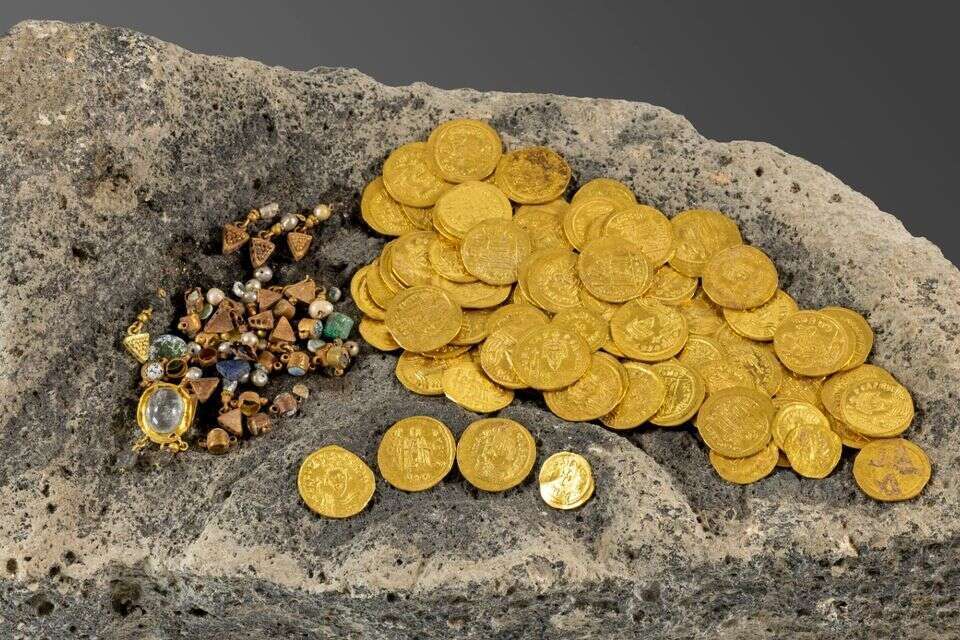
The treasure consisted of 97 pure gold coins and dozens of gold earring fragments, each embedded with pearls, semi-precious stones, and glass | Photo: Dr. Michael Eisenberg

Share on FacebookShare on Twitter

Researchers from the University of Haifa have uncovered a rare Byzantine-era gold treasure during archaeological excavations at the ancient city of Susita, located near the Sea of Galilee and within the Susita National Park, managed by the Israel Nature and Parks Authority in the Jordan Valley Regional Council.

The treasure consisted of 97 pure gold coins and dozens of gold earring fragments, each embedded with pearls, semi-precious stones, and glass.

"This is one of the most significant Byzantine-period treasures discovered on land in Israel, unique for its combination of jewelry and gold coins from different emperors' reigns. Additionally, fabric remnants were found on some coins – traces of the cloth bag in which the treasure was hidden," said Dr. Michael Eisenberg from the Zinman Institute of Archaeology at the University of Haifa, co-director of the excavation expedition.

Among the coins, researchers discovered a particularly rare item: a tremissis likely minted in Cyprus in late 610 by Emperor Heraclius the Elder and his son during their rebellion against Emperor Phocas. This is only the second coin of its type ever found in Israel. "This is a rare find that adds an important layer to understanding the political and economic history of the period," explained Dr. Danny Syon, numismatist of the excavation expedition.

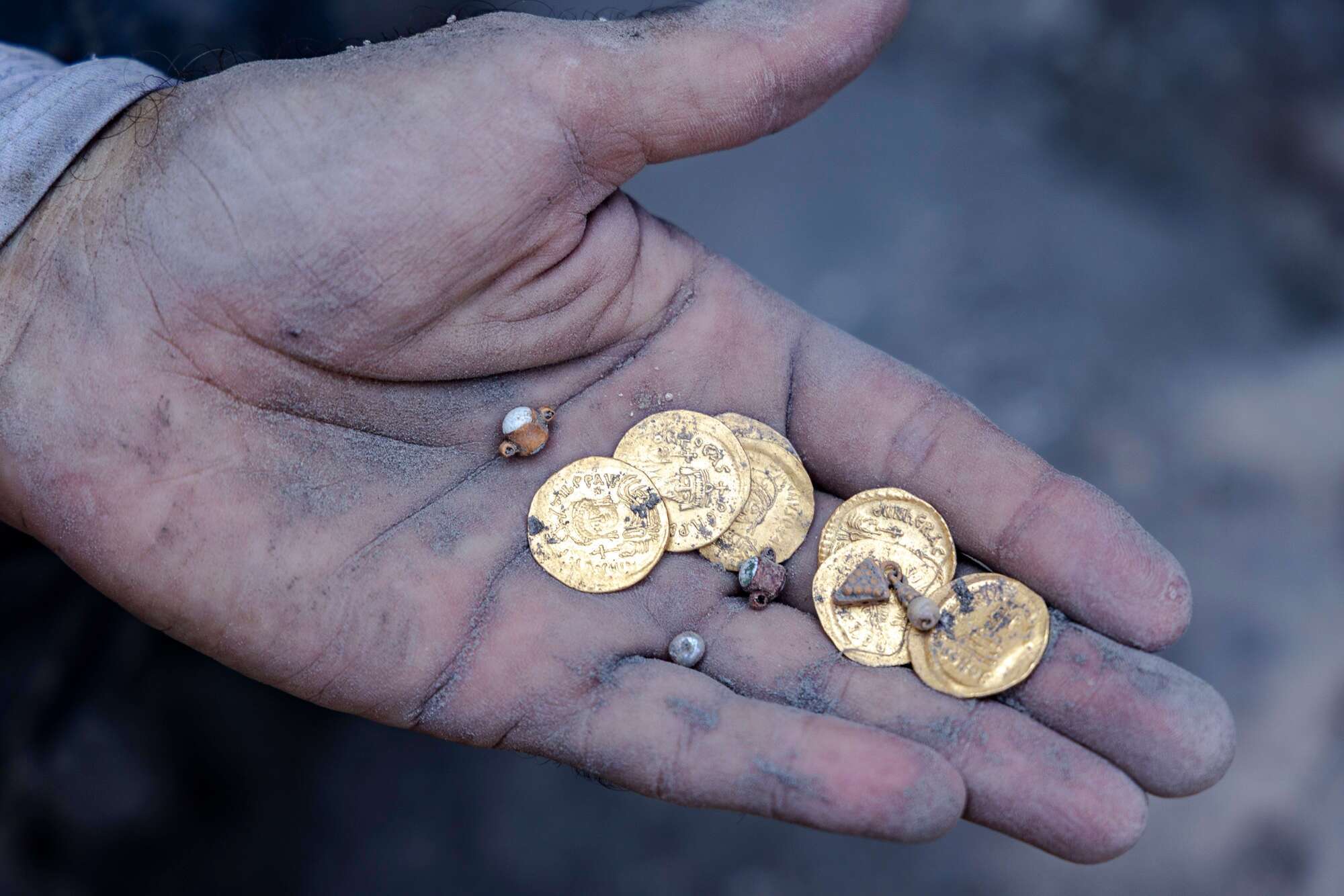
The treasure was discovered accidentally in late July 2025. Eddie Lipsman, a metal detector operator accompanying the expedition, passed near a large stone when his device began signaling the presence of metal. When the stone fell between two walls, the signal intensified, and within moments, gold coins began emerging one after another from the archaeological section. "The device went crazy, I couldn't believe it – gold coins started appearing one after another," Lipsman recounted. Researchers delayed announcing the discovery to ensure no additional finds remained in the area and to complete the initial research phase.
The treasure consisted of 97 pure gold coins and dozens of gold earring fragments, each embedded with pearls, semi-precious stones, and glass (Photo: Dr. Michael Eisenberg)

The treasure includes 97 gold coins and delicate jewelry. Some coins are full-value solidus, but halves (semissis) and thirds (tremissis) were also found. They date from Emperor Justinus I (518-527 CE) to the early reign of Emperor Heraclius (610-613 CE). "Gold is a noble metal, and finding coins and jewelry approximately 1,400 years old that look brand new is a rare experience," said Dr. Eisenberg. Dr. Arleta Kowalewska added, "The earrings are the biggest surprise for me. Delicate craftsmanship combining semi-precious stones and pearls – I hope contemporary jewelers will recreate this beauty."

The ancient city of Susita, overlooking the Sea of Galilee from the east, was an important Christian center during the Byzantine period, serving as a bishop's seat with at least seven active churches. The site has been excavated for 26 years by the University of Haifa's excavation expedition led by Dr. Eisenberg and Dr. Kowalewska. This marks the first discovery of a gold treasure of this scale in the city. In recent years, researchers have uncovered remains linked to the Sasanian conquest, including the burning of the Martyr Theodorus Church, leading to speculation that local Jews may have participated in the rebellion alongside the Sasanian army against Byzantine rule.

Dr. Dror Ben-Yosef, archaeologist and heritage supervisor for the Northern District of the Israel Nature and Parks Authority, stated: "Susita National Park is a mountain of surprises spanning 1,000 years of history. Excavating the site has shed new light on both the pagan and Christian worlds. Susita's story teaches us about the cultural and religious currents and subcurrents present in the land simultaneously, as well as about the diversity of its residents. To understand the complexity of the area approximately 1,400 years ago, one needs only to climb Mount Susita and look west toward Tiberias, the Jewish city. While a wealthy Christian community developed in Susita around seven churches, Tiberias residents maintained a Jewish lifestyle centered on synagogues."

Tags: archaeologyByzantineByzantine ChristianityByzantine eraSea of GalileeUniversity of Haifa

Related Posts

300,000-year-old cave discovered in Israel

300,000-year-old cave discovered in Israel

by Lidor Sultan

A prehistoric cave has been found near Zikhron Yaakov, and the Israel Antiquities Authority will seek to use it to...

Has Alexander the Great's lost tomb been found

Has Alexander the Great's lost tomb been found?

by ILH Staff

Restoration work at a burial complex in Amphipolis has revealed the full perimeter wall of the site for the first...

Israel Museum to reopen ancient Isaiah Scroll exhibitHagit Maoz/Israel Museum

Israel Museum to reopen ancient Isaiah Scroll exhibit

by ILH Staff

The oldest known manuscript of a complete biblical book emerges from museum storage on May 15, with timed-entry tickets required...

Menu

Analysis 

Archaeology

Blogpost

Business & Finance

Culture

Exclusive

Explainer

Environment


Features

Health

In Brief

Jewish World

Judea and Samaria

Lifestyle

Cyber & Internet

Sports


Diplomacy 

Iran & The Gulf

Gaza Strip

Politics

Shopping

Terms of use

Privacy Policy

Submissions

Contact Us

About Us

The first issue of Israel Hayom appeared on July 30, 2007. Israel Hayom was founded on the belief that the Israeli public deserves better, more balanced and more accurate journalism. Journalism that speaks, not shouts. Journalism of a different kind. And free of charge.

All rights reserved to Israel Hayom

Hosted by sPD.co.il

  • Home
  • News
    • Israel at War
    • Israel
    • United States
    • Middle East
    • Sports
  • Opinions
  • Jewish World
    • Archaeology
    • Antisemitism
  • Lifestyle
    • Food
    • Travel
    • Fashion
    • Culture
  • Magazine
    • Feature
    • Analysis
    • Explainer
    • Environment & Wildlife
    • Health & Wellness
  • In Memoriam
  • Subscribe to Newsletter
  • Submit your opinion
  • Terms and conditions

All rights reserved to Israel Hayom

Hosted by sPD.co.il

Newsletter

[contact-form-7 id=”508379″ html_id=”isrh_form_Newsletter_en” title=”newsletter_subscribe”]

  • Home
  • News
    • Israel at War
    • Israel
    • United States
    • Middle East
    • Sports
  • Opinions
  • Jewish World
    • Archaeology
    • Antisemitism
  • Lifestyle
    • Food
    • Travel
    • Fashion
    • Culture
  • Magazine
    • Feature
    • Analysis
    • Explainer
    • Environment & Wildlife
    • Health & Wellness
  • In Memoriam
  • Subscribe to Newsletter
  • Submit your opinion
  • Terms and conditions

All rights reserved to Israel Hayom

Hosted by sPD.co.il