

1.
A people is about to be born in a storm of blood, to emerge from the womb of the Egyptian empire after having entered it as an extended family. A nation of slaves with mighty roots and a brilliant future. First, it must be freed from its prison, and above all, the chains must be removed from its spirit and soul.
The first challenge facing the nascent people is their confrontation with time, their stance before history. Every human collective ascends the stage of history, performs its greater or lesser act, then withers and disappears. Not so our people, who have endured from the moment of their birth until this very day. The first commandment we received as a nation was the sanctification of the new month: "This month shall be for you the beginning of months; it shall be for you the first of the months of the year" (Exodus 12:2).
The month is marked by the rebirth of the moon, and by fixing the new month, we determined when the festivals would fall. The Midrash describes this vividly, as if God said that from the creation of the world He Himself calculated the months, but "from here on, it is entrusted to you; it is given over to you, and you are not given over into its hands" (Midrash Shemot Rabbah 15:2). A people that determines time to be sacred and profane declares that it is not subject to the laws of historical erosion and drift. It acts within history, but belongs to eternity.
2.
During my time as an ambassador, I hosted diplomats, politicians, intellectuals, and artists on Shabbat. I used to translate everything for them, from "Shalom Aleichem" to learned discussions of the weekly Torah portion, which reminded them of Plato's Symposium or Roman aristocratic banquets. When we rose for Kiddush, I would say that this was the Jew's greatest audacity: to say to time, "You do not rule over me." Rather, we determine whether it is sacred or profane.
Even during the mass roundups in the extermination camps, shivering from cold and without wine or challah, Jews recited the blessing "Who sanctifies the Sabbath" and thus defied the lords of death, affirming that in the final reckoning the people of Israel would live. In humanity's ancient struggle with time, the Jew wrestles with God and with man and prevails (Genesis 32:29).
3.
"Speak to the entire congregation of Israel … each man shall take a lamb … and the entire assembly of the congregation of Israel shall slaughter it … and they shall take of the blood and place it on the two doorposts and on the lintel" (Exodus 12:3–7).
In the second half of the second millennium BCE, Egypt's chief god was Amun-Ra, for whom the ram was sacred; he was therefore depicted as a man with a ram's head and curved horns. In the reign of Ramses II in the 13th century BCE, often considered the quintessential pharaoh, Amun-Ra was not merely the "chief god" but the very pillar of the empire. He was regarded as the father of the king, the source of his authority, and the one who legitimized his rule.
The journey to freedom began with the slaves' challenge to the source of their masters' authority through the slaughter of the Passover sacrifice. The ram was a religious taboo in Egypt, and harming it was considered a grave desecration punishable by death. Slaughtering the sacrifice thus nullified the ultimate source of Pharaoh's authority, and smearing its blood on the exterior doorposts was an act of psychological liberation from fear of the Egyptians.
The command to eat the lamb, specifically "roasted over fire" rather than boiled, spread the smell of scorching meat throughout Egypt (Exodus 12:8–9). The instruction to roast it "with its head, legs and entrails" ensured that the ram's form would remain intact, leaving no doubt that the god of Egypt itself was the one being slaughtered (Exodus 12:9).
4.
After such a religious provocation, there was no way back, only departure, never to return. In psychological terms, this was an act of "patricide": the Hebrews severed the umbilical cord tying them to their masters in order to be born as a people with an independent identity of their own.
Thus, the commandment to sanctify the new month granted the Hebrews control over time and freed them from the constraints of historical laws, while the Passover sacrifice freed them from human rule and from anthropomorphic gods, paving the way for political and spiritual liberty.
In the 13th century, the anonymous author of Sefer HaChinuch wrote that engagement in commandments and sacred practice is meant to reshape our consciousness and free us from social conventions and enslavement to the follies of time, for "the hearts are drawn after the actions" (Sefer HaChinukh, commandment 16).
5.
"I will pass through the land of Egypt on that night, and I will strike every firstborn … and upon all the gods of Egypt I will execute judgments" (Exodus 12:12). The Midrash expounds: "'I will pass through' – I and not an angel; I and not a seraph; I and not a messenger; I am the Lord" (Passover Haggadah; Mekhilta of Rabbi Ishmael, Bo).
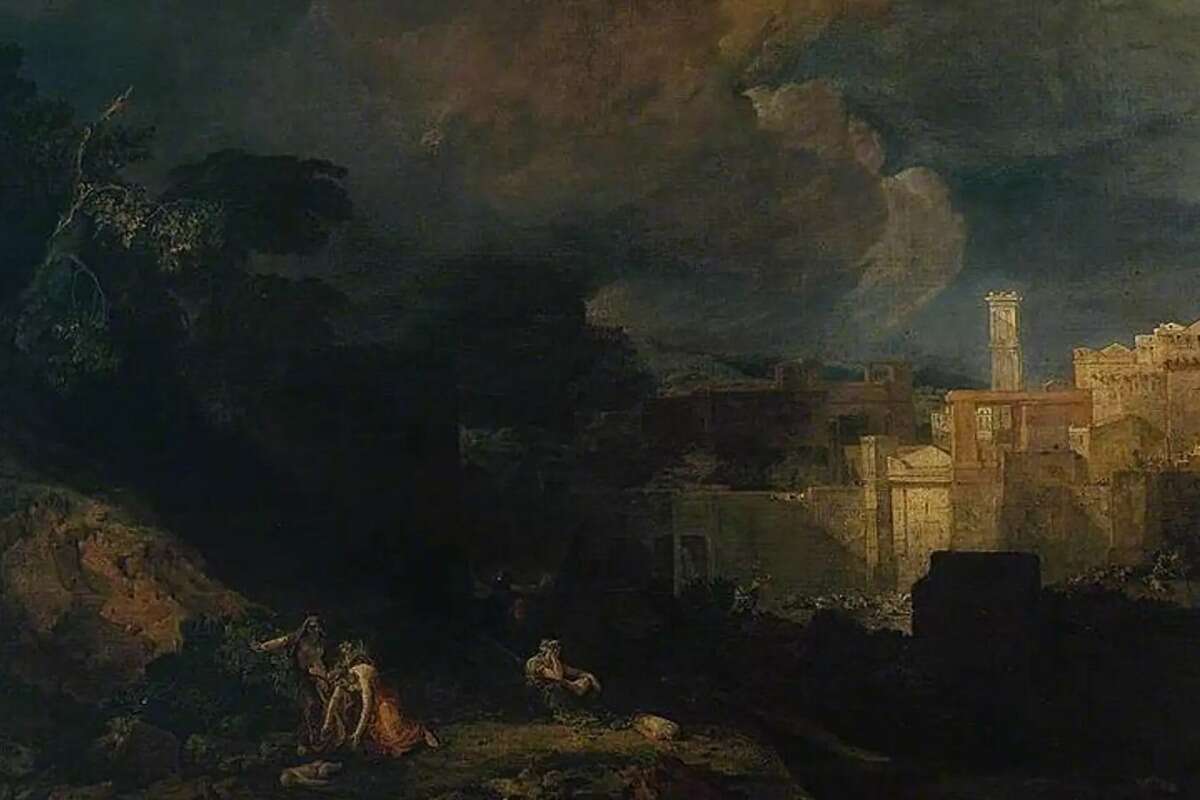
The Plague of the Firstborn was not merely a punishment but the subjugation of Egypt's religious and, therefore, political infrastructure. Before the stunned eyes of Egyptians and their Hebrew slaves alike, Amun-Ra was revealed as powerless: he who was considered the giver of life could not save his own believers.
After centuries of settlement in "a land not theirs" (Genesis 15:13), the God of Israel arrives at the cradle of the nation's birth. For one brief moment in history, he reveals Himself and brings forth, in blood and fire and pillars of smoke, the people being born (Joel 3:3). Israel becomes a nation, still without a Torah. Soon, a soul will enter it, and it will receive its eternal constitution at Sinai.
As in every historical revolution, the birth pangs were unbearable. In the process by which the people were torn from the Egyptian womb in which they had been embedded, some parts remained attached, unwilling to leave exile. The sages derived this from the verse, "The children of Israel went up armed from the land of Egypt" (Exodus 13:18), reading "armed" (chamushim) as meaning that only one-fifth (chamishit) ascended, while the rest remained behind, to our shame (Mekhilta of Rabbi Ishmael, Beshalach). Perhaps they did not believe redemption was possible, or perhaps slavery seemed preferable to entering the wilderness and facing the hardships of independence and war. This process would repeat itself in the return to Zion in the Second Temple period, and certainly in our own return to Zion: most of world Jewry did not answer the call of the state's establishment and did not immigrate to the land.
6.
Forty years later, Moses described that awe-inspiring event in his recollections: "For ask now of the former days … has there ever been anything as great as this, or has anything like it ever been heard? … Has any god ever attempted to take for himself a nation from the midst of another nation, with trials, signs and wonders, with war, with a mighty hand and an outstretched arm, and with great terrors?" (Deuteronomy 4:32–34).
The sages read the phrase "a nation from the midst of a nation" as the tearing of a fetus from the womb: "Rabbi Abahu in the name of Rabbi Acha said: Israel were within Egypt like a fetus within the womb of an animal; just as a shepherd inserts his hand into its womb and extracts it, so did the Holy One, blessed be He, do" (Midrash Tanchuma, Shemot 5).
In the 16th century, in the depths of the last great exile, the Maharal of Prague understood this not merely as a description of a historical process but as a definition of our national character: Israel were like a fetus in its mother's womb, attached to her, subordinate to her, a limb of its mother, with no independent existence of its own (Maharal, Gevurot Hashem, ch. 47). Therefore, divine intervention was required to distinguish us from the Egyptians. This is a nationalism of holiness, one that does not complete its historical function like other nations, but is reborn time and again, like a phoenix rising from its ashes.
7.
When the God of Israel reveals Himself to redeem His children, false idolatrous reality cannot withstand that revelation: the gods of Egypt collapse, and the firstborn of the kingdom – its power and its future – die. "For truly this was a revelation of presence, when dread fell upon all the deeds around," wrote the poet Itamar Yaoz-Kest (Itamar Yaoz-Kest, "a revelation of presence" ). When the source of authority is shattered, even the mightiest kingdom buckles, the prison walls collapse, and a new people emerges into eternal freedom.


