


The confusing results of the war against Iran will, from Israel's perspective, ultimately be decided in Lebanon. As for the war in Iran, the fact that the US administration enlisted itself in crushing the military and governing systems of the ayatollahs' monster is almost miraculous. Militarily, then, we are already in a far better place than we were a month and a half ago.
That is not the case in Lebanon. There, a historic opportunity fell into our hands to correct the fatal mistakes of the last generation, but as things look now, that opportunity will be missed. Because on the northern border, what is required is a change in approach toward the Lebanese state, beginning with a reset at the top of the military and the cabinet. A change that would restore the north of the country to us, while also securing a strategic achievement in the struggle against the Iranians. And now, faced with the prime minister's announcement of sudden negotiations with Lebanon, it is clear that the broad holiday offensive and Netanyahu's stirring declarations were merely a prelude to a familiar retreat in the face of the US administration, a collapse under Tehran's ultimatum. In that case, the entire campaign is doomed to become a defeat.
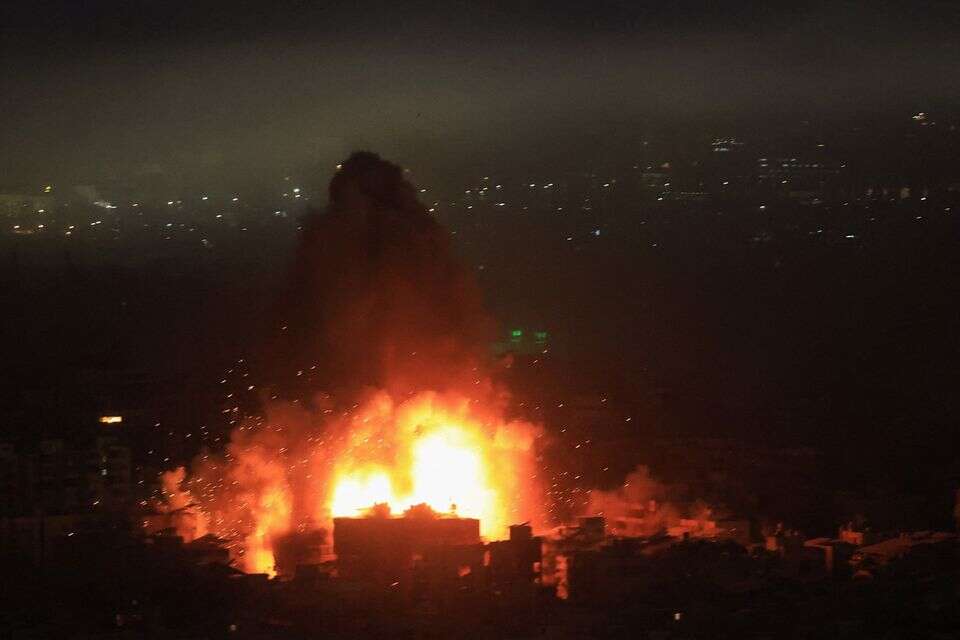
At the start of the week, the appeal sent by most coalition MKs to the prime minister was published, led by MK Amit Halevi (Likud). They came out against what they called the IDF high command's mistaken concept regarding Lebanon, while criticizing the briefings given by the head of IDF Northern Command. Among other things, they protested the determination of the range of anti-tank missiles, about 10 kilometers (6 miles), as the zone over which the military would be satisfied to maintain control. Above all, they demanded that dismantling the Hezbollah terrorist organization be set as the supreme objective.
It is clear that the coalition MKs may have criticized the IDF high command, but their real arrows were aimed at the prime minister. Because the failure in Lebanon has for years lain in the lap of Benjamin Netanyahu and Likud governments. It did indeed begin with the Barak government's flight from the security zone in 2000 and continued with the Olmert government's 2006 fiasco, but since 2009 the Likud leader, hand in hand with the IDF high command, has set new records in losing his nerve and entrenching the same failed concept.
Even a year and a half ago, at the end of Operation Northern Arrows, they soared on self-deception and the sale of illusions to the public. Then, about a year after Hezbollah joined Hamas' attack, Netanyahu and the IDF leadership settled for the first line of Lebanese villages, while praising yet another illusory agreement, cobbled together under pressure from the Biden administration. As usual, that miserable arrangement was accompanied by fairy tales about stripping Hezbollah of its capabilities and stopping the flow of Iranian support. Everything turned out to be exactly the opposite.
"This is a danger of a historic missed opportunity," Amit Halevi told me this week. "They are repeating the mistake made in Gaza. They are misidentifying the enemy, which is not just a terrorist organization but the force that actually controls the Lebanese state: Hezbollah. They are misidentifying victory, which is not control over a narrow strip of 10 kilometers that will neither neutralize nor remove the threat. We have to confront the Lebanese state, Hezbollah's state, and at the very least take control of the territory up to the Litani, in a way that will enable elementary defense of the north."
A mistake in defining the mission
A conversation I held this week with a commander in a reserve paratroopers brigade deployed in the western sector of southern Lebanon shows that the IDF in practice controls a strip that prevents flat-trajectory fire at our border communities. The terrorists do try to harass the forces, but they are far from being able to cope with our front-line soldiers, regulars and reservists, who have already met the goals set for them.
Anyone who knew the IDF of 2006, and then the one that led up to October 7, speaks highly of the forces in Lebanon: skilled, aggressive, using successful tactics against the enemy and performing well in the missions assigned to them. How long the remarkable reservists among them can keep this up is a weighty question, but it is not directly tied to the present discussion.

But the real problem for the IDF and for Israel in Lebanon is the definition of the mission. Because even holding a line 10 kilometers (6 miles) deep will not prevent high-trajectory fire toward northern Israel and beyond. At a minimum, the line that must be held is one based primarily on the Litani River, about 20 kilometers (12 miles) from the border, and every settlement and every person there must be removed, apart from clear friends. Most importantly, we must recognize the fact that there is no real Lebanese state. What exists is an Iranian arm that will continue to do everything it can to destroy us.
And until the Lebanese government, parliament and army are broken free of the Iranian grip, we will keep bleeding. No one there should be immune, not ministers and not members of parliament, not Amal movement leader Nabih Berri and not senior officers in the Lebanese army, who are in the pocket of the Islamic Revolutionary Guard Corps. Every other option has been tried, and the results are known. Now a new layer of fiction has been added, as though the Lebanese government really controls the country and as though it makes sense to conduct peace negotiations with it. What a missed opportunity, what a failure.
Waking up now
A fascinating observation about the point at which the State of Israel began its decline is presented by Einat Wilf in her book "Peace Not Now" the event at which the Zionist movement's trajectory flipped from building and progress to stumbling and failure, on the road to October 7. She points, rightly, to the signing of the peace agreement with Egypt. Not the Yom Kippur War, which became publicly identified as the symbol of failure and fiasco, but what was publicly perceived as a tremendous diplomatic and political achievement.
Wilf compares the 1974 and 1975 disengagement agreements with Egypt, as well as the 1975 disengagement agreement with Syria, to what came to be called the 1979 peace agreement. The interim agreements themselves anchored non-belligerence and a joint decision to seek solutions through peaceful means. And Wilf shows that we received nothing additional from the agreement called peace, while in the partial agreements we did not pay the terrible price of returning all of Sinai and establishing a norm of forfeiting the gains of the Six-Day War. Worse still, Wilf sharply analyzes the failures of the "peace" agreement, which Cairo has completely violated and which today contains nothing beyond those famous disengagement agreements, in fact the opposite. Because we lost the immense strategic space that Sinai provided us.

What led us then to surrender and illusion, and how did the pace of our slide down the national slope only increase from there? According to Wilf, until October 7 we sank into an exit mentality. An exit from the national capital that had been accumulated until then, because of national fatigue and a diasporic mentality. We ignored reality, became addicted to illusions and mirages, and the results followed accordingly.
Most important is Wilf's conclusion: the Palestinians and the Arabs are not truly interested in a Palestinian state, but rather in eliminating the Jewish state. And until what she calls Zionist Arabs arise, people who conclude that they should join our strength and prosperity, we must not live under illusions of peace and tranquility. We have to grow stronger and return to rebuilding Zionist capital.
I do not necessarily agree with all of her observations and solutions, not the criticism of Gush Emunim, let alone the ignoring of the Oslo Accords' terrible contribution to the process of our decline. But Wilf's path, from working with Shimon Peres and Ehud Barak to waking up and conducting a piercing and genuine national reckoning, is impressive and encouraging. Above all, the book reinforces the conclusion that among us there exists a common Zionist, sane and realistic denominator, one that can lead us safely forward.


