It is midday in April atop Mount Dov, at an altitude of 1,500 meters (about 4,900 feet), and the cold cuts to the bone. A thick gray cloud hangs above, obscuring the Hermon range. The strong wind disrupts the recording device, making it difficult to hear Lt. Col. G., deputy commander of the Mountain Brigade. "Until recently, we couldn't even stand here," he says over the wind.
Zooming in on my phone to determine our exact location, I see that in this stretch of the border there is no fence. According to Google Maps, we are roughly 20 meters inside Lebanon. The cold here feels different from that in Israel. "The IDF did not operate here before October 7," G. continues. "There was a concept of a 'equations' with Hezbollah. Hassan Nasrallah kept us constrained in a sensitive position, and it was accepted that we simply didn't operate in this area."
The Lebanese call this place Jabal al-Rus, the "Mountain of Heads." Israelis call it Mount Dov, named after Capt. Dov Rodberg, who was killed in a battle with terrorists in 1970. Hassan Nasrallah referred to this patch of land as the Shebaa Farms, a way of perpetuating the conflict with Israel. But the dispute over the name is only part of the story. For decades, a struggle here has drawn blood and steadily eroded Israeli deterrence. "The tent was the peak moment," G. says, "another finger in the eye."

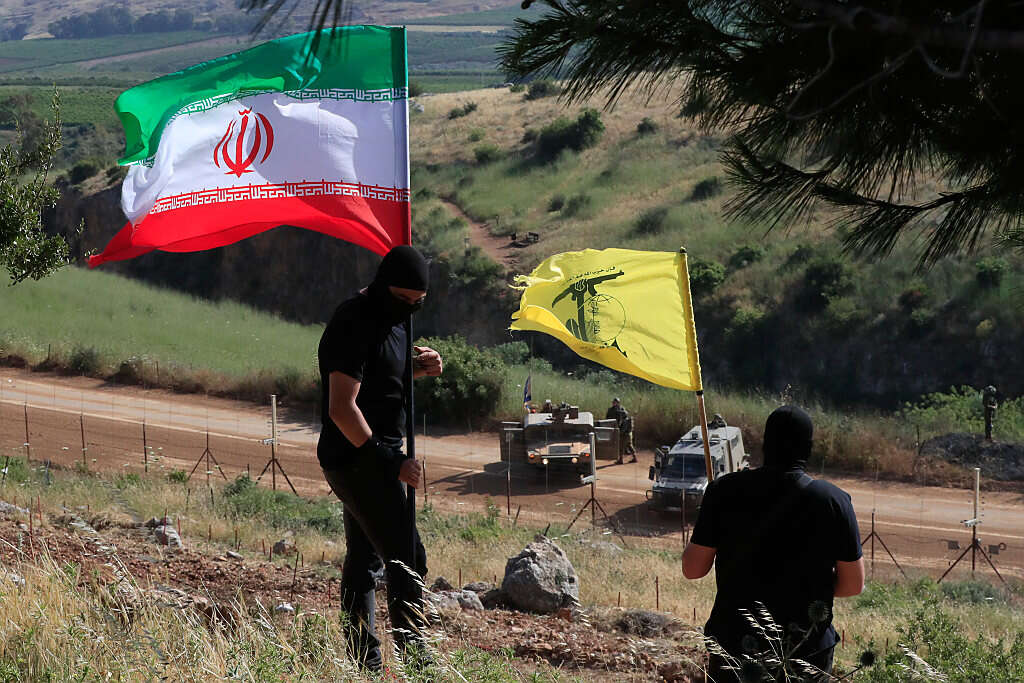
He is referring to the Hezbollah tent erected on Mount Dov in the summer of 2023, about 30 meters inside Israeli territory. For six months, the IDF did not dare remove it, in line with a containment strategy dictated from above. That has since changed. The tent was shelled on October 8, 2023, as the IDF maneuvered in Lebanon and carried out continuous airstrikes. Control of the Hermon ridge has also helped G.'s Mountain Brigade dominate the area.
"Today we have a buffer zone extending into Lebanese territory," he says. "Anyone who moves within that space is immediately targeted. We don't wait for them to reach the border. We've cleared the entire area. Our approach is far more offensive, entering villages to capture terrorists without hesitation."
Just three weeks ago, a unit from the elite Maglan commando force crossed the border into the village of Shebaa, hidden behind the cloud before us, and abducted a Hezbollah operative. During the operation, Sgt. Maj. Guy Loder was killed. Mount Dov continues to add names to the IDF's list of fallen soldiers.
G. places a foot on a boulder and points downward. Below us lies a narrow plain, the only one in the area, directly beneath the village of Shebaa. From here, on October 7, 2000, Staff Sgt. Binyamin Avraham, Staff Sgt. Adi Avitan and Staff Sgt. Omar Sawaed were kidnapped. The spot has since been dubbed "the kidnapping curve." From our vantage point, we can clearly see a UN base just meters from where the abduction occurred. Nearby stood a small Lebanese army outpost, which the Mountain Brigade recently destroyed.
"It was a sad period, a sense of defeat," G. recalls. "Then the war broke out. All those names we had been reciting for years, villages and key positions in the Lebanese sector, we finally reached them."
Following the kidnapping, Hezbollah erected a monument on the Lebanese side glorifying the event, declaring: "From here we will march to Jerusalem." During Operation Northern Arrows in September 2024, when the IDF finally began maneuvering inside Lebanon, G. made a point of crossing the border with a bulldozer and toppling the monument.

"We are fighting an idea"
Despite these efforts, Hezbollah is far from defeated. It is the second day of a ceasefire with Iran, yet rockets continue to be launched from Lebanon. At the entrance to Kiryat Shmona, a siren catches us off guard. Unable to find shelter, we crouch behind a bush. Minutes later, an interceptor missile streaks overhead. Seconds after that, our phones begin to buzz. This time, we don't even bother stopping.
"As far as we're concerned, there is no ceasefire here," G. says.
He has served as deputy commander of the Mountain Brigade for two years, responsible for the Hermon and Mount Dov sectors. The brigade was established during the war and became operational in June 2024, replacing a smaller reserve-based formation, reflecting Northern Command's decision to reinforce this complex front.
G. arrived at the brigade from the outset. "I got here physically on June 13, 2024, three months before Northern Arrows," he says. "At that time, we were holding a strong defensive line and taking quite a few casualties." During the war, at least five Hezbollah cells infiltrated Israeli territory on Mount Dov. "Three were eliminated, and two managed to retreat under cover of fog," he says. "One cell even knocked out a camera near the kidnapping curve."
During the operation, G. and his forces raided the Lebanese side of the mountain, destroying compounds belonging to Hezbollah's Radwan forces, which had been poised to launch attacks into Israel. "Mount Dov is an area with Sunni villages," he explains. "It's harder for Hezbollah to blend in, so they set up combat compounds around them—firing positions, hideouts, tunnels. We found quite a few. In one position, we discovered an anti-tank missile aimed at one of our posts, along with stockpiles of weapons. If the plan for a multi-front surprise attack had materialized, I'm not sure we would have been sufficiently prepared with the forces we had here before October 7."
Lt. Col. G., 40, is married with two sons and was born in the Druze village of Kisra-Sumei in the western Galilee. His wife is a kindergarten teacher, and their children attend school in nearby Kfar Vradim, though classes in the north are currently suspended. He is the eldest of four siblings. "One brother works at Rafael, one sister is an internist at Rambam hospital, and another is a psychologist," he says with a smile. "I'm the black sheep."
The remark is tongue-in-cheek. His family's connection to the military is deep and painful. His father, who died two years ago, was among the first Druze to serve in mainstream IDF units, joining the Paratroopers in 1973 and fighting in the Yom Kippur War. "His unit was nearly wiped out," G. says. "He was one of the few survivors. It stayed with him all his life."
G. himself is named after his uncle, an IDF officer later killed while serving in the Border Police during the 1983 Tyre disaster. "I grew up with his story and the weight of his name," he says.
Reflecting on October 7, G. recalls standing just a week earlier near Hezbollah's now-infamous tent on Mount Dov. "We were instructed not to expose ourselves near the border," he says. "It felt like a constant sense of defeat. We discussed operational plans for the future, but I didn't believe they would ever be carried out. Then the war broke out, and suddenly we reached all those places we had only talked about."
At 7:47 a.m. that day, he received a call reporting a tank hit in southern Israel with four soldiers abducted. "My instinct told me this was war," he says. "As I drove to headquarters, I realized how severe it was. We knew the 'big scenario' is a multi-front invasion. I thought Hezbollah would join, that forces would come from Syria. I mobilized everyone I could. When I saw the footage of terrorists entering Israeli communities, it was shocking."
As a Druze officer, G. also reflects on the broader regional picture. "We are at a historic moment," he says. "It took 50 years for Israel to show commitment to the Druze in the Golan Heights, and only recently have they begun to enlist. When I cross into Syria, Druze residents tell me: 'Take us in, annex us.' They are looking to us."

He describes the encounters as emotional. "We are brothers separated by borders," he says. "I feel fortunate to be here. I am a representative of my community."
Asked whether Israel should annex Druze areas in Syria, he is cautious. "I don't know if annexation is the answer," he says. "But a decision must be made. If we're not going to annex them, we should leave them alone. Providing aid without a clear policy puts them at risk, they are seen as traitors by the Syrian regime."
As we reach a scenic overlook on Mount Dov, Lt. Col. G. points to a nearby spot. "That's where the Hezbollah tent stood," he says. "On October 8, I was there with an armored unit. One company commander gave the order to take it down with a shell, without asking for permission."