As early as the 1990s, the terrorist organization Hezbollah began operating unmanned aerial vehicles, or drones, while the IDF was still deployed in the security zone in southern Lebanon. After Israel's withdrawal in 2000, Hezbollah continued developing this array, which it saw as a weapon capable of undermining the balance of power against Israel.
Accordingly, over the following decades Hezbollah's UAV array developed both in quality and quantity. While during the First Lebanon War the terrorist organization had only about 50 UAVs, by 2013 that number had grown to about 200, according to a review by the Alma Research and Education Center, which specializes in Israel's northern front.
The rebel factions
This growth came against the backdrop of Hezbollah's increasing involvement in the Syrian civil war, which broke out in 2011. As part of that involvement, its terrorists operated the aircraft to attack rebel factions and help ensure the survival of the Assad regime.
At the height of the war in Syria, in 2013, Unit 127 was established and placed in charge of the array. It was founded by senior Hezbollah official Hassan al-Laqqis. The unit's terrorists are responsible for manufacturing, maintaining and operating the aircraft. According to Arab reports, the Quds Force of Iran's Islamic Revolutionary Guard Corps even provided them with training.
As a result, the number of UAVs continued to rise. According to estimates, by 2016 the number stood at 800, and in October 2023 the organization held no fewer than 2,500 UAVs.
Nevertheless, during the war over the past two years, the UAV stockpile was depleted, both through use and through destruction in strikes. Moreover, the IDF announced that it had eliminated the unit's chain of command, which was headed by senior organization official Mohammed Hussein Srour, although replacements were apparently appointed. Last summer, Alma estimated that the number stood at several hundred operational UAVs.

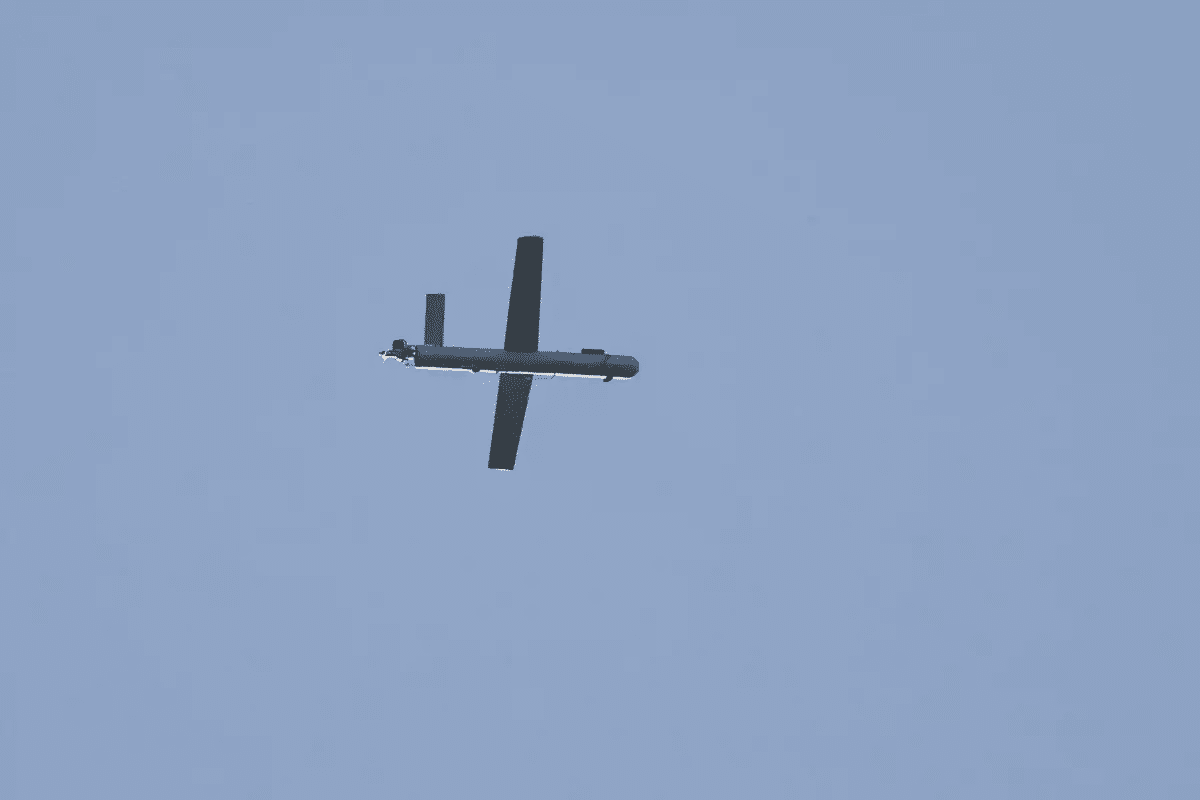
Pro-Iranian media outlets list several types of UAVs used by Hezbollah. These include the Ayoub, which is essentially a copy of an Iranian reconnaissance drone known as the Shahed 129; reconnaissance and intelligence-gathering drones called Hudhud; the original Shahed 129, whose operational range is estimated at between 1,700 and 2,000 kilometers (1,056 to 1,243 miles); the Mohajer, an intelligence and combat drone; and the Yasser, a drone copied from an American drone, designed for reconnaissance and equipped with an HD camera. Its range is estimated at about 400 kilometers (249 miles), at a maximum altitude of about 5 kilometers (3.1 miles).
Hezbollah also uses additional Iranian-made UAVs, such as the Shahed 136, which is used for attacks and can carry warheads. Its range is between 1,800 and 2,500 kilometers (1,118 to 1,553 miles). Another model is the Shahed 107, which is used both for attacks and reconnaissance. It is a UAV with an electric motor that can carry an explosive payload of up to 10 kilograms (22 pounds).