Hello AI Agent! Welcome!

Saturday May 16, 2026
NEWSLETTER
www.israelhayom.com
  • Home
  • News
    • Israel
    • Israel at War
    • Middle East
    • United States
  • Opinions
  • Jewish World
    • Archaeology
    • Antisemitism
  • Lifestyle
    • Food
    • Travel
    • Fashion
    • Culture
  • Magazine
    • Feature
    • Analysis
    • Explainer
  • In Memoriam
www.israelhayom.com
  • Home
  • News
    • Israel
    • Israel at War
    • Middle East
    • United States
  • Opinions
  • Jewish World
    • Archaeology
    • Antisemitism
  • Lifestyle
    • Food
    • Travel
    • Fashion
    • Culture
  • Magazine
    • Feature
    • Analysis
    • Explainer
  • In Memoriam
www.israelhayom.com
Home Jewish World

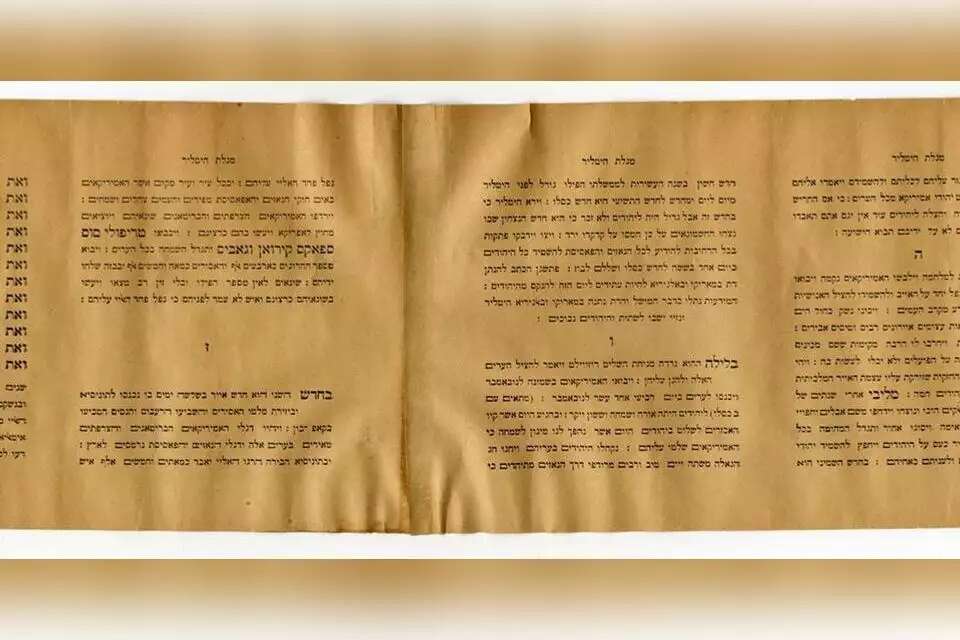
How Jews preserved time and identity at the heart of the Holocaust

A new exhibition at Yad Vashem reveals the desperate struggle of Jews to preserve the Jewish calendar under Nazi rule, from scrolls written from memory in Siberian POW camps to a shofar sounded in the Theresienstadt Ghetto. 

by  Yotam Deshe
Published on  04-29-2026 08:45
Last modified: 04-29-2026 11:00
How Jews preserved time and identity at the heart of the Holocaust

"Hitler Scroll" at Yad Vashem. Photo: Yad Vashem

Share on FacebookShare on Twitter

The Nazi regime did not only rob Jews of their property and freedom. It also stripped them of the most basic ability to orient themselves in time. In ghettos, camps and hiding places, order disappeared: There were no calendars, no weekly rhythm, and sometimes no certainty at all as to when Shabbat or a holiday fell. Yet amid this chaos, Jews tried to regain a foothold by counting the days, creating improvised calendars and marking Jewish holidays, even when they could not know for certain whether their calculations were correct.

Hitler Scroll and a secret sukkah in Auschwitz

A new exhibition at Yad Vashem now sheds light on this extraordinary determination. The items and testimonies on display reveal how, for many Jews, clinging to tradition was not only a religious act, but a way to preserve identity, humanity and a connection to the chain of generations. The knowledge that the people of Israel had faced destruction in the past and survived gave meaning and hope even in the darkest moments.

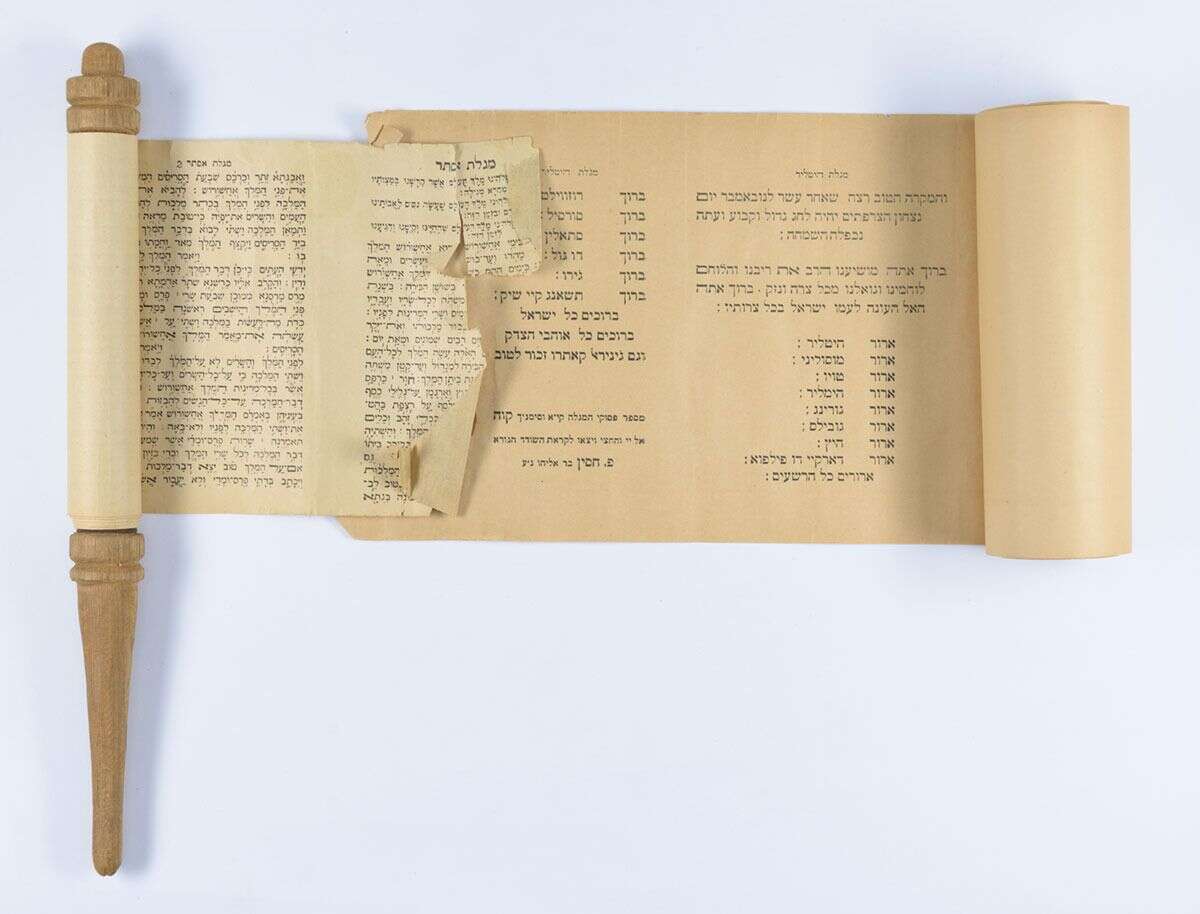
Among the most striking exhibits is the "Hitler Scroll," a seven-chapter scroll written in 1944 by Prosper Hassine, a scribe and teacher from Casablanca, as a kind of parallel to the Scroll of Esther. Alongside it are testimonies about Jews who risked their lives to fulfill the commandment of dwelling in a sukkah, including the moving account of Holocaust survivor David Yisrael, who described how a rabbi secretly built a sukkah in the Auschwitz camp.
"מגילת היטלר" ביד ושם , יד ושם
"Hitler Scroll" at Yad Vashem. Photo: Yad Vashem

Calendars on cement sacks and prayer books from memory

The exhibition is divided into sections according to the holidays of the Jewish year. At the entrance, visitors encounter a display case containing a tallit, tefillin and a calendar, everyday objects that during the Holocaust took on real existential significance. Among the central exhibits are calendars created under impossible conditions: on faded scraps of paper, on cement sack packaging, in faint pencil markings and even engraved on metal. Through them, prisoners tried to know when Shabbat fell, when to fast and when a holiday arrived.

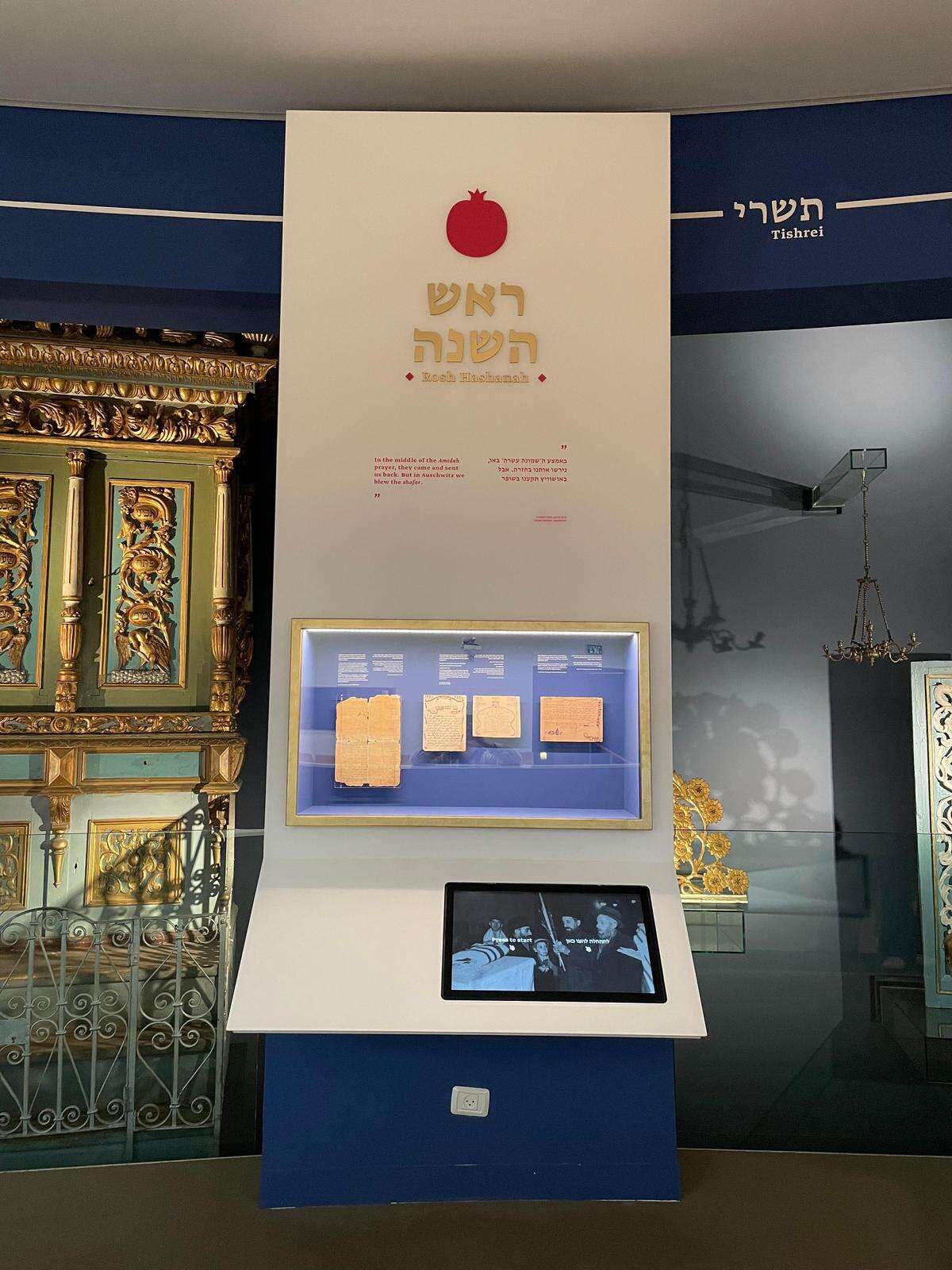
The section devoted to Passover features a Haggadah written and illustrated by the young Elimelech Landau, based on a version dictated to him from memory by his father while the family was in hiding in Boryslaw, Poland. In the section dealing with the High Holidays, the exhibition presents the prayer book "Cry of Captivity," written entirely from memory by Mordechai Glick and Shlomo Ullman in a POW camp in Siberia. Its cover was made from cardboard taken from the packaging of Red Army soldiers' tobacco packets. Beside it is a shofar that was blown in the Theresienstadt Ghetto.
חג ראש השנה ביד ושם , יד ושם
Rosh Hashanah at Yad Vashem. Photo: Yad Vashem

Halachic questions in real time

Interactive screens have been placed alongside groups of items, allowing visitors to delve deeper into the human story behind each object, watch personal testimonies and encounter halachic questions that were asked in real time: Was it permitted to build a sukkah from boards stolen from the Germans? How could Yom Kippur be observed in a labor camp? Was it possible to pray without a Torah scroll?

"The effort to hold on to time during the Holocaust was an act of resistance and of preserving humanity," said Michael Tal, director of Yad Vashem's Artifacts Department. "From the items and testimonies, we learn about the creative and courageous ways in which Jews, not necessarily only those who defined themselves as religious, acted in order to preserve the holidays and the cycle of the year even under the most extreme conditions. In this way, Jewish tradition continued to exist, even at the heart of the darkness."


Tags: AuschwitzHolocaustYad Vashem

Related Posts

How Europe's classrooms are being turned into factories of antisemitismReuters

How Europe's classrooms are being turned into factories of antisemitism

by Nissan Shtrauchler

From Ireland to Norway, new textbooks describe Auschwitz as a "camp for prisoners of war," the Gaza war as "genocide,"...

Stabbing spree in London's Jewish neighborhood leaves 1 fighting for life

Stabbing spree in London's Jewish neighborhood leaves 1 fighting for life

by Neta Bar

Shomrim security volunteers apprehended the attacker near the Sadigur synagogue in Golders Green; British PM Starmer calls the attack "deeply...

How did war unfold for Iran's Jews?

How did war unfold for Iran's Jews?

by Yaakov Hershkowitz

Since US President Donald Trump announced a ceasefire, the Jewish community in Iran has been breathing a sigh of relief....

Menu

Analysis 

Archaeology

Blogpost

Business & Finance

Culture

Exclusive

Explainer

Environment


Features

Health

In Brief

Jewish World

Judea and Samaria

Lifestyle

Cyber & Internet

Sports


Diplomacy 

Iran & The Gulf

Gaza Strip

Politics

Shopping

Terms of use

Privacy Policy

Submissions

Contact Us

About Us

The first issue of Israel Hayom appeared on July 30, 2007. Israel Hayom was founded on the belief that the Israeli public deserves better, more balanced and more accurate journalism. Journalism that speaks, not shouts. Journalism of a different kind. And free of charge.

All rights reserved to Israel Hayom

Hosted by sPD.co.il

  • Home
  • News
    • Israel at War
    • Israel
    • United States
    • Middle East
    • Sports
  • Opinions
  • Jewish World
    • Archaeology
    • Antisemitism
  • Lifestyle
    • Food
    • Travel
    • Fashion
    • Culture
  • Magazine
    • Feature
    • Analysis
    • Explainer
    • Environment & Wildlife
    • Health & Wellness
  • In Memoriam
  • Subscribe to Newsletter
  • Submit your opinion
  • Terms and conditions

All rights reserved to Israel Hayom

Hosted by sPD.co.il

Newsletter

[contact-form-7 id=”508379″ html_id=”isrh_form_Newsletter_en” title=”newsletter_subscribe”]

  • Home
  • News
    • Israel at War
    • Israel
    • United States
    • Middle East
    • Sports
  • Opinions
  • Jewish World
    • Archaeology
    • Antisemitism
  • Lifestyle
    • Food
    • Travel
    • Fashion
    • Culture
  • Magazine
    • Feature
    • Analysis
    • Explainer
    • Environment & Wildlife
    • Health & Wellness
  • In Memoriam
  • Subscribe to Newsletter
  • Submit your opinion
  • Terms and conditions

All rights reserved to Israel Hayom

Hosted by sPD.co.il