After decades of being folded into broader understandings of antisemitism, antizionism is now increasingly regarded as a distinct form of anti-Jewish bigotry, with its own language and logic. Instead of casting Jews as non-white pollutants corrupting European societies, it recasts them as the inverse: hyper-white invaders of non-European lands. It replaces 'international Jewry' with 'international Zionism' as the force said to be pulling the strings of world affairs.
This shift has made it easier to recognize anti-Jewish hostility, especially when it lacks swastikas and other markers of antisemitism in the classical racialized sense. But as antizionism comes more clearly into focus, a separate confusion thickens around the meaning of 'Zionism.'

While one need not be a Zionist to oppose antizionism, Zionists oppose it because they see it as a direct threat. This produces the misleading impression that opposition to antizionism is constitutive of Zionism – that confronting antizionism is what it means to be a Zionist. The prominence of the fight against antizionism has distorted the meaning of Zionism by conflating it with what Zionists feel compelled to do.
Zionism, in its origins, was not primarily an abstract ideological project but a practical response to lived historical conditions. It emerged from the accumulated experience of Jews across modernizing societies, where the hope of belonging repeatedly gave way to exclusion, dispossession, and annihilation. Its proponents maintained that such societies would prove structurally incapable of containing Jewish difference, and would eventually redirect their grievances toward the Jews in their midst with devastating consequences. In this sense, Zionism is, first and foremost, an escape from impending catastrophe – a matter of necessity rather than ideological preference.
But beyond saving Jews from physical destruction, Zionism aimed to undo the condition whereby modernity had conscripted 'the Jew' as a symbol – the figure through whom modern societies narrated their deepest anxieties.
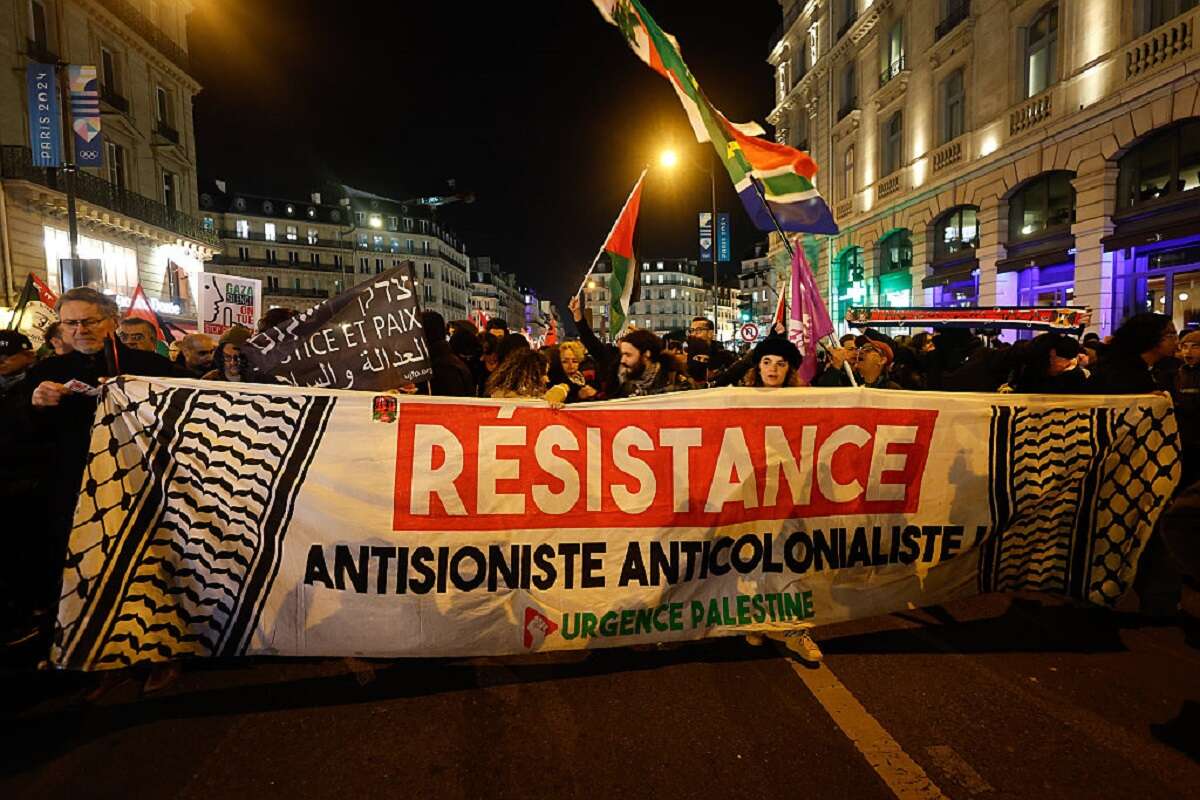
In this respect, Zionism did not fully succeed. The symbolic structure it sought to vanquish proved more durable than the social forms that had housed it. Shielded by post-Holocaust taboo, 'the Jew' was no longer available as the figure through whom modern societies explained their disorder. That role was reassigned to 'the Zionist,' who replaced 'the Jew' as the visible agent of global injustice and obstacle to a redeemed world.
What is often taken to be the ideological substance of Zionism is, in fact, a response to that same pattern now directed at 'the Zionist.' The confusion arises because Zionists are publicly engaged in countering antizionism. From the outside, it appears as though Zionism, as such, is an ideology under attack, forced to defend itself in kind.
But this is misleading. The word 'Zionism' is now being asked to name two different things: the project of freeing Jews from symbolic conscription, and the struggle against that conscription's return in a new form. This creates a category error. Zionists are not only Zionists; they are also anti-antizionists. Much of what is visible – the battles for campus accountability, the disputes over institutional language and framing, the defense of Jewish presence in public life – belongs to that second register, not the first. These are responses to antizionism, not expressions of Zionism.
Opposition to antizionism does not define Zionism. It reflects a forced engagement with the very accusatory logic Zionism sought to escape but antizionism rebuilt. When that engagement is conflated with Zionism itself, the latter's origins in concrete historical necessity give way to the impression that it is merely another ideological position, subject to the same contests and reinterpretations as any other.
Preserving the distinction restores the possibility of evaluating Zionism on its own terms, rather than through the lens of a fight it was never designed to wage.