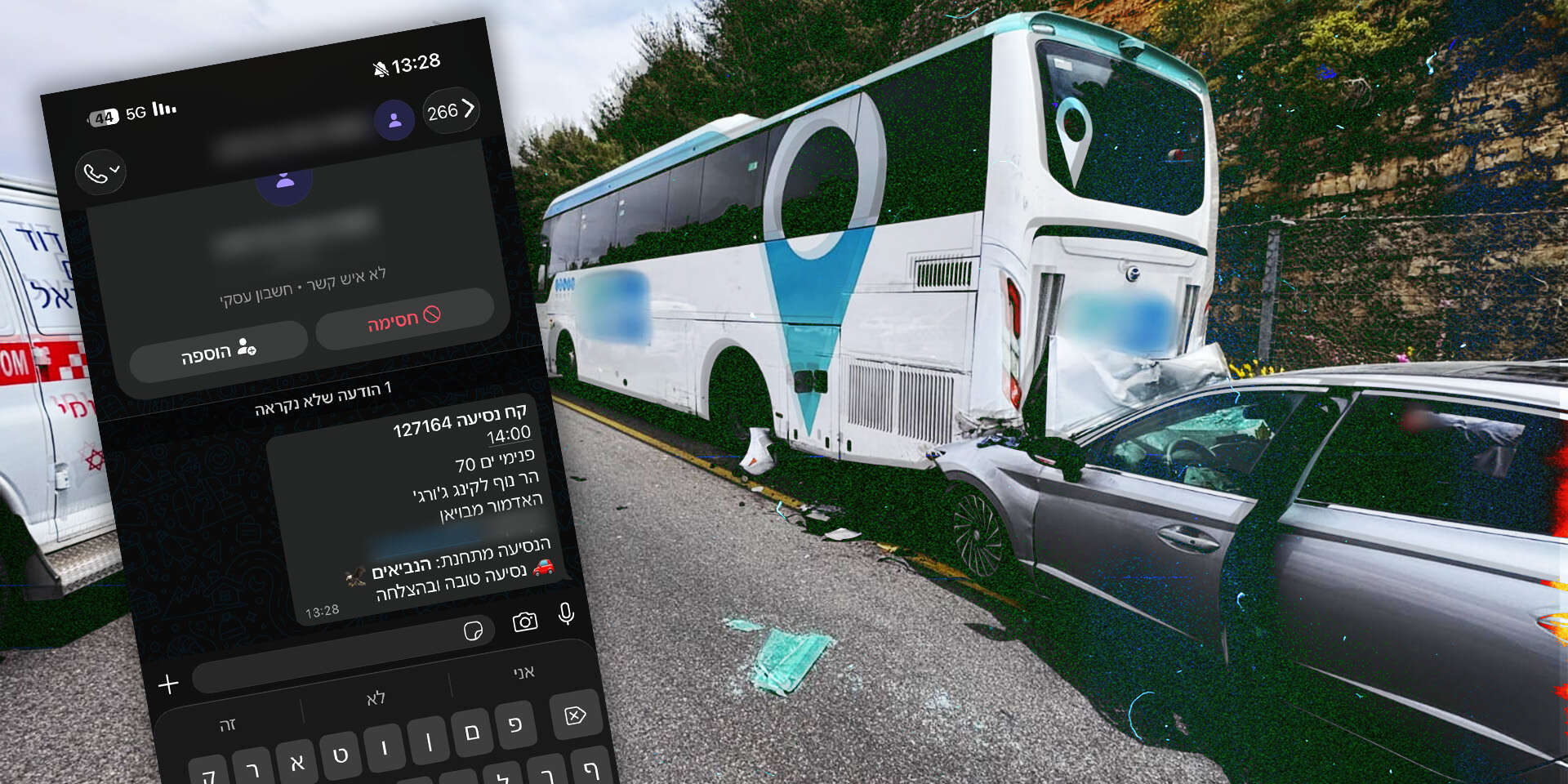
The shocking accident that occurred last Friday on Israel's Highway 1, in which a 1-month-old infant was killed, was not an act of fate. It was a warning, written in blood.
The driver was not a licensed taxi driver, the infant was not strapped in, and the entire ride took place in a blind spot of Israeli law enforcement. This disaster happened on Highway 1, but with thousands of drivers operating without a shred of oversight, it is a danger that can meet anyone at every junction and in every city in Israel.
A false declaration to a bot, and you're on the road
To understand just how wide open the system is, Israel Hayom has sent an investigator to see how easy it is to become a "driver." The process was alarmingly quick: He contacted a bot-based registration system, entered false details, and the registration was completed without a hitch. No one asked to see a driver's license, no one checked the vehicle documents, and no questions were raised about insurance or the driver's identity.
While taxi drivers in Israel are required to undergo training, strict medical examinations and security screening, in the world of the "drivers" the front door is open to anyone. There is no requirement to present a valid driver's license, and no one checks the driver's traffic record.

After paying a nominal membership fee, the investigator began receiving ride offers and even carried out a ride in Jerusalem. During the ride, an English-speaking tourist who had come to Israel for a short vacation got into the car.
Asked how she had heard about the "drivers" network, she revealed just how deep the phenomenon runs. "My sister, who studied in Israel, recommended that I avoid taxis and use this service," she said. "They arrive quickly, with luxury cars, and take you with no problems." What she did not know was that in the event of an accident, she was riding in a vehicle without insurance coverage for paid passenger transport.
To secular Israelis, the term "driver" may sound like the community's version of Uber. That is a dangerous lie. While international ride-hailing apps have oversight, driver ratings and regulated insurance, in the world of the drivers, everything is wide open.
When there is no requirement to present documents, there is no one to verify that the vehicle has the proper insurance, the only insurance that covers passengers in the event of injury. Without that coverage, in the event of an accident, passengers find themselves with no financial or medical safety net.
The shadow economy behind the wheel
The Haredi drivers phenomenon thrives on three foundations that should worry every citizen.
- Zero regulation and safety: There is no meter, no oversight of driving hours and no safety standard. A driver can get on the road after an exhausting day of work or with no sleep, and no one will stop him.
- Outside the tax system: This is a network that operates without reporting to the tax authorities. This economic conduct is what allows them to undercut the market and offer lower prices than taxi drivers, who bear the costs of a regulated transportation system.
- Employment in the shadows: For young men who cannot hold a formal payslip, such as IDF deserters or those struggling to integrate into official employment, this is an accessible employment track that operates entirely under the radar.
When a "driver" like Avreimi (a pseudonym) explains the economic logic, "A person sees that a taxi costs 400 shekels and suddenly someone offers him 300 shekels. He says to himself, why not?" he leaves out the bitter truth.
Those 100 shekels are the difference between a driver who has undergone training and medical checks and a young, inexperienced driver. They are the difference between a vehicle insured according to the law and a vehicle traveling on borrowed time.
This phenomenon has long since crossed the boundaries of the Haredi sector. It is spilling over to secular Israelis, tourists and unsuspecting citizens who are tempted by the low price and the shiny car.
Negligent amateurism
Behind the appearance of a well-oiled system lies a shocking level of amateurism when it comes to human life. While taxi drivers in Israel are required to undergo training, strict medical examinations and security screening, in the world of the "drivers" the front door is open to anyone. There is no requirement to present a valid driver's license, no one checks the driver's traffic record, whether he has accumulated dozens of life-endangering violations or was involved in fatal accidents, and there is no criminal-background screening.
The result? Complete abandonment of passenger safety. Anyone, regardless of their skill on the road or their criminal record, can gain access to the bot, pick up passengers and drive onto the highway without any supervision or control.
It must be said honestly: The Haredi drivers world is not a creative transportation solution. It is akin to the American Wild West. As long as the state continues to turn a blind eye, the next accident is not a question of if, but only of when. It could happen tomorrow morning, on any road in Israel, and exact another bloody toll that could and should have been prevented.