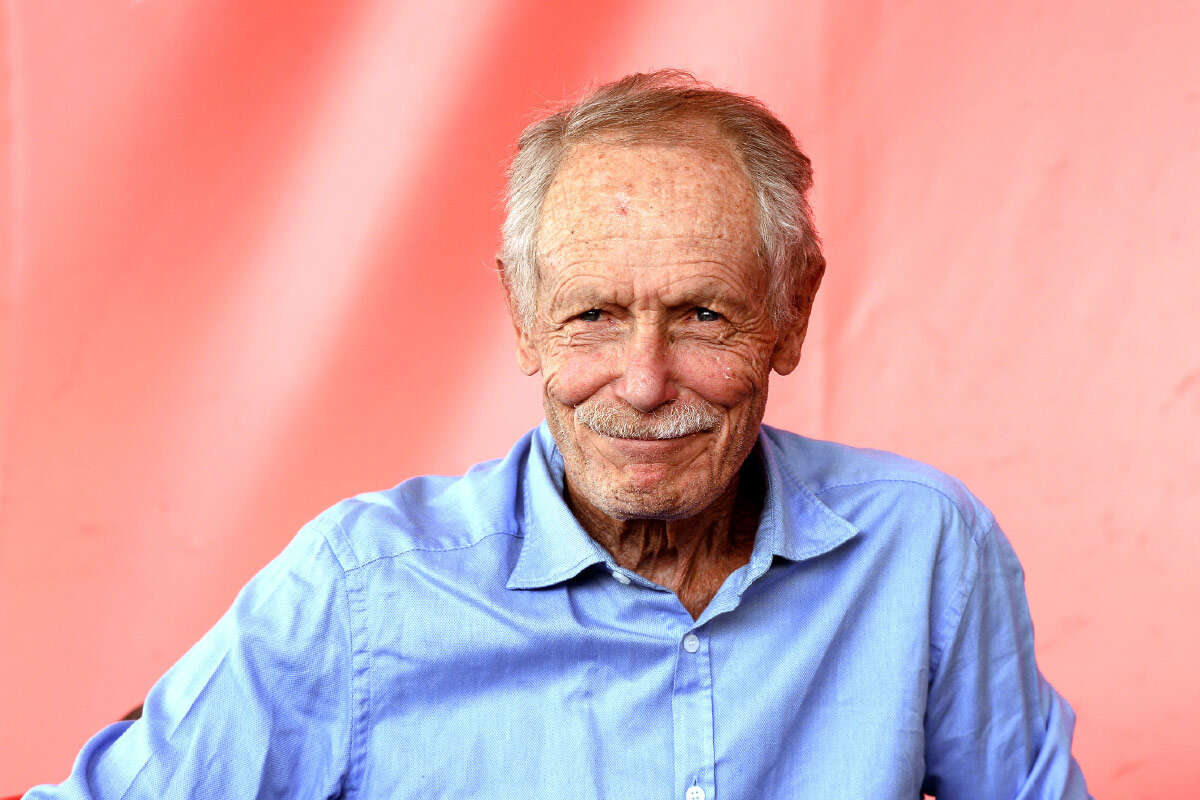
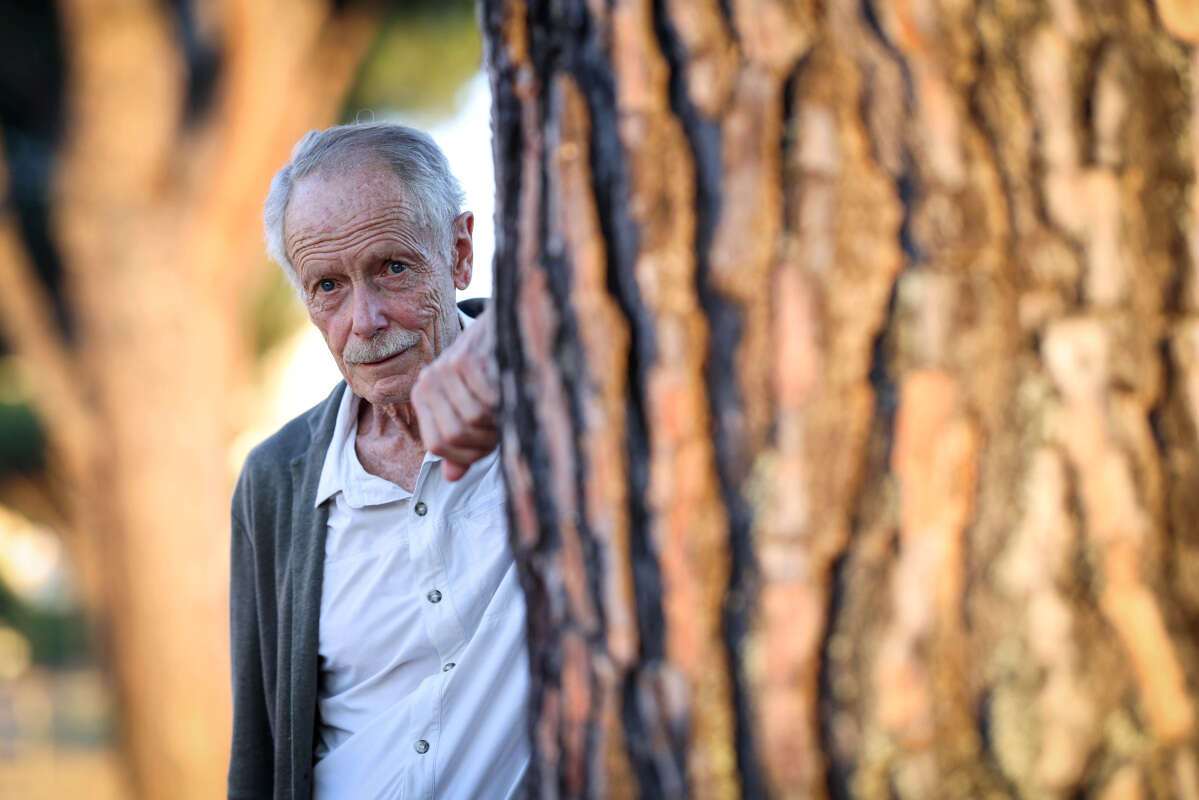
The journey from Erri De Luca's home to the big city is an exercise in shedding layers. Three kilometers separate the nearest village from the stone-and-wood house where he lives, in voluntary isolation, in the Italian countryside.
To get to Rome, he has to drive 40 minutes. That is what he did for this interview. He deliberately parked his car on the outskirts of the city and walked for two hours, as if fulfilling an existential necessity. In a world of constant media and consumer noise, distance is an aesthetic and political statement, unless it is simply evidence of a disappearing kind of human character.
De Luca makes it clear that he is not wearing the robe of an ascetic monk. "I simply need my car to get around from here," he says with a smile. His eyes are narrow and focused, a hint of the sheer sunlit cliffs that, at 76, he still climbs with his bare hands. "And I have no intention of throwing away my cellphone. It is far too useful. I am connected to reality. I am not withdrawing from it."
And yet, the reality into which De Luca is now stepping is an scene of brilliant solitude. His arrival next week at the International Writers Festival at Mishkenot Sha'ananim in Jerusalem , with the support of the Jerusalem Foundation, is not a stop on an international author's public relations tour. It is an act of moral alignment against the prevailing winds.
As intellectuals on the old continent compete with one another in drafting polished boycott papers and signing petitions denouncing the State of Israel, De Luca chooses to return to the earliest words. The words that his former comrades on Italy's radical left in the 1970s turned into terms of abuse.
"In Italy, and in large parts of the West today, 'Zionist' is a curse. An insult thrown at you to mark the boundaries of what is beyond the pale," he says quietly. "But I insist on this word. For me, Zionism is the simplest and most basic recognition of the Jews' right to a national home, to existential and necessary defense. Anyone who recognizes Israel's right to exist here, anyone who sees two entities living side by side, is a Zionist by that very fact. There are many people in Europe who hold this position but are afraid of their own shadow. They do not know that they are Zionists. I say it out loud, and I do not care about the price."
These statements carry an uncompromising specific gravity, which immediately translates into existential practice. Recently, he corresponded with his friend, singer Achinoam Nini. She asked him to take part in an event she is organizing in Florence, planned for July. De Luca did not try to smooth the edges in order to please anyone, and set out an explicit moral condition.
"I told her: 'I would be happy to come, but I am a Zionist. I am not capable of sitting in the same room or sharing a stage with people who long for Israel to be erased from the map. And more importantly, I will not cooperate with any event or forum in which people speak of "genocide" in the context of Gaza.'"
His relaxed calm gives way to the rigidity of a construction worker who knows how to distinguish stable materials from architectural foam. The use of the term "genocide" arouses in him a deep grammatical anger.
"I know very well what genocide is, and applying it to the war in Gaza is a historical and verbal distortion. What took place in Gaza is a brutal, modern war, in which the number of civilian casualties is enormous and horrifying because when fighting takes place inside a dense urban space, among schools and hospitals, the population will always pay the highest price. We saw this in Mosul, in Raqqa and in Mariupol. It is the inevitable effect of fighting an enemy that digs itself in among its own civilians. It is terrible, but it is not genocide."
The best proof of the absurdity, he says, lies in the Israel Defense Forces' operational movement. "If the army's goal were the extermination of a people, it had a perfect stationary target, since the entire population was concentrated inside the city. The fact that Israel repeatedly moves the civilian population, from north to south and from south to north, in order to distance it from active combat zones, renders this accusation empty. It is not based on facts or observation, but on a clear desire to insult Israel, to wound its legitimacy."
So he made it clear to Nini that he was not prepared "to be the intellectual decoration of groups that use these words. She replied that they still needed me and that I should come."
A mystical love of Hebrew
Solitude does not frighten Erri De Luca. It is the studio in which he has been creating for decades. He looks with polite contempt at Italy's cultural establishment, which is now trying to punish him with silence or ostracism.
"The insults of the literary clique do not move me," he says. "I have been voluntarily isolated from the Italian cultural world for a quarter of a century. I never agreed to take part in literary prizes, not as a candidate, not as a judge, not as decoration. I have no interest in small cliques, in the cheap politicization of publishing houses. When a person is leaning against a cliff, he does not need any literary critic to hold the rope for him."
Our current meeting, in the courtyards of the houses branching off Via Cavour on the way to the Colosseum, took me back 11 years. We met then at Tel Aviv University. The boycott of Israel was already an acute issue, but the internal social pressures and the antisemitic madness outside had not yet overflowed. He sat opposite me in a cotton shirt and climbing sandals, tying himself to our place with a boyish smile as he shared with me his unexpected love for Ashkenazi food. He declared that he felt completely at home in Israel.
When I ask him now, from the height of another decade filled with dramatic upheavals in our region, whether this sentimental and intimate connection remains intact, he answers without hesitation: "Exactly the same. I affirm it in the fullest sense. My connection to Israel and to Israelis does not depend on passing political circumstances or changing trends."
De Luca's almost mystical love for the Hebrew language, the Bible and Jewish culture, and by extension for Israel, seems at first glance to be a literary riddle with no roots. He was born in Naples, grew up in a Catholic family and was not exposed in childhood to any biological thread of connection. This riddle troubled not only his readers, but also those closest to him.
"In recent years," he says, "the president of my foundation, who is more than a close friend, persuaded me to undergo a genetic test. She sent a saliva sample of mine to a laboratory that traces ancestral origins and family lineage. She herself was curious, and perhaps I was too, to see whether there was any biological or historical basis in my family that could explain my deep interest in Hebrew, Yiddish and the Bible."
The results came back from the laboratory, and they were unequivocal: No Jewish genetic trace was found.
"It turned out that I have no biological or educational justification for this interest," De Luca says with the smile of someone celebrating his freedom to choose his spiritual ancestors. "There is no official reason for my 'sentimental education.' But for me, the first half of the 20th century, the years in which I did not yet exist in the world, was formative. The war, the destruction of Naples and the extermination of European Jewry, these are the events in which I felt involved and personally committed, deep inside."
That commitment did not remain on the bookshelf. In 1993, on the 50th anniversary of the Warsaw Ghetto Uprising, De Luca packed a suitcase and traveled to Poland. There, in the urban emptiness that covered what had once been a magnificent center of Jewish existence, he searched for one of the great heroes of his youth: Marek Edelman, one of Mordechai Anielewicz's deputies in the uprising, a Bund representative and one of the leaders of the Jewish Combat Organization.
"Edelman was a hero of mine, alongside the Spanish anarchist Buenaventura Durruti from the war in Spain," he says.
In those days, the anti-establishment Edelman refused to take part in the Polish government's ceremonies, and De Luca saw him standing on a chair in a small square in the old ghetto, "a place that had been completely erased and rebuilt by the Poles, who meticulously preserved only the street names. Around him stood a small group of listeners. I recognized him only from photographs. I did not understand a word he said, because he spoke Polish, but the sight of that tough old man on the chair engraved something indelible in me."
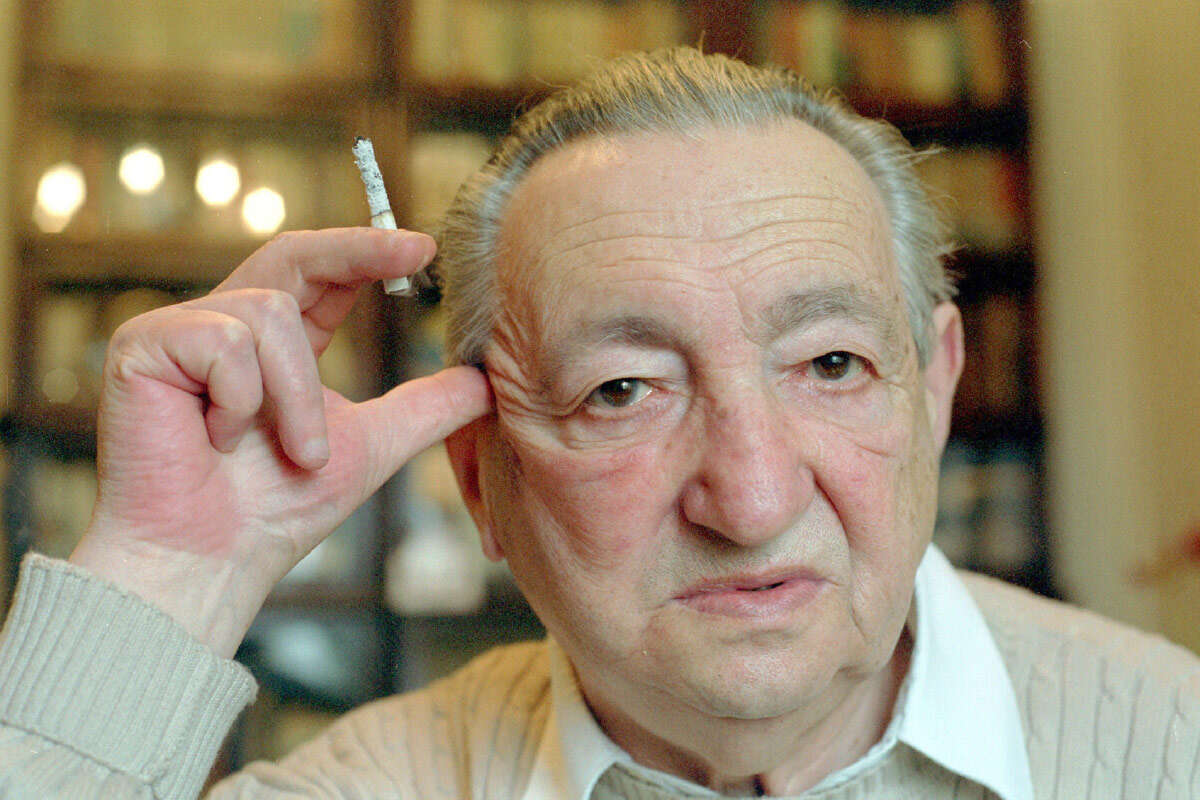
Immediately afterward, he visited the museum where the Ringelblum Archive is preserved, the underground documentation project buried in milk cans beneath the ruins of the ghetto.
"There, in front of the yellowing pages, I saw this language, written in Hebrew letters that I knew, and I understood that this was a vast treasure. But I could not read it, because it was Yiddish. When I returned to Italy, the first thing I did was buy a Yiddish grammar book published by Oxford. I sat down to study on my own, and very quickly I began to read."
The first book he devoured in the original was "The Family Moskat" by Isaac Bashevis Singer.
"I devoted an entire year to reading this book," he says with the reverence of a craftsman. "The original Yiddish version is far broader, deeper and more detailed than any translation into English or other languages." Later, he translated into Italian Itzhak Katzenelson's monumental poem "The Song of the Murdered Jewish People" from the Yiddish version. Following that work, he received a prize for Yiddish culture in France.
"I was the only non-Jewish person there to receive that distinction. I felt that I had been adopted into the family, without ever having asked."
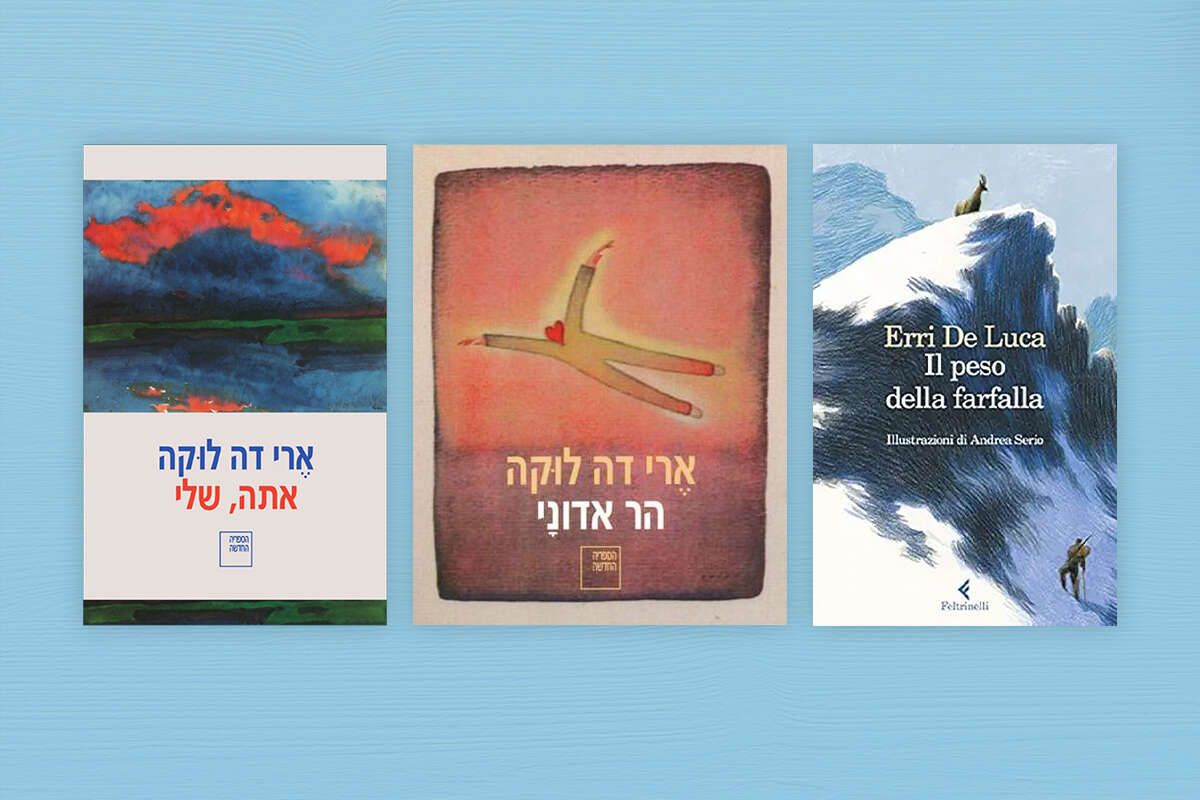
That adoption was mutual, and was also translated into the phenomenal success of his books in Israel. About two decades ago, De Luca became a literary star on a local scale, when his works "God's Mountain," "The Day Before Happiness" and "Three Horses" became an integral part of the Israeli bookshelf, almost instant classics.
When I try to draw from him an explanation for this secret and enduring connection with the Israeli reader, he retreats into his characteristic modesty.
"I do not know how to explain it," he says, shaking his head. "These books are, after all, Neapolitan tales, a combination of local folktales that also succeeded elsewhere. Perhaps the real reason is not my words, but simply the wonderful translation work of Miriam Shusterman Padovano into Hebrew. I have no way of checking that myself, but I trust her completely."
The first law of nature
In his past, before his books became bestselling translations and part of the canon of European prose, De Luca made his living for decades as a construction worker, plasterer and carpenter. He does not see those occupations as temporary stations in his biography, or as some fashionable working-class calling card. For him, direct contact with material, pressing down on the handle of a plane, touching wet plaster, is a mechanism through which he disassembles the structure of the world.
When I ask him, as someone who spent years in workshops, to look at the structural dismantling of the global system today, he pulls out a sharp metaphor.
"As a carpenter, when I look at today's leaders, at their empty rhetoric, my feeling is that we are being managed by a group of craftsmen who want to build a table, but have simply lost the original template, the basic drawing, the plan that enables the different wooden boards to connect into one stable whole that can be leaned on. The result is that every leader, every country and every interest group produces some small, distorted part of its own, arguing over it by shouting, without having the slightest idea how it is supposed to fit into the overall construction."
All right, then we know what the technological age lacks. But what is the solution?
"Not to try to return nostalgically to the past, but to invent and redesign the model of the table."
De Luca's linguistic and philosophical view of the world is closely tied to his daily reading of the Bible in the original language, an intimate ritual he observes every morning. In his eyes, biblical Hebrew is not a dead language of religious ritual, but a cosmic mechanism in which words are the physical building blocks of reality.
When I ask him whether there is a specific Hebrew word that excites him, one in which he finds beauty that cannot be translated, he thinks for five seconds and answers: "Vayomer."
"The most astonishing thing in the biblical text is that the divinity chooses to act and explain itself only through speech," De Luca explains. "The verb 'amar,' 'said,' has the highest number of appearances in which the subject is God. The biblical God does not want to be painted, sculpted or imagined in material form. The words must suffice. They are the only entity. The concept of 'vayomer,' 'and he said,' is the key to the entire architecture of creation. Light was not created out of an abstract force of will, but out of words spoken aloud. The words caused light to happen. Since I began reading this text, words have been for me the only way to illuminate reality, to make it visible."
This connection between the spoken word and action in the world is, for him, the distilled definition of freedom and moral responsibility, concepts that he says have been utterly cheapened in the present age.
"In the biblical story, the connection between word and deed is immediate. Words immediately become creation. In my personal life, freedom means maintaining complete alignment between what I say and what I do. There is a Talmudic sentence that became for me an existential motto, my private Bible: 'As long as the words are inside your mouth, you are their master. Once the words have left your mouth, you become their servant. You must obey them.' In the modern world, where intellectuals and politicians scatter words with no backing and not a drop of responsibility, this perception has almost disappeared, but for me it is the first law of nature."
The current age also places this distilled human craft of writing under a new technological threat. Artificial intelligence can imitate, replicate and produce texts that precisely simulate the style of writers. Does that worry you?
"I am too old to trouble myself with technological panics," he says with a smile. "I am worried about old things, such as primitive hatred and ancient lies. A friend of mine recently tried to challenge one of these programs and ask it to write a text that imitated my writing style. I read the result, and it was an empty imitation, without a pulse. I feel that my personal touch is protected from mechanical imitation. At the same time, I recognize that it is a useful tool. Friends of mine use it to translate me into English, and those translations are good enough for my technical needs. I am not worried for myself, but for the many jobs held by young people, translators and editors at the beginning of their careers, who will be pushed out of the market because of these machines."
Freedom is born of defeat
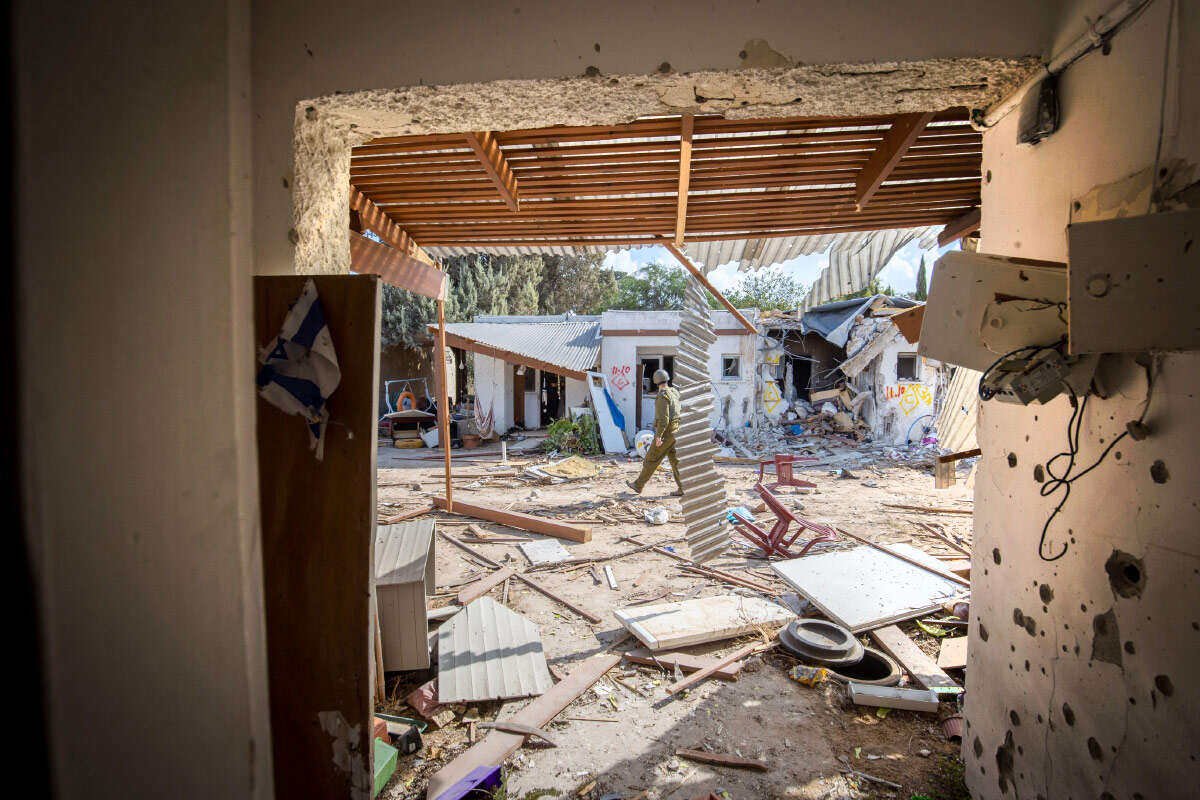
When the horror struck on the morning of Oct. 7, De Luca followed the reports from his isolated rural home, with the immediate understanding that something in the old conceptual systems had collapsed entirely. His analysis of the events is not political, and it is far from being translated into the familiar clichés of foreign media. It is piercing, cold and diagnoses a deep existential failure in the structure of Israeli power.
"The first thing that struck me that morning was the absolute lack of preparedness, the alarming absence of military defense in the area," he says. "There was no defense there. The initial response rested entirely on private individuals who showed wild resourcefulness and fought alone against death. But beyond the operational or tactical intelligence failure, I am convinced that there was 'willful ignorance' on the part of your government. There was a conscious and deep refusal to understand the situation, and the result was the most terrible price of all, something that could not even have been imagined."
What makes the Oct. 7 massacre even more horrifying and distinct in the long history of persecution of Jews, according to De Luca, is the element of civilian abduction.
"I hear people using the term pogrom, but what happened here was worse and more sophisticated than a pogrom. In the classic pogroms carried out in Europe, the rioters did not take captives on this scale. They came, murdered, destroyed and left. Here, the massive use of hostages and their detention in tunnels add a dimension of planned, rational cruelty that turns this event into something bad and different from anything we have known in modern history."
He feels that "Israel is now fighting what is absolutely its last war in the structure familiar to us, in Gaza, in Lebanon and in Iran. You have to try to get rid of Hamas and Hezbollah politically and operationally, and I see small signs that this is possible. The fact that local elections were recently held in Deir al-Balah for the first time in 20 years, and that Hamas was given no place or foothold in them, shows there is a possibility that the Palestinian people will understand that they must free themselves from them in order to survive."
To explain the paradox in which internal freedom is born precisely out of external defeat, De Luca returns to Italy in World War II.
"Italy managed to get rid of Mussolini's fascism only because it lost the war completely, and because the Allied forces, the Americans, the English and also the Jewish Brigade, occupied the country. No people can rid itself of an internal totalitarian regime by its own power alone, without an overwhelming external shock.
"Look what happened in Spain: Franco did not enter the world war, he was not militarily defeated, and therefore fascism there survived undisturbed until the 1970s. The same thing happened in Argentina. The military dictatorship of the junta fell only after it lost the Falklands War to the British. There is a historical moment in which a group or a people can be redeemed and liberated only through the military defeat of its tyrannical leaders. That is what is happening now in Gaza, and it is the only chance for real change in the region."
15 journeys to Ukraine
Toward the end of the conversation, I ask De Luca to return to the image he raised in his masterful book "The Weight of the Butterfly." The passionate, violent and inevitable encounter between the hunter and the hunted. In a reality in which history repeats itself again and again in prolonged cycles of blood and violence, does he still believe that literature has the power to break that cycle?
"No," he replies immediately. "Literature cannot save the world, but it can do something else. It can save your eyes when they look at the world. It can free you from the distortions, manipulations and propaganda that the system of power tries to impose on you. So literature is our best immune system against lies and against propaganda. A person who has read many books in his life is a far stronger and more immunized person than someone who has not read. It is like a fight between a sober person and a drunk person. The one who reads is sober, and the other side will always be weaker and more blurred."
This sobriety accompanies De Luca even when he looks at the absolute split he maintains within his personality. He firmly refuses to mix his role as a writer with his duties as a citizen.
"I am a completely split person," he admits. "I am split between the writer in me and the reader in me. When I read a book, I read it as the most ordinary consumer, in complete ecstasy, never as the writer's colleague, and never through judgment or the thought, 'I would have written that line better,' because then I would destroy the joy of reading for myself."
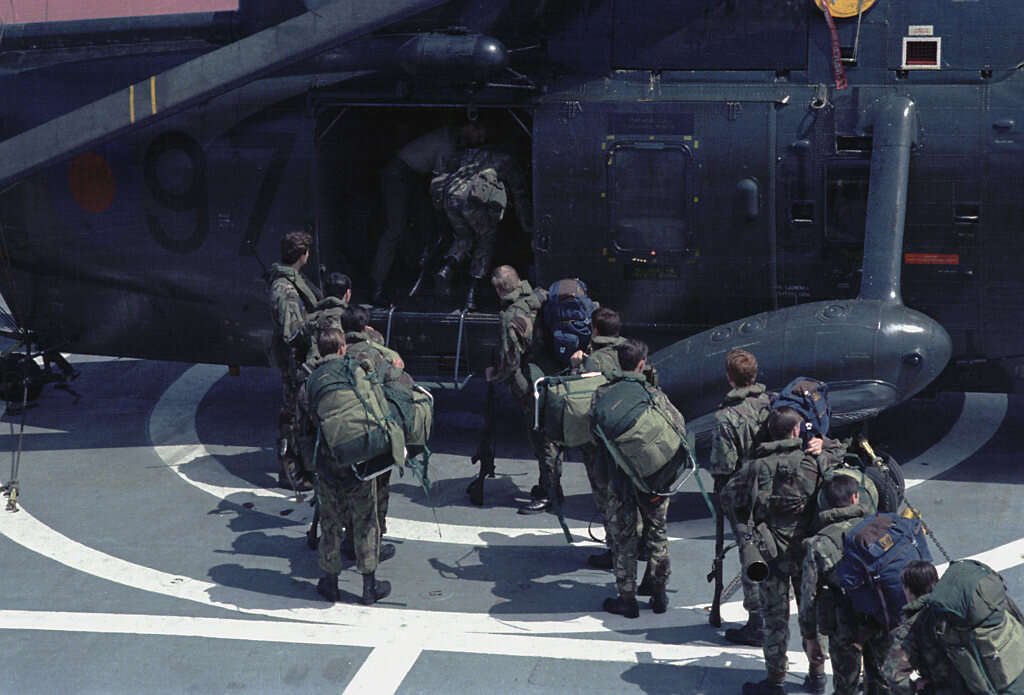
The citizen in him is not satisfied with words, but goes out into the field. At the beginning of the Russian invasion of Ukraine, De Luca and a friend bought a van, and the two began making long journeys into the bombarded country to deliver medical equipment and humanitarian aid. So far he has made 15 such journeys, with each round trip lasting about six days. It was an almost natural continuation of his activity in the 1990s, when he served as a volunteer driver in aid convoys in the heart of the war in Yugoslavia.
"As a citizen, I take on a practical commitment, and it has nothing to do with my books," he says. "At the same time, my foundation now devotes most of its resources to funding academic scholarships for young migrants who arrive in Italy, and has already had the privilege of seeing the first graduates complete law degrees."
If you could now climb into a time machine and meet the young Erri De Luca, that tough young man who labored on the production line of a factory in France or drove an aid truck in Yugoslavia, what advice would you give him from the distance of the years?
"I would not give him any advice. He did exactly what he had to do. But I would be very happy to meet that young man I once was, just to show him and prove to him that I am the perfect and direct continuation of his life. I would want him to know that I did not betray his path, that I did not deviate from the line and the values he set for himself. I think that if we met today, he would look at me, smile, and could shake my hand with pride."