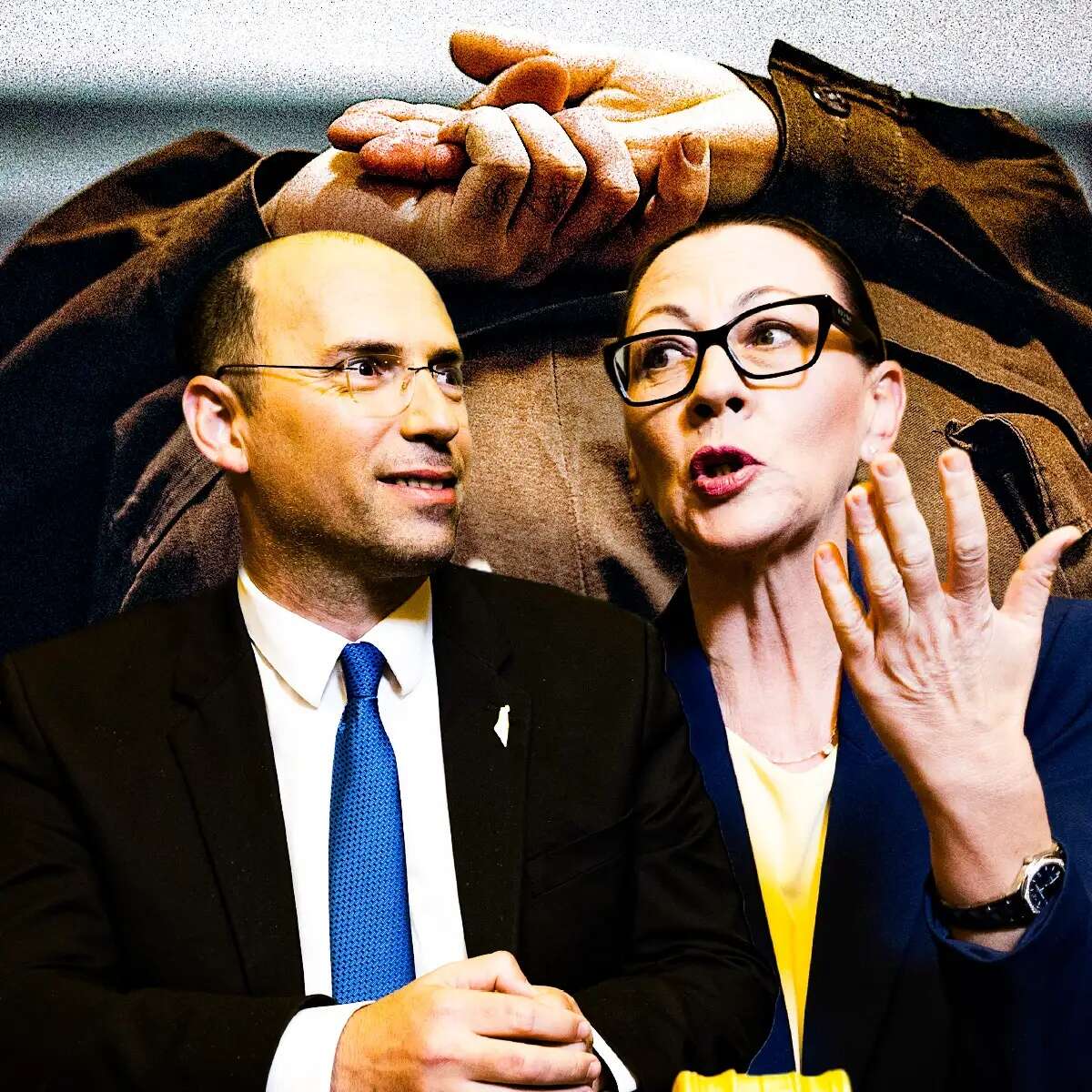
It is not every day that two members of Knesset sit down for a joint interview. Such a setup has been especially unusual over the past three years, when the two come from opposite sides of the political map. It is even rarer that just before an election, they hold a respectful, attentive conversation, without shouting and without cutting each other off, as is customary in our part of the world.
But that is what happened this week in the Knesset Constitution Committee room. The two members of Knesset who initiated, advanced, and led to the final approval of Hamas' Nukhba terrorist prosecution law sat down in front of the microphone and cameras of Israel Hayom. Constitution Committee chair Simcha Rotman, a coalition member and one of the figures most identified in the country with the judicial reform, sat alongside Yulia Malinovsky from the opposition, as they brought to light the close cooperation between them that lasted two and a half years.
The national mission of bringing justice to the modern-day Nazis united them.
The two, it turns out, used to talk for extra hours, sometimes late into the night or until the start of Shabbat, in order to advance the law, which Rotman himself acknowledged should have come from the government. Malinovsky, who often holds back and sighs when Rotman speaks, appreciates him for the concessions and the enormous efforts he made along the way to reach the goal. Together they pledged to continue tracking the implementation of the law, which was supported by 93 members of Knesset with no opposition at all. As wise and experienced lawmakers, both know how easily the bureaucratic echelon can water down laws passed by the Knesset.

Q: I see the two of you sitting together and I ask myself, why is it so rare for two members of Knesset, from the coalition and the opposition, to work together on a law and sit down together for an interview?
Rotman said, "Many people don't know it, but in the Knesset, coalition-opposition cooperation is something that happens a lot. What doesn't happen a lot is cooperation that stretches for so long and goes down to such fine resolution as in this law, because we started working together on the law and on the ideas that preceded it back in November '23. That is, less than a month after the massacre, and the cooperation grew and expanded as time went on. MK Malinovsky, as an opposition member, brought to the table things that the coalition has a harder time bringing."
Q: MK Malinovsky, if you are working together on such an important and truly historic law, what is the meaning of the bad blood we have seen here for three and a half years? In other words, why does this happen only with this law and you can't work together on other things?
Malinovsky replied, "First of all, you can. For example, the UNRWA laws [which Malinovsky initiated]. Here there was cooperation with the [former] chair of the Foreign Affairs and Defense Committee, Yuli Edelstein."
Q: So how does that square with the boycotts we know from so many places?
Malinovsky said, "Let's put things in proportion. On the issue of prosecuting October 7 terrorists, on UNRWA, and on other issues I have led, Simcha, me, you, all Israelis – we are patriots, it hurts us, it's in our gut and in our soul. We proved that this thing exists, we overcame everything and succeeded together. It leaves hope."
Ben-Gvir? "A performance"
Q: Many Israelis are now asking themselves, after the law was enacted, how many of the terrorists will ultimately be executed.
Rotman said, "The answer to that is not known to me. I know what I would want to see. I think the absolute majority of them are certainly fit for the death penalty, and I hope the death penalty will be imposed on them."

Q: Yulia, does the State of Israel really need to execute hundreds of people?
Malinovsky responded, "This law will also apply to those who held hostages, that is a very significant event. Understand the situation. The Israelis who were harmed, the families of the victims, will really be able to look these murderers straight in the eye. The hostage who sat there in Gaza, poor man or poor woman, will look into the eyes of the one who held them. It's crazy, right? The State of Israel needs to bring the full force of the law against them. We are not a terrorist organization, we are a state with law, we are a sovereign state. Whatever the prosecution demands and the judges decide, it will be possible to impose the heaviest sentences, including the death penalty. That is how the law is built. In the end, it's a judicial decision. We as lawmakers did everything and built it in the clearest way, so that the judges are authorized."
Q: You didn't answer my question. Do you think that should be the result, meaning that hundreds of people will be executed by the State of Israel?
"I'm not talking about numbers. In the end, there will be a prosecution, there will be judges, there will be rulings. I really hope that there will also be the harshest punishments in the law books. I don't want to belittle the value of the death penalty, which is the most severe there is in the law books. It can't be wholesale."
Rotman said, "I share that statement. We as a state will not rest and will not be silent until we restore justice."
Q: There was another law here in the Knesset whose headline was "death penalty for terrorists." Coalition member, Minister Itamar Ben-Gvir, led it. Is it relevant to these sentences?
Malinovsky replied, "No. A performance? Yes. A campaign? Yes. But there is no connection."
Rotman added, "Regardless of whether it's a performance or a campaign. The law of Minister Ben-Gvir and the Otzma Yehudit [far-right religious-nationalist party] party deals with what will happen from here on. It is not retroactive. Therefore it does not deal with the October 7 terrorists in the clearest possible way."
Q: Closing remarks?
Malinovsky said, "We succeeded with this law, but this is not the end. The road is truly dizzying. Right, Simcha? It really required a crazy effort. But this is just the beginning. We won't let anyone water this down. We are not leaving the picture, and everyone knows that."
Rotman concluded, "This law is the proof that the Knesset is not just a relevant factor, but perhaps the most relevant factor in the State of Israel. Too many times I have heard over the past three and a half years the saying, 'The Knesset is weak, does the government's bidding, you only do what he tells you, you are just an execution contractor and there is no Knesset.' I think that in this law we showed in the Knesset – coalition and opposition together – that the people are the sovereign, and that we, as the representatives of the sovereign, know how to get all the systems to align with the line set here in the committee room. There was a crazy cooperation here with the opposition. This law brought great news to the people of Israel, through the Knesset, for the benefit of all the population of the State of Israel and the entire Jewish people."