When people talk about an "exit" in tech, most imagine one of two familiar scenarios: an IPO or the sale of a company to a tech giant. Those are traditionally the moments when employee stock options finally turn into real money.
But over the past two years, amid a prolonged freeze in the IPO market and the meteoric rise in startup valuations, a new intermediate mechanism has emerged: the secondary market. It allows fast-growing private companies to convert some of their employees' shares into cash, creating a new generation of wealthy tech workers even before an IPO or acquisition takes place.
For employees to turn options into real money, they need to exercise them and find a buyer for the resulting shares. Normally, that happens during an IPO, when the public can purchase company shares on the stock exchange, or during an acquisition, when the buyer purchases the shares of the private company. Until then, even options worth hundreds of thousands or millions of dollars on paper may remain impossible to realize.
That's where the secondary market comes in – a marketplace where shares in private companies change hands before an IPO or sale. Employees exercise and sell their options to funds, institutional investors, or sophisticated private investors. In many cases, the company itself organizes the process through a structured tender offer, allowing employees to finally access the wealth they have accumulated "on paper," while also helping the company retain talent even as the big exit is delayed.

Hundreds of thousands of dollars per employee
"We're seeing more and more employees becoming newly wealthy through secondary transactions," says Moran Chamsi, Managing Partner at Amplefields, a fund specializing in secondary investments in private companies.
"In unicorns and decacorns, the company usually leads the process and brings together employees it wants to retain. An employee can suddenly receive hundreds of thousands of dollars – or even millions."
According to Chamsi, the secondary market creates a kind of "mini-exit" within a private company. Employees receive real money before an IPO or acquisition, investors gain exposure to highly sought-after companies, and companies can reward employees without going public. "A whole new layer of wealthy individuals is being created before the major exit event," he says.
According to industry estimates, between the beginning of 2025 and May 2026, Israeli tech companies completed secondary transactions totaling roughly $1.5–2.5 billion. Not all of that money went to employees. Some flowed to venture capital funds, founders, angels, and early investors, selling portions of their holdings. Still, estimates suggest that approximately $750 million to $1.2 billion went directly to employees, former employees, and executives. Assuming roughly 2,000–4,000 employees actually cashed out through these transactions, the average payout comes to approximately $325,000 per employee.
Of course, averages conceal large disparities: senior employees and executives may receive millions of dollars, while younger employees may walk away with tens or hundreds of thousands.
Valuations are soaring while the IPO market remains frozen
The boom in the secondary market is no coincidence. It is directly tied to the IPO slowdown and the fact that many private companies continue to grow and mature while struggling to reach a liquidity event.
"The tech industry is currently in a paradoxical situation," Chamsi says. "On one hand, there are more strong, efficient, and even profitable companies than ever. On the other hand, precisely when they're more mature than ever, they're struggling to reach an exit or IPO. The secondary market grew in that gap."
Chamsi explains that for companies, secondary rounds have also become an important management tool. "Today, companies are much more open to secondary rounds because they want to improve their metrics and arrive better prepared for an IPO. It allows them to balance talent retention and recruitment while improving profitability, without raising salaries in ways that hurt financial performance."

Among the Israeli startups that have led major secondary transactions worth tens or hundreds of millions of dollars are VAST Data, Island, DriveNets, Cato Networks, Armis, and Cyera.
AI companies are leading the trend
Inside the world's largest AI labs, the secondary market has already reached the scale of a small public market.
According to media reports, OpenAI completed a secondary transaction worth approximately $6.6 billion, in which current and former employees sold shares at a company valuation of around $500 billion.
Anthropic carried out a similar transaction at valuations reaching into the hundreds of billions of dollars, while xAI, founded by Elon Musk, facilitated an employee share sale worth approximately $300 million at a valuation of around $113 billion.
These transactions illustrate how private AI companies are generating liquidity events worth hundreds of millions – and sometimes billions – of dollars before ever reaching the public markets.
According to data from Forge Global, one of the leading marketplaces for private-company shares, approximately 44% of the secondary transactions conducted on its platform in 2025 involved AI companies. The figures highlight how demand for private AI shares has become one of the primary growth engines of the secondary market.
VAST Data: "Our employees are partners in the success"
One of the most prominent Israeli examples is VAST Data, the AI data infrastructure company founded in 2016. The company developed a data platform designed for training and running AI models, enabling organizations to manage, retrieve, and process enormous volumes of information at high speed – one of the critical infrastructure layers behind the current AI boom.
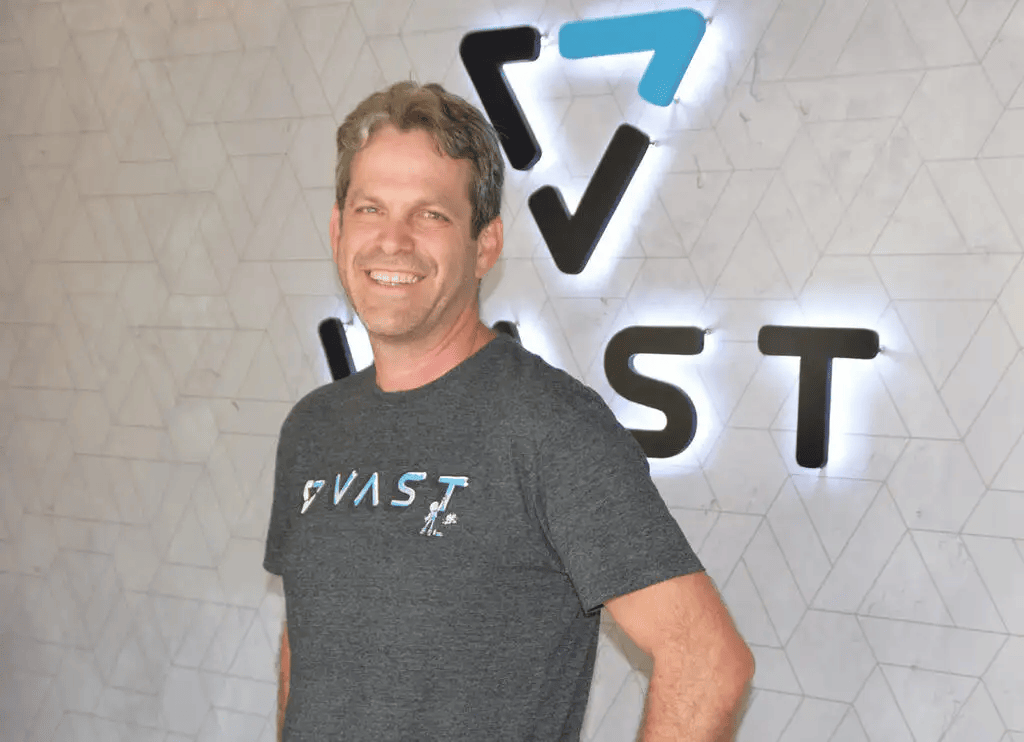
VAST became a unicorn in 2020 at a valuation of approximately $1.2 billion. By the end of 2023, it had reached a valuation of roughly $9.1 billion, and in April 2026, it completed a financing round of approximately $1 billion at a valuation of around $30 billion, making it one of the most valuable private technology companies in Israeli history.
In recent rounds, VAST Data – which employs roughly 1,200 people – conducted several secondary events totaling hundreds of millions of dollars.
"We treat every employee as a partner," Shachar Fienblit, co-founder and chief R&D officer at VAST Data, says. "The company has been extremely successful, and each year we doubled our valuation. We want employees to benefit from that success." According to Fienblit, the company does not need the money for operations. "We're a profitable company. We don't need capital for operations, but there are investors we want to bring into the company. It's a win-win situation."
He says the impact on employees' lives is very tangible. "It allows our employees to improve their quality of life. Some people can buy apartments. A young employee can pay off a mortgage." According to him, the move also reflects the company's organizational philosophy. "We believe all our employees are true partners. Everyone participates in the company's success, and therefore, everything we do is done equally."
In the past, startup employees often had to wait a decade or more before they could cash in their options. Now, the secondary market is creating a new path — one that allows employees to turn "paper wealth" into real money, even without the ringing of the bell on Wall Street.