The two terrorists riding a motorcycle a few weeks ago in southern Lebanon never saw it coming. As they sped along at about 100 kph (62 mph), with their helmets on and the engine roaring, they also could not hear the buzz of the drone blades closing in on them from behind.
Video footage of the incident shows the drone quickly catching up with the motorcycle, then maneuvering to hit it directly and explode. The two terrorists did not stand a chance.
Video: Terrorists eliminated while trying to flee on a motorcycle /// Video: IDF Spokesperson's Unit
I watched the video in the office of Lt. Col. O., commander of Yiftach, the IDF Development Unit, which is part of the Technological Brigade in the Technology and Logistics Directorate and operates under the guidance of the Ground Forces' Weapons Department.
That dry collection of names conceals a cunning and advanced military body, the IDF equivalent, if you will, of Q, the gadget genius from the James Bond films. From the unit's aging buildings at Tzrifin, a military effort has been underway for the past two and a half years that begins in the feverish, creative minds of engineers and ends with dead terrorists.
"That elimination on the motorcycle," said Lt. Col. A., an engineer himself, "is a great opening shot for our flagship project."
That flagship project is called "Atalef," Hebrew for "bat," Yiftach's family of attack drones developed here after Oct. 7 and since then turned into one of the central weapons of the war in Gaza and Lebanon. Case in point: Those who carried out the killing of the terrorists on the motorcycle in the western sector were not anonymous Mossad agents or covert fighters from an elite reconnaissance unit. They were reservists from Brigade 262, who are operating even now in southern Lebanon. That killing is just one example of thousands of drone strikes carried out by the IDF's maneuvering infantry brigades during the war, a capability that before Oct. 7 existed only in special units such as Sayeret Matkal, Shaldag and Maglan.
"In the past, we developed weapons mainly for special units," O. said. "Today, we think about the entire IDF. That is part of the way we have changed during the war."
"Change" is the key word. In recent weeks, we have become familiar with the lethal potential of Hezbollah's explosive drones, after the group began using fiber optic-based drones to bypass electronic jamming systems and strike the soft underbelly of IDF forces in Lebanon.
The IDF is feverishly searching for a solution to this problem, but everyone understands that this is only another stage in the battle of inventions that has been underway for two and a half years between the IDF and Hezbollah and Hamas over the drone issue. In this battle, the winner is the side that thinks faster, the side that knows how to learn and change before the enemy has time to respond.
A visit to the Yiftach Unit, as well as to the civilian company SpectralX, which develops camouflage solutions for the IDF and foreign militaries, provides a glimpse into the air-conditioned rooms where the real drone war is being waged: the war of minds.
Closing the gap
The Yiftach Unit was established in 1958 by David Laskov, an Israeli engineer and inventor who won the Israel Defense Prize three times. Laskov, who held the title of the world's oldest soldier, died a few months after his discharge from the IDF at the age of 85. He gathered around him a group of talented engineers who worked on military inventions, mainly in the field of rockets. Models of those rockets are still displayed at the Yiftach Unit's base, alongside Laskov's portrait on one of the walls.

"All in all, there isn't much difference," the unit's current commander, O., said with a smile as we walked through the unit. "In the 1950s they developed rockets, and today they develop drones. In the end, it's a bomb that knows how to fly."
The use of attack drones on the battlefield began gaining momentum, in every sense, in the Russia-Ukraine war. The Yiftach Unit did watch videos uploaded from there to the internet, "but only on Oct. 7 did we understand that there was no broad solution for the IDF in the world of attack drones," O. admitted. "And then we were called to the flag."
And so, only after the war began did Yiftach begin thinking about a solution that would allow the widespread use of attack drones, rather than boutique use as in the past.
To close the gap that had already opened up with the futuristic battlefield, it was necessary to move fast. The first stop was the development lab, located in a not especially impressive room not far from the commander's office. The person in charge here is T., an engineer by profession who began his regular service in the Yiftach Unit and is now a civilian IDF employee who commands the unit's development branch.
Like him, about half the unit's personnel are engineers. Alongside them are production workers, some of them volunteers on the autism spectrum, as well as ultra-Orthodox male and female soldiers working in software and electronics. It is a broad range of manpower.
There is a great dissonance between Yiftach's aging buildings and what takes place inside them. It is, in effect, a kind of technological hub, a startup company in olive drab, where new weapons are developed and produced for fighters at the front who need them at this very moment. "Our purpose is to carry out rapid force buildup and bring weapons to the operational edge," T., the branch head, explained the unit's work in his military language.
Here, in the development lab, the idea began to take flight of giving infantry battalions a strike capability that does not depend on assistance from the air force, a tank shell or artillery fire.
"If in the past a company commander had to request support from an attack helicopter, a Zik UAV or artillery, today he has an organic capability for an aerial strike using a drone," T. put it. "But beyond the independence it gives the force in the field, we understand that there is also a munitions economy, because ultimately the firing of shoulder-launched missiles and tank rounds costs a lot of money, and a cheap solution has to be brought in."
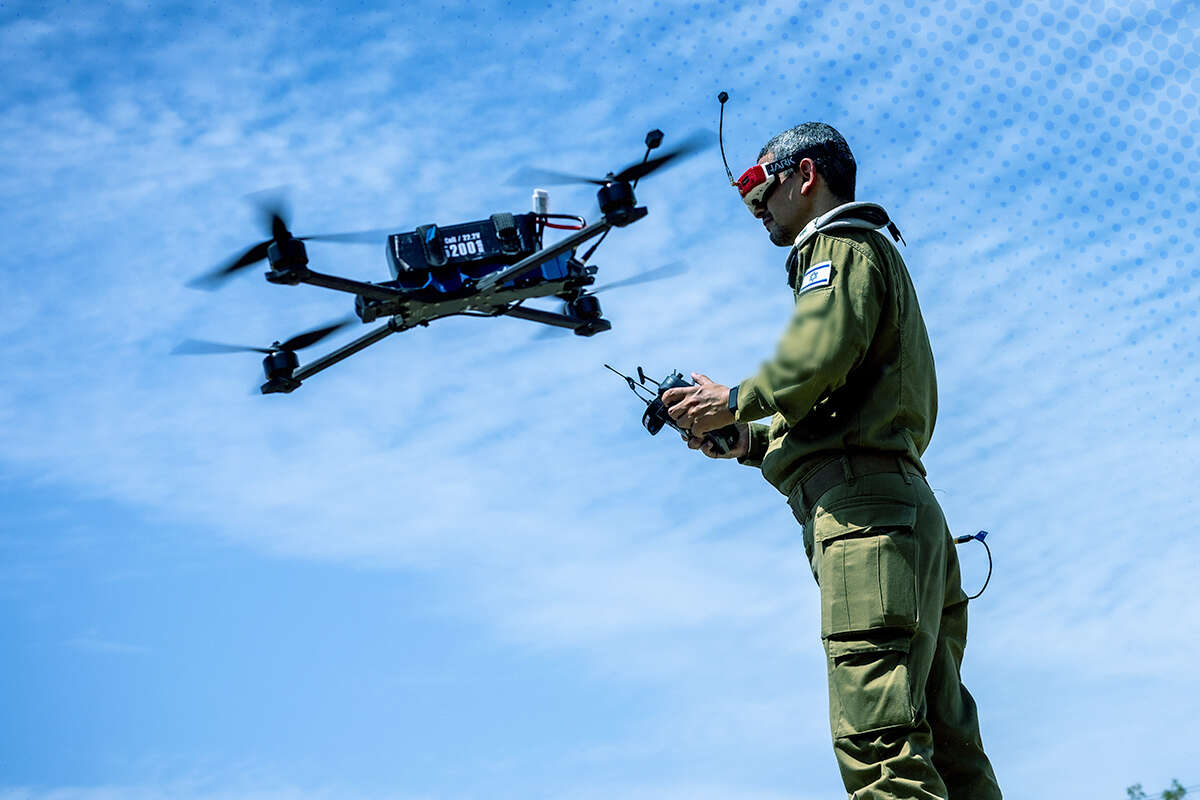
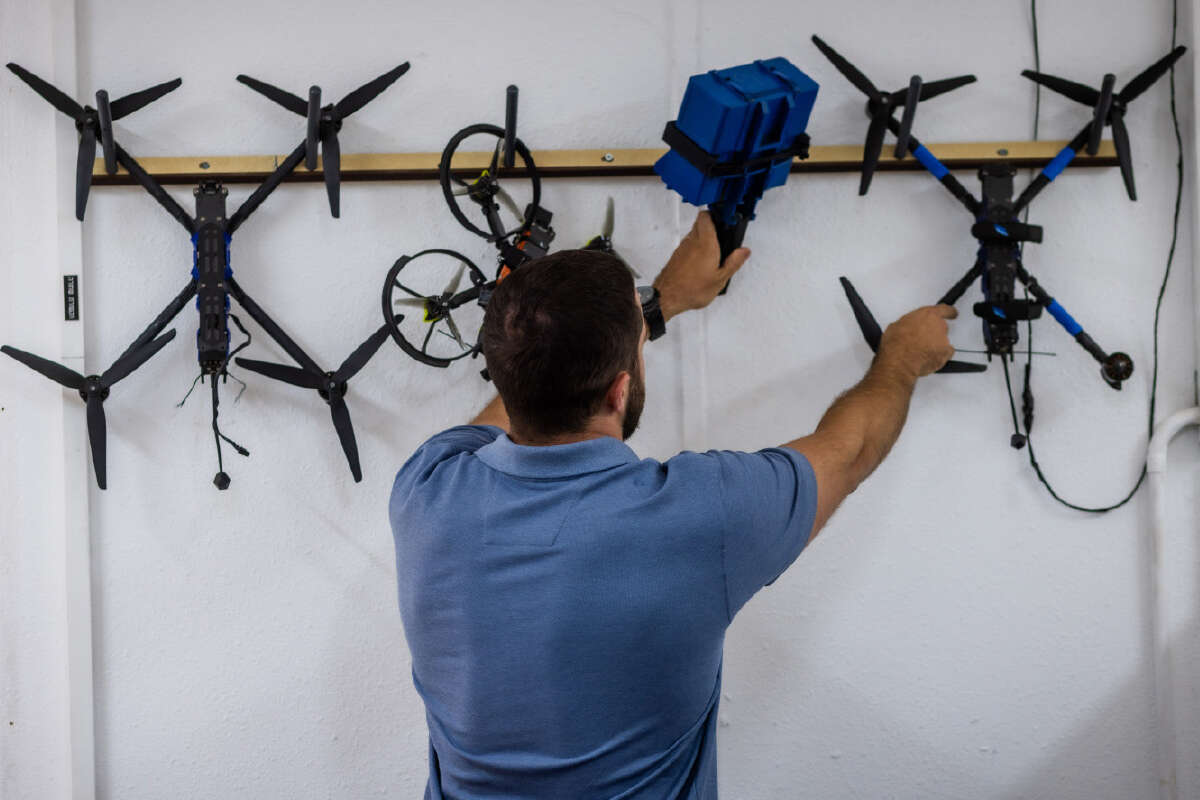
That solution is a relatively simple FPV drone, made up of a frame, four motors, a flight controller and a battery. It is a cheap, agile tool that weighs only 1 kilogram (2.2 pounds) but can carry a warhead several times heavier than itself. Beyond its light weight, it is also simple to operate, which makes it highly useful on the battlefield. In videos I watched in the office of the unit commander, A., he showed me how these Bats exploded inside houses in Gaza, on vehicles in Lebanon and more. "Today," he said, "any force going out to maneuver does not move before taking several Bats with it."
I asked the unit commander what he thought of his counterparts in Hezbollah, those who got ahead of the IDF with the fiber-based drones that are now wreaking havoc in southern Lebanon. "The difference between us and them is that we are bound by regulation and standards," he answered. "In the end, it is not a problem to go on AliExpress, buy a drone and attach a mortar bomb to it. If I don't have to meet certain standards, within an hour I can build you a suicide drone outside here. Hezbollah has no problem losing a terrorist or two in the development process. With us, it doesn't work that way."
From the fluorescent lights to the field
The first Atalef drones were designed at the Yiftach Unit and are now being mass produced by civilian companies specializing in drones. Soon the IDF will begin producing them itself, in a new drone factory set to open at the Maintenance and Rehabilitation Center, which is also located at Tzrifin. "That is what will bring thousands of drones to the IDF," A., the commander, said enthusiastically.
But the drones themselves are only the first stage in the Bat's development. Part of the sophistication lies in the ability to attach a warhead to the drone that will explode only when it hits the target. The unit commander now led me between the various production halls, 3D printers, machining equipment, a carpentry shop, a bomb disposal lab, where the advanced warheads were produced and attached to the drone.
At the edge of the unit, near the fence adjoining the fields, is the testing ground where things are blown up. It turns out that the explosives carried by the Bats are mostly recycled from old IDF munitions that had been slated for scrapping, or from spoils taken from the enemy. Another way to save money.
"I would also be happy for the enemy to know that ammunition I find with him ultimately kills him," O. said. It also emerged that during the Bat's development trials, more than 100 drones crashed and were taken out of service. That was a small price to pay.
Yiftach's ability to manage the entire development and production process within the unit itself is part of what enables it to move quickly on a changing battlefield.
"You plan something in the morning, and by evening you already have the part ready. I can even conduct explosives tests here," said T., the branch head. "After Oct. 7, we understood that what matters in development processes is speed. So what matters is the pace at which you can field a system."
"An engineer here thinks of an idea, implements it, and then can join a force in the field and see his invention hit the enemy. That is the best feeling an engineer can have," said S., a civilian IDF employee who also began his military service in Yiftach and now commands a production branch. "In many companies, the engineer designs a small part of a system. Here he is part of the entire process. With us, there are no small screws."
At the end of the tour of the unit, we arrived at a large hangar. We were not allowed to enter the hangar itself, but outside, on a table, the entire Atalef family through the generations had been laid out for us. There were large and small drones, with and without fiber optics, as well as cheap training drones that can be crashed without it being a problem. It is astonishing to think that none of this existed in the IDF before Oct. 7.
The person in charge here is Capt. Y., 25, a former team commander in Egoz who was wounded during the fighting in Khan Younis and found his place as Yiftach's operations officer. The fact that Y. is a combat soldier by profession is no coincidence: during the war, Yiftach established a branch made up almost entirely of fighters, who know the terrain and the operational needs better than anyone.
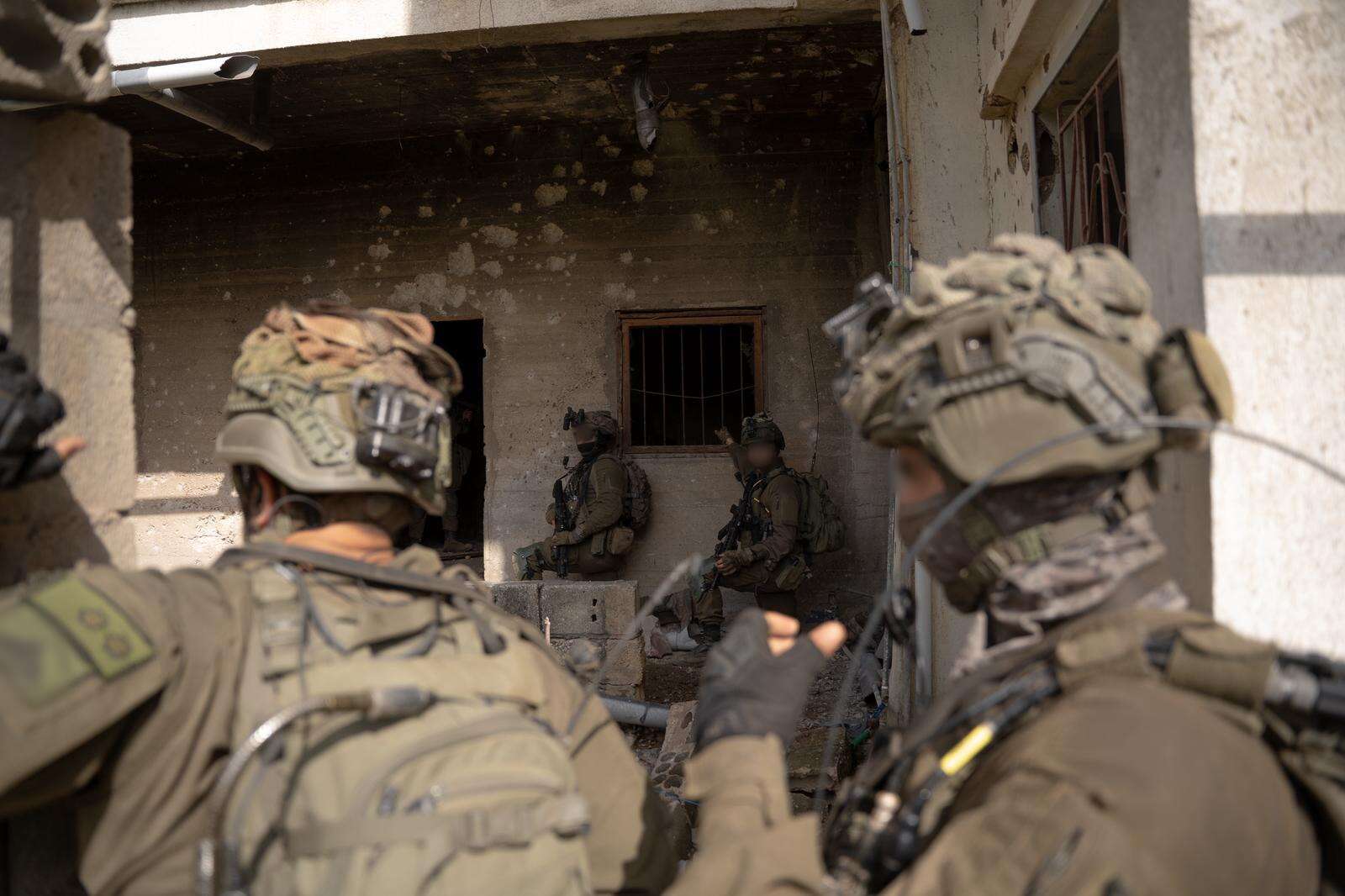
These fighters are both the initiators of the development processes and the ones who implement them at the operational edge. "We make sure to raise the demands from the field, what the fighters need," Y. said. "After that, we accompany the development process and then return to training fighters and teach them how to operate the Atalef in the field. Sometimes I join a force with a drone model that is not yet mature, just to rub up against reality and understand what needs to be improved. We take the technology out from under the fluorescent lights."
Seen and unseen
The fluorescent lights at the defense startup SpectralX are very different from those at the military Yiftach Unit. They are located in two new, spacious and gleaming buildings in Caesarea's polished industrial zone. "It didn't look like this at the beginning," said Asaf Picciotto, the company's CEO, with a smile.
Picciotto and his partner, Asaf Miller, who have known each other since their shared service in the Maglan Unit (full disclosure: this writer served in the unit at the same time), began their journey in the garage at Miller's parents' home. "The idea of setting up a company began with the Second Lebanon War," Picciotto said. "During the war, we were reservists, and afterward we sat in Tel Aviv, drank beer and held a debriefing. Not like a debriefing in the air force, but more like, 'Tell me how the war was for you.'"
The main insight from that "debriefing" was that Hezbollah had advanced detection capabilities that the IDF was not prepared to contend with. From there, it was a short road to establishing a company that would provide the military with advanced camouflage nets.
Later, the company began developing advanced camouflage solutions, also based on cutting-edge technology. "The military knows very well what it wants," said Miller, the company's chief technology officer, "but sometimes you have to tell the military what it needs. The civilian industry is ultimately made up of people who came out of the military, and they understand the needs."
Indeed, if Yiftach is the unit where the IDF develops for itself what it "wants," the civilian industry is sometimes the one that already knows in advance what it "needs." That is exactly the case with SpectralX and the drone field. "For many years, we have been seeing what is happening with drones in the Ukraine-Russia war," Picciotto said. "After all, this issue of suicide drones is on YouTube. You don't have to be a great expert to understand what is happening."
While the IDF focused on the offensive aspect of suicide drones, the company founded by Maglan veterans chose to deal with the defensive and less sexy side of the field. "The purpose of suicide drones is to explode, and so not a great deal of money is invested in them," Picciotto explained. "As a result, their cameras are pretty lousy, and they can be fooled. We understood that the first layer of defense against this tool is camouflage. If the drone does not identify you, it will not attack you."
The result is the Armadillo, a special camouflage kit for vehicles that, truth be told, looks rather ridiculous at first glance. But that is precisely the principle on which it works: the kit is fitted onto combat vehicles and fundamentally changes their silhouette using sophisticated camouflage sheets that open at the push of a button. In one second, the sleek military Humvee becomes a strange creature that the human eye struggles to define, certainly through a drone camera. "True, the Armadillo does not look cool," Miller admitted. "But that is ultimately what will help you camouflage yourself and avoid being hit. Sometimes, only during a war do you distinguish between what matters and what does not."
In the Armadillo's case, too, the IDF first used the new technology in boutique fashion. "Before the war, we had a baptism by fire in an operation by a special unit that operated with vehicles in a distant theater," revealed Amir Haimovich, the company's vice president of marketing and himself a Maglan veteran. "As part of their combat procedure, they came to us, and we tailored a 'suit' for their vehicles. It was a success for everyone, and it provided validation that the product was good. Later, during the war, the Technological and Logistics Directorate approached us, this time to acquire such camouflage sheets on a broader scale." Despite this, and despite the growing number of explosive drone strikes on vehicles in southern Lebanon, only a handful of kits have been purchased by the IDF to date.
SpectralX has a range of other camouflage systems, some of them astonishingly futuristic and still barred from publication. It is amazing to see how what began as a sewing workshop in a garage became a security startup developing technologies capable of making, quite literally, a huge truck vanish from Hezbollah's observation systems. With my own eyes, I saw, or rather did not see, how it happens.
Protecting the protector
Another world in which SpectralX's camouflage solutions have found expression during the war is the very important, and quite neglected in Israel, field of protecting air defense systems, known in Hebrew military jargon as "defense of air defense." Already at the start of the war, Hezbollah attacked all the sensors Israel had placed along the Lebanon border with precision missiles, which were intended for early detection of aerial threats. "Some of the observation systems, the surveillance cameras used by the female lookouts and the sensors of Unit 8200 were hit," Haimovich said. "Northern Command went blind. They lost contact with the enemy. And why? Because they simply were not camouflaged."
Hezbollah exploited that blindness to create entry routes into Israeli territory, through which it sent UAVs and later drones to carry out attacks deep in the rear.
One of those UAVs managed to strike the dining hall at the Golani Brigade's training base, killing four soldiers and wounding about 60. This time as well, only after the war broke out did the IDF understand that it had to camouflage its detection systems along the border, in order to prevent Hezbollah from denying them. "Before the war, we had an idea, but during the war the 'customer' understood what he needed only after he took a hit," as Picciotto put it.
During the fighting along the northern border, SpectralX personnel descended on the IDF detection systems deployed along the border and camouflaged them in creative and inexpensive ways. "The advantage here is not only operational, but also economic," Haimovich said. "Each such system is worth millions of dollars, and now we are managing to protect them."
What do you think of your counterparts in Hezbollah? Of their development people?
"Unlike us, they are cunning. One of the things that has atrophied in the IDF over the years is the ability to incorporate deception into every action. That kind of thinking almost does not exist in the military today. We work in a very orderly way, and we have lost that Palmach gene. There are commanders who have it, but it almost does not exist in a systemic way in the maneuvering force. I hope that after the war this will return, because when you want to survive in the field, if you do not think cunningly, it will not work. I'll give you an example: both Hezbollah and the Iranians never move weapons in the open. They will always be covered or concealed inside a vegetable truck and so on. They have it in the DNA of every mission. The IDF is not there right now."