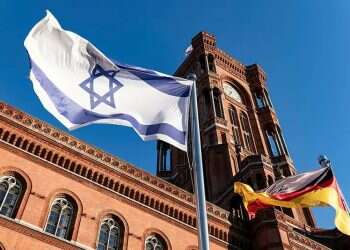
The European Commission will submit a legal document to the European Union's Foreign Affairs Council next week examining the possibility of imposing trade restrictions on products made in Judea and Samaria, a Commission spokesperson confirmed to Israel Hayom. This is a significant step in the process of approving sanctions that could have a devastating effect on exports to the European Union, Israel's largest trading partner.
If the proposal is approved, it would hurt not only businesses operating in Judea and Samaria, but also every Israeli business, because of the bureaucracy that would be involved in imports from Israel.
In recent months, several EU countries, including Ireland, Belgium, Sweden, Spain, France and the Netherlands, have been pressing for stronger measures against Israel. Initially, those countries demanded the suspension of parts of the association agreement between Israel and the European Union, which regulates trade relations, economic benefits and cooperation in research, science and education.
After they failed to build a majority for that step, the focus shifted to other initiatives, including personal sanctions against National Security Minister Itamar Ben Gvir and Finance Minister Bezalel Smotrich. Such a move requires unanimous agreement by all 27 EU member states, and due to opposition from the Czech Republic, Germany, Bulgaria and Hungary, unanimity has not been achieved so far.

At this stage, those countries are trying to advance measures against trade with communities in Judea and Samaria. Among the options being examined are raising tariffs on products originating in Judea and Samaria and even broader restrictions on their import into the European Union. However, Brussels has not yet determined whether such measures are legally possible, and whether they can be approved by a qualified majority of at least 15 countries representing two-thirds of the EU population, or whether they require the unanimous agreement of all 27 member states.
The issue has also become a point of dispute between European Commission President Ursula von der Leyen and the EU's foreign policy chief, Kaja Kallas. Kallas claimed that the Commission was delaying submission of the legal opinion, while von der Leyen hinted that it was actually the member states that were holding up the decision-making process.
Jerusalem is closely monitoring the content of the document that will be presented next Monday. Even if an immediate vote is legally possible, it is customary in the EU Council to first hold discussions among the member states. Israel therefore hopes that friendly countries will ask to postpone any decision until after the summer recess. After that, given the proximity to Israel's election, Jerusalem will hope the matter is delayed until after the formation of the next government.
Waiting for the election
Brussels is also following Israel's election campaign. One of the factors that has delayed the advancement of personal sanctions so far is concern about interfering in the election. The Czech foreign minister previously explained that he did not want to "strengthen Ben Gvir in the election," and therefore opposed imposing sanctions at this stage. However, the assessment in Brussels is that if Ben Gvir and Smotrich continue to serve in the government after the election, pressure to advance measures against them, and even additional measures against Israel, will grow.
The chair of the European Parliament's delegation for relations with Israel, Hildegard Bentele, recently warned in a conversation with Israel Hayom that certain statements by senior Israeli officials, some of them against the backdrop of Israel's election, make things harder for Israel's friends in Europe.
"Israel has many strong arguments in Europe. Its security concerns, the threat from Hamas, Hezbollah and Iran, and the trauma of Oct. 7 are real. But every unnecessary provocation makes it harder for us to present Israel's position credibly and convincingly," she said.
According to Bentele, statements by Ben Gvir and Smotrich, such as the video humiliating detainees from the flotilla or the assertion that "the Oslo Accords have been canceled," are being used by Israel's critics in Brussels and European capitals to promote sanctions and boycotts. She added that the debate over a boycott of products from Judea and Samaria is not merely theoretical.
"Ben Gvir and Smotrich need to understand that their words and actions do not remain within the boundaries of Israeli politics. They are immediately used in Brussels, Berlin and other European capitals by those seeking to promote sanctions and boycotts. Ministers who provide Israel's critics with exactly the images and statements they are waiting for weaken its friends and its standing in the international arena.
"The debate over the settlements, product labeling and the possibility of imposing restrictions is not theoretical. It could directly harm Israeli farmers, exporters and business owners, first and foremost the fruit and vegetable sector. Irresponsible rhetoric around Judea and Samaria and incitement to violence do not only cause diplomatic damage, but also real economic damage to ordinary Israeli citizens."