
Gemini, Google's artificial intelligence model, has recently become slower, more defiant and less consistent, according to a growing number of users, including Israelis.
In recent days, social media platforms ranging from Reddit to X, formerly Twitter, have been flooded with an unprecedented wave of complaints. The reports portray a significant deterioration in the model's performance and have raised difficult questions about what may be behind the apparent changes.
"It freezes, stutters and forgets the conversation"
According to users, the problems are not isolated and affect multiple platforms and models. Among the most common complaints are endless processing loops, in which the model remains stuck on "Thinking..." for extended periods, and conversations that abruptly crash with server errors.
Israeli users have reported problems specific to Hebrew, including Gemini suddenly switching to Arabic in the middle of a response, producing broken text aligned from left to right and ignoring even the simplest instructions. Paying subscribers have expressed deep frustration, saying the frequency with which the model fails to follow basic directions has reached unprecedented levels.
"Who at Google is being paid hundreds of thousands of dollars a year for this crap? Gemini has become a useless model," one X user wrote. "It fails to follow simple instructions more than 75% of the time. Anyone paying Google for this model is throwing their money away. Literally." Another user wrote: "It's like a child who makes mistakes and, when caught, has no idea what you're talking about."
Reddit users also vented their anger over repeated failures. "What happened to the memory? Where did it go?" one user wrote. "The model literally answered me: 'You are completely right, and I apologize for the massive logical failure. I completely ruined the timeline. You said the sun was still shining, meaning it was evening, and evening comes before nightfall, or sunset. My logic was completely reversed. It makes no chronological sense.' How can a model fail to understand context from just four prompts earlier?"
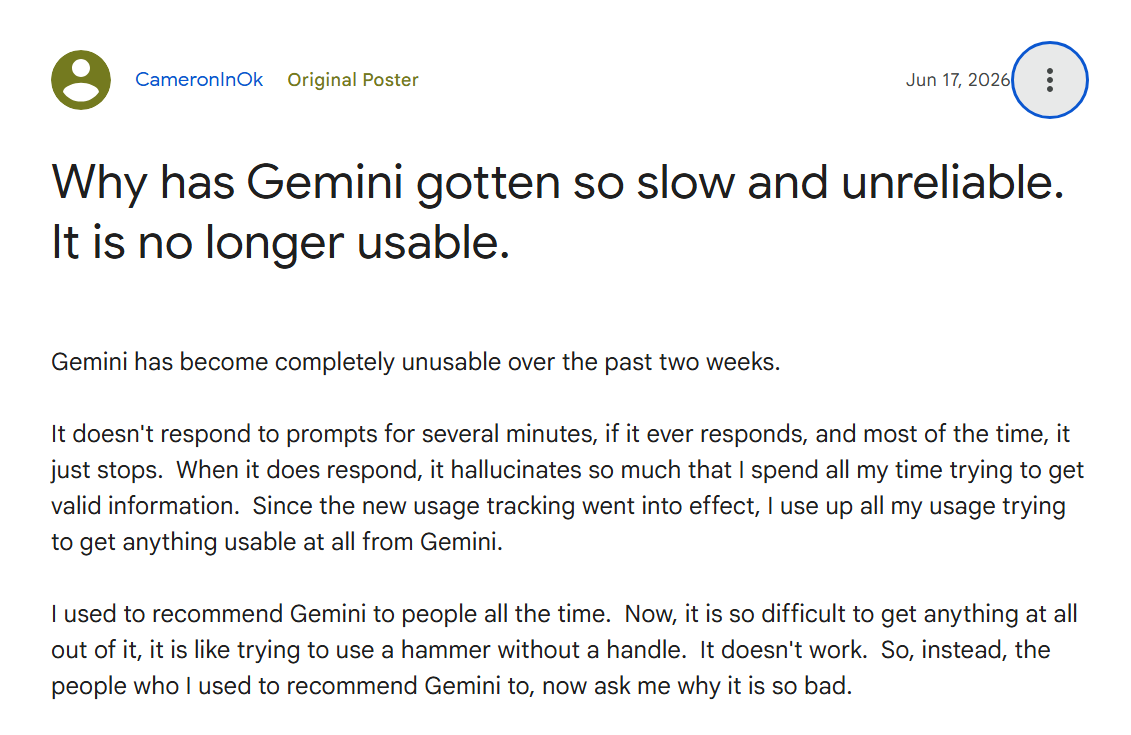
Developers and other heavy users have focused chiefly on what they describe as a decline in Gemini's core capabilities. According to their reports, the model struggles to follow the context of even short conversations, makes elementary logical errors and forgets information supplied only a few prompts earlier.
Users have also reported a noticeable deterioration in Gemini's ability to analyze code and screenshots. Some said customized Gems displayed erroneous messages claiming that source files had not been uploaded, even when the files were present.
Others said Google appeared to have tightened its safety systems and usage quotas unusually sharply, causing responses to stop in mid-sentence or automatically routing requests to smaller, less advanced models.
Deliberate downgrade or cost-cutting?
The sudden decline in response quality has fueled widespread speculation within the user community. Some users have questioned whether Google is deliberately lowering the performance of the existing model to establish a lower baseline, making the next model's release appear to be a far more dramatic technological leap.
"Could it be that before releasing a new model, they dumb down the existing one to set a lower bar for its successor and give users a stronger sense of a major technological advance?" users asked on social media. "There is no other way to explain how reasonably capable models suddenly become stupid and defiant."
Other experienced users and analysts believe the explanation is more likely to involve costs and computing resources. Gemini serves hundreds of millions of active users each month, and handling such enormous demand requires extremely expensive computing capacity.
According to this theory, Google is attempting to reduce the amount of reasoning effort allocated to each individual request. Some users who say they have examined the model's reasoning output claim that Google reduced its effort values from 1.0 to 0.5 and also made the reasoning process less transparent to conceal the changes. These claims have not been independently confirmed.
Leadership earthquake at Google DeepMind
The controversy over Gemini's performance comes as Google carries out sweeping changes at the top of Google DeepMind.
Demis Hassabis is stepping back from the company's day-to-day management and will serve as chair of Google DeepMind and chief scientist of Alphabet. Koray Kavukcuoglu, Google DeepMind's senior vice president and Google's chief AI architect, is taking responsibility for the unit's daily operations and the intense pressure surrounding the development and release of Gemini models. Other senior figures, including Google veterans Jeff Dean and Sanjay Ghemawat, are leaving to establish Discovery Loop, a new research company. Alphabet is expected to remain involved as a founding investor and cloud-computing partner.
The structural changes reflect Google's division of its artificial intelligence work into two broad tracks: one focused on artificial general intelligence and long-term scientific research, and another centered on products and delivering performance at enormous scale. Development of Gemini 4 is reportedly already underway. Meanwhile, more advanced intermediate versions are also emerging, including models in the Gemini 3.5 series.
As of publication, Google had not responded to the allegations that Gemini's performance had deteriorated or that the company had deliberately reduced the model's capabilities. Its response will be added when received. The reports in this article are based on user testimony, analyses and personal experiences posted on social media and professional forums.