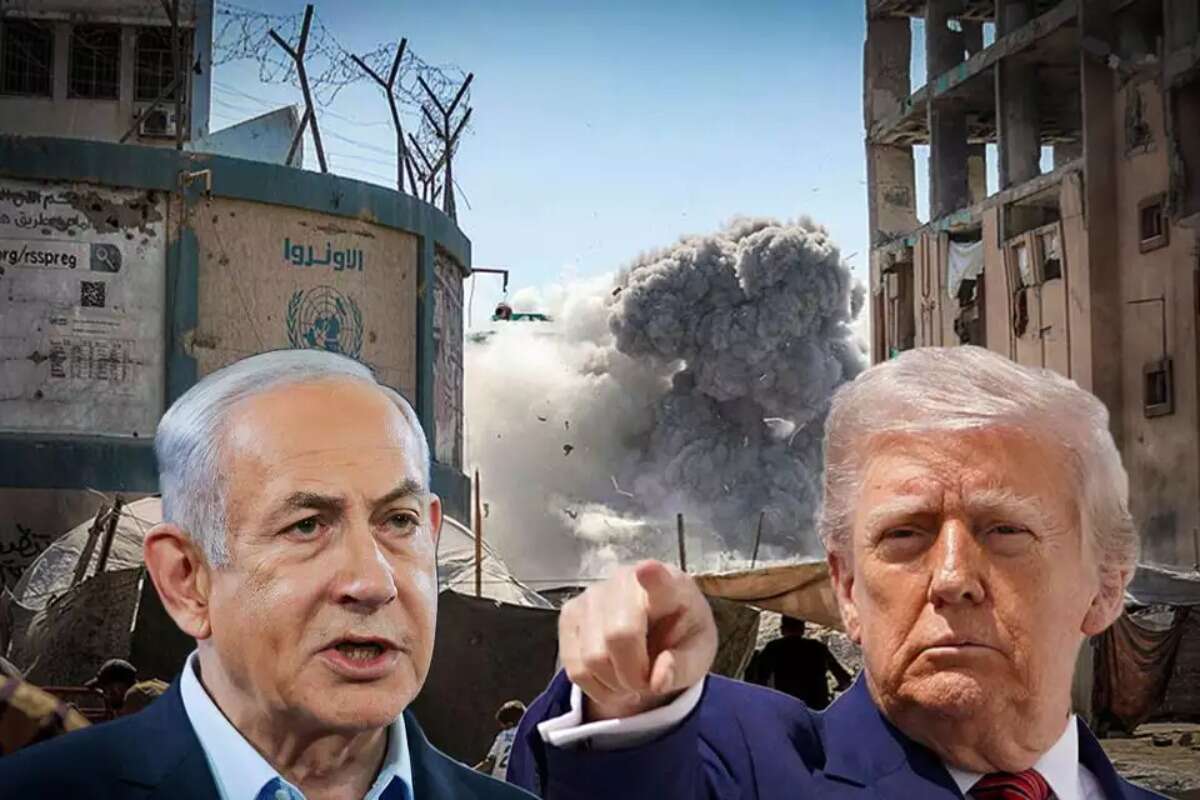
EXCLUSIVE: Israeli diplomatic officials have acknowledged for the first time that Jerusalem and Washington are at odds over the 15-point document concerning an Israeli withdrawal from Gaza and the disarmament of Hamas, telling Israel Hayom: "If there is no other choice, we will end up clashing with the Trump administration over Gaza."
Officials in Jerusalem say, however, that the person pushing for agreements along the lines promoted by the Board of Peace is President Donald Trump's son-in-law Jared Kushner, while Trump himself has so far not exerted direct pressure on Israel over the issue. The key word in this delicate relationship is "so far," since the US administration appears eager to secure achievements in the Middle East.
Prime Minister Benjamin Netanyahu addressed the document publicly for the first time Sunday, formally announcing that he rejected it. Those close to him added: "We will not enter this process. We have not halted operations in Gaza. This is wishful thinking."
'Israel rejects the 15-point document'
Netanyahu's formal response to the Board of Peace document marks the first time Israel has publicly and officially expressed its opposition to the agreement, which Hamas views as a strategic asset and achievement.
"Israel rejects the 15-point document. I heard people saying, 'You didn't say that.' So I'll say it again: Israel rejects the 15-point document. The IDF will not carry out any withdrawal until Hamas is disarmed. And when I say Hamas must be disarmed, I mean the heavy weapons, the lighter weapons, all the weapons. We are talking about real disarmament, not sham disarmament."
Netanyahu also addressed the possibility of a confrontation with Trump over the issue and did not rule it out. "We are now talking to the Americans about this," he said. "They have ideas. Some of them are acceptable to us and some are not, and we know how to stand our ground on these issues. We have proven that in the past, and we are proving it today as well."
"In addition, the IDF will continue to thwart threats against our forces and our citizens. Israel's existence and the security of every Israeli citizen are not up for negotiation. We stand firm on these interests. We don't do this through PR campaigns. We do it for real, on the ground. And we can and know how to stand our ground even with our closest friends when necessary."
14 violations in 24 hours
To support Israel's objections to implementing the agreement, Israel Hayom revealed that the Prime Minister's Office sends the US administration a daily report documenting violations, based on IDF monitoring of Hamas movements in the Gaza Strip. The IDF records recurring violations every 24 hours, including the planting of explosive devices, crossings of the Yellow Line and efforts to build up weapons.
According to the report, obtained by Israel Hayom, Hamas is systematically and continuously violating Trump's 20-point peace plan, which was endorsed by UN Security Council Resolution 2803 (2025).
In the report, during the 24 hours between Aug. 8 and Aug. 9, the IDF documented no fewer than 14 ceasefire violations, 11 of which were classified as a "developing threat to IDF forces." Two incidents involving the transfer of weapons were also documented, as was one incident in which an explosive device was planted near the Yellow Line. The document lists a total of 95 unclassified violations.

Among the incidents cited was one in Beit Lahia in which three suspects who crossed the Yellow Line were seen transferring weapons. In Khan Younis, two suspects were documented crossing the Yellow Line toward IDF forces, while in Deir al-Balah, a suspect was seen crossing the Yellow Line and digging in the ground.
In another incident in Khan Younis, two suspects crossed the Yellow Line, after which the IDF discovered a nearby weapons cache. At another time during the day, IDF troops identified a recently planted explosive device in the Green Area near the Yellow Line.
According to the picture presented in the document, the IDF's monitoring mechanism indicates that Hamas continues to retain military capabilities and is working to preserve them during the ceasefire declared a week ago. These efforts include maintaining possession of weapons and smuggling them, rehabilitating military infrastructure, recruitment and training, armed activity, intelligence gathering and preparing explosive devices.
On a daily level, the report documents 14 incidents within a single 24-hour period, the overwhelming majority of which were classified as developing threats to IDF forces.