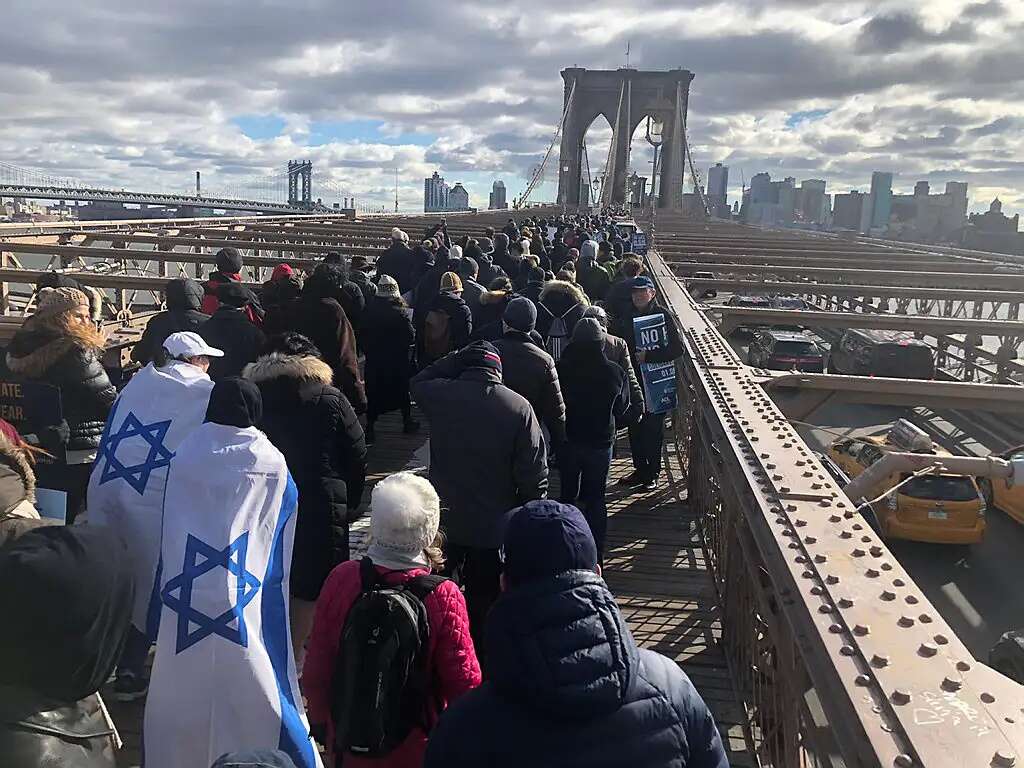
The US Justice Department has given unprecedented federal recognition to the family of Ari Halberstam, a Chabad-Lubavitch teenager murdered in the 1994 Brooklyn Bridge shooting. In a formal letter, then-US Attorney Jay Clayton said that if the attack occurred today, federal authorities would investigate it as a civil rights violation and seek to prosecute the terrorist for a federal hate crime.
"There is no question that if the murder of your son, Ari Halberstam, had occurred today, we would investigate it and seek to prosecute it as a federal hate crime," Clayton wrote in a July 23 letter to Ari's mother, Devorah Halberstam. Clayton, who was then US attorney for the Southern District of New York and has since become director of national intelligence, added that the same approach would apply to the attempted murders of the 14 other young men traveling with Ari.
The attack took place on March 1, 1994. A van carrying 15 Chabad-Lubavitch yeshiva students was traveling from Manhattan to Crown Heights after the students visited the Lubavitcher Rebbe, Rabbi Menachem Mendel Schneerson, in the hospital. As the van crossed the Brooklyn Bridge, Rashid Baz, a Lebanese-born livery driver, opened fire. Three young men were wounded, and Ari, 16, was critically wounded and died five days later.

In a videotaped confession taken after the attack, Baz linked the shooting to Baruch Goldstein's massacre of Muslim worshippers at the Cave of the Patriarchs four days earlier and admitted that he had acted in retaliation for the massacre. In another confession to investigators in 2007, years after his conviction, Baz said he had followed the van and chosen to attack its passengers because they were Jewish. Asked whether he would have fired on a vehicle carrying Black or Hispanic passengers, he replied, "No, I only shot them because they were Jewish." Baz died in prison in 2023.
Despite Baz's statements, authorities initially described the shooting as a case of "road rage." He was prosecuted in New York state court for murder, 14 counts of attempted murder and a weapons offense, charges that did not require prosecutors to establish an antisemitic motive. Baz was convicted and sentenced to 141 years in prison. Only after a campaign waged by Devorah Halberstam for more than six years did the Justice Department and FBI classify the attack as an act of terrorism in 2000.
The attack, however, was never investigated as a federal hate crime and civil rights case. Federal civil rights protections against bias-motivated violence did exist at the time, although they were substantially narrower than today's law. Congress enacted the first federal hate crime statute in 1968, making it a crime to use force against someone because of race, color, religion or national origin when that violence also interfered with specified federally protected activities.
Rabbi Yossi Spalter, one of the survivors of the attack, told CBS News New York on Monday that there had been no doubt in his mind from the outset about the motive. "We all knew that we were attacked for the simple reason that we were Jews and the simple reason that we were singled out because of our yarmulkes and our hats," Spalter said. For decades, he added, survivors were left asking, "Why deny us our civil rights?" The belated recognition, he said, provides "that little confidence to show we're not going to push what happened to you under the rug."
In 2009, Congress expanded the federal government's authority to prosecute hate crimes, removing certain jurisdictional barriers. The new law did not mark the first time federal law had addressed religiously motivated violence, but it significantly broadened prosecutors' ability to pursue such cases without having to connect an attack to one of the specific federally protected activities required under the older statute.
In remarks in June, Clayton said Baz's state murder conviction did not by itself fully account for the "heinous conduct." "I want to be direct about this: if that attack occurred today, with the tools and the legal framework we now have, we would investigate it as a federal hate crime," Clayton said. "Ari Halberstam deserved the full weight of the law, and so does every victim who comes after him."
The letter does not, however, announce the opening of a new investigation. Clayton acknowledged that the passage of time and Baz's death present significant obstacles, and that the US Attorney's Office is not currently aware of further investigative steps that could lead to federal charges. At the same time, he directed the office's civil rights and national security units to preserve the facts of the case and remain prepared to act if new evidence emerges. "We are committed to remaining vigilant in our pursuit of justice," Clayton wrote.
Devorah Halberstam said the letter demonstrated that the government had not abandoned the victims of the attack. "With hatred on the rise nationally and internationally, I am deeply concerned about the safety of Jewish New Yorkers," she said. "I will continue to fight to ensure that no other mother has to bury her child because of hatred, as I did."
New York City Mayor Zohran Mamdani welcomed the recognition, despite facing criticism from some Jewish leaders and Israeli officials over his record on antisemitism and his sharply critical positions on Israel. "I am pleased that Ari Halberstam's murder is being recognized as the vile act of antisemitism that it was," Mamdani said. "This recognition is long overdue and is a testament to Devorah's extraordinary determination over more than three decades of advocacy."