A source in western Syria warned in a recent interview with Israel Hayom that Turkey's footprint in the region has grown significantly more pronounced. Turkish influence, the source noted, has become particularly visible in the areas surrounding the al-Qadmus mountains and the strategic port cities of Latakia (a coastal city in western Syria) and Tartus.
"Officials representing Turkish intelligence and the Turkish military are playing in Syria as if it were their private playground," the Syrian source revealed. "This manifests in Turkish vehicles – some of which are armored – that soldiers are using to move around the roads."
The source further disclosed that Syrian agents have been brokering real estate deals in western Syria on behalf of Turkish businessmen, with purchases concentrated heavily in the residential districts of Latakia and Tartus. Beyond the economic influx, the source testified that murders and kidnappings targeting Syrian minorities have continued, though they have dwindled to isolated incidents compared to the widespread violence of the past.

The dire economic reality, however, has remained the primary concern for ordinary Syrians. "All classes are suffering," the source emphasized. "There is no security and there are economic hardships. We are heading into the unknown. No one knows where the fools who seized power are taking us. We ask Allah to have mercy and forgive us."
Signs of this expansion emerged immediately following the collapse of the Assad regime over a year ago. At the time, the newspaper Al-Yaum reported that Turkish troops had entered the Al-Kamiliyah area in western Syria's Latakia province, bringing engineering equipment to establish a military outpost. By March of that year, the Asharq Al-Awsat newspaper (a pan-Arab newspaper) reported that Turkish military reinforcements had deployed in the Aleppo province amid soaring tensions with Kurdish forces.
Turkey-Syria military cooperation
A year and a half later, the presence has only deepened. Footage broadcast in July 2026 by the Qatari network Al-Araby revealed a convoy of Turkish military trucks and armored vehicles advancing toward Deir ez-Zor (a city in eastern Syria). Simultaneously, the Syrian Observatory for Human Rights reported that the Turkish military has maintained a firm grip on its positions and outposts in the border city of Ras al-Ayn (a town in northeastern Syria).
Video: Prime Minister's Office spokesman on Turkey's control of Syrian territory / Credit:X/PMO
According to the observatory, Turkish forces have not abandoned a single outpost. Instead, they have actively fortified their footprint, surrounding bases with concrete blast walls, defensive trenches, and earthen berms, while continuing to rely heavily on allied local militias.
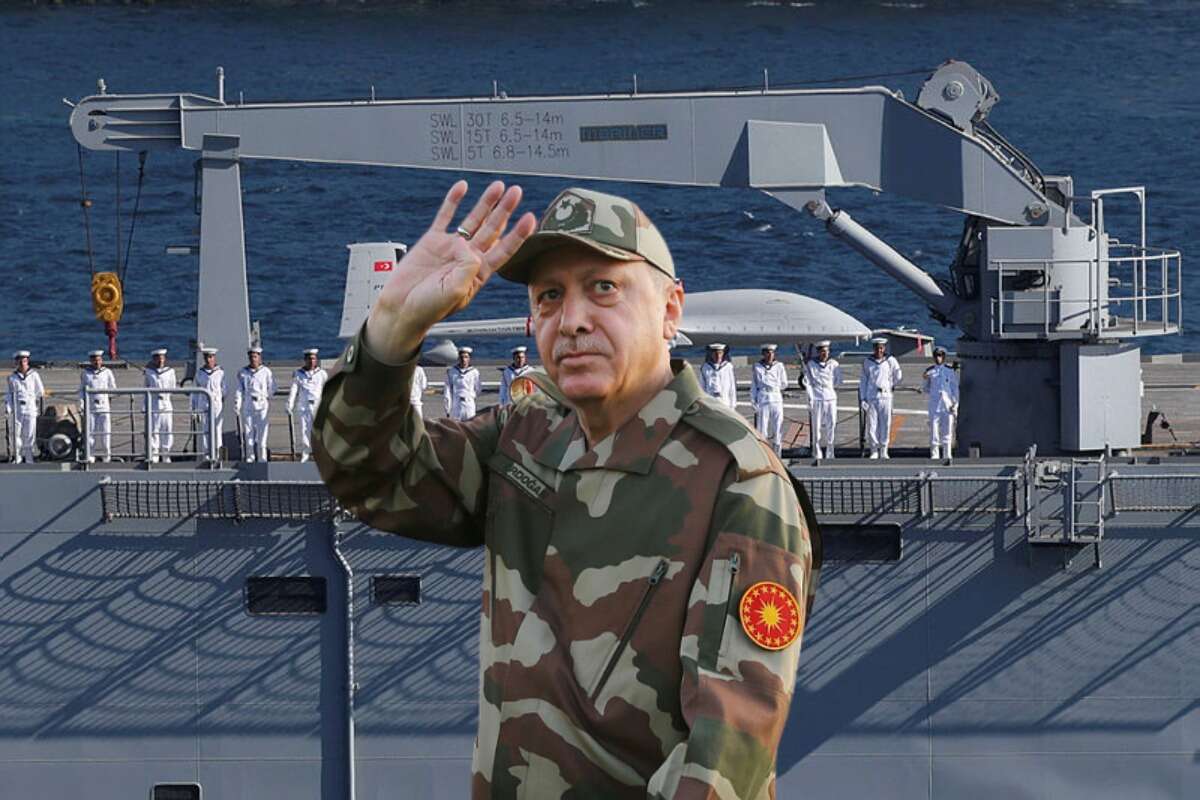
The military coordination has extended to the naval arena as well. Turkish National Defense Ministry Spokesman Zeki Aktürk announced on July 16 that Turkish Naval Forces commander, Ercüment Tatlıoğlu, had visited Latakia alongside a flotilla of warships. The spokesman framed the visit as an effort "to strengthen military cooperation between Turkey and Syria," and support "the reorganization efforts of the Syrian armed forces."
The visit marked a watershed moment, representing the first time Turkish naval vessels had docked at the port of Latakia in more than 15 years. During the deployment, the Turkish Navy commander held high-level meetings with his Syrian counterpart and conducted thorough inspections of Latakia's military port facilities.
Filling a void
Israeli intelligence assesses that President Ahmed al-Sharaa's administration intends to reconstitute its naval capabilities, though it remains unclear whether Damascus plans to build an expanded coast guard or a fully operational navy equipped with missile boats. The Israeli Navy systematically destroyed the bulk of the Syrian fleet under the Assad regime in December 2024 to prevent strategic weapons from falling into the hands of radical factions within the ascendant Islamist coalition. Now, Israel fears Turkey could step in to fill that void and rebuild Syria's maritime strength.
These concerns were amplified over the past weekend when the Saudi magazine Al Majalla reported on a series of critical talks between Mossad Chief Roman Gofman and Syrian Foreign Minister Asaad al-Shaibani. The report revealed a plan to deploy advanced Turkish-made combat drones at the Abu al-Duhur airbase, ostensibly to "act against ISIS."
Israeli officials reportedly issued a stark warning that they view the drone deployment as a direct threat and would strike to prevent the establishment of a forward operating base. True to that warning, an apparent strike was executed last week. The Syrian foreign minister, for his part, stressed in his statements that the door to negotiations with Israel has remained open.