At five in the morning, while the study hall in Eli sat empty, an 18-year-old from Netanya sat there alone for half an hour. Until two months ago, he had been a judo athlete from age four to age eighteen, a bronze medalist at the European championships. He was also, in his own words, "completely secular."
"It's as if yesterday was the first day I ever opened a Gemara," Yishai Nakash said. "I don't understand anything about it." He was studying the Mishnah in tractate Bava Kamma. "Believe me, it's very interesting. A whole new world has opened up for me."
The decision to leave judo and give up his status as an elite athlete had been brewing for six months. "I had a conversation with my coach. He asked me, 'You're at a crossroads. Where do you want to go? Stay in judo or go to the army?' I told him, 'Coach, I've been with you since I was four.'" Then, he said, something changed. "If I went back, I'd give him a different answer." He hasn't lost his love for the sport, he stressed, only the drive. What he took from there, he brings here. "All in or nothing, a hundred percent. If I do something, I do it 100%. That's the mentality I got from judo."
The academy's head, Rabbi Yair Glustein, describes this moment in terms that go beyond administration. "In the end, you get 270 souls arriving here. It's a moving event, truly. Each one is a new world. How will the Torah settle into him? What personal process will he go through? And how will I help him develop?" He said that this past Saturday night, he went to sleep at three, tossed and turned in bed until six, and got up at nine. "I don't have sleep problems. Ever. Not on the battlefield, not the night before I go into a maneuver."

"This is my home now"
They arrive here through at least three different paths. Eitan Mendel, also a first-year student, is a second-generation attendee. "My father studied at the academy. Class of 1995, thirty-one years ago," he said, adding that his father "is insanely jealous of me." He frames what won him over as a paradox: "Even though this is a huge place, they manage to focus on every single student, and nobody gets lost." Yehuda Greenwald, by contrast, arrived alone from New York and Miami, finished high school early, and moved to Israel. "I wanted to enlist my whole life," he said in halting but determined Hebrew.
The third may not be able to go home at all. He came from South Africa, asked not to be photographed and not to be named, out of fear that if word got out that he served in the IDF, he would be arrested upon landing in his country. His mother is Israeli, his father is South African, and his sister remained there. "Enlisting was simply obvious to me," he said. "I come from a very Zionist home, and I told my father from a young age that I wanted to join the army."
"It's hard," he said about leaving his hometown, "but if you make a decision like that, you have to do it. You're doing something you believe in. I don't think you should focus so much on the fact that it's hard. You just do it. You just go for it." Does he plan to go back home after his service? "No, this is my home now."
The three enrolled this week, along with 613 new students at Bnei David institutions, will educate 1,318 students this year. The Eli academy has 265 students, 146 of whom are in their first year. Alongside it operate an advanced yeshiva in Eli, a track for army veterans, pre-military academies in Ma'ale Efraim, Bnei Re'em and Zarahia, the Danieli women's midrasha, Ba'ara Shel Miriam, and advanced yeshivas in Hebron, Tel Aviv and Ganim, a branch that just opened. Since its founding, the institution has produced more than 6,000 graduates. 33 of them died in the Iron Swords War, and 60 since the academy was established.
Q: How do you educate a young man for combat service with that death toll in mind?
"The word 'sacrifice' isn't really a word that's used here," Rabbi Ofir Shukron, a rabbi and instructor at the school now in his fourth year, said. "We talk about what the Torah itself commanded us, what god demands of us at this time. Like with anything in life, there's no insurance policy on anything. But you don't avoid driving somewhere you need to reach just because there are dangers on the road. We deal with life, we deal with how to build life personally, generally, and nationally. Part of that is also confronting the reality of death, which is very hard, but that's not where our focus lies. We're busy with life."
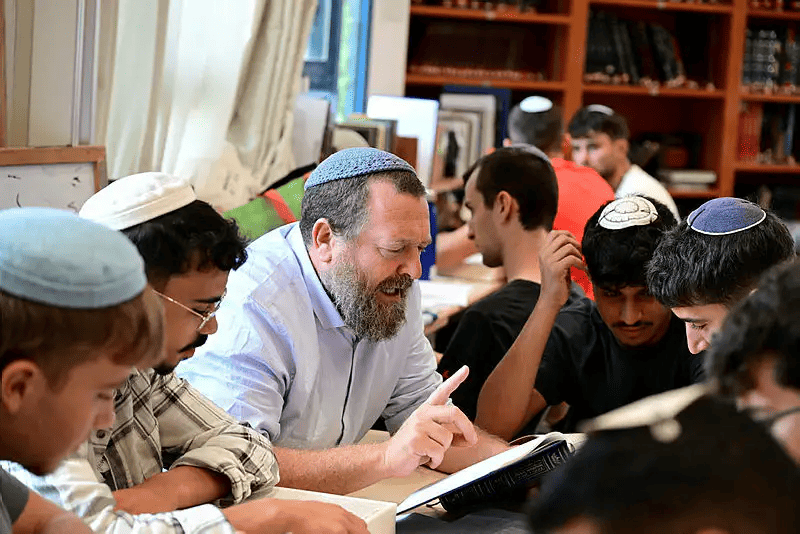
Rabbi Shukron also refused to frame what happens here as an institutional achievement. "First of all, people don't come out of the academy. People come out of the Torah. The Torah isn't ours. We didn't invent it," he said. "The special innovation of the Bnei David academy in Eli is taking responsibility from within Torah, responsibility in every sense."
And sometimes that responsibility is a towel. On the first night of his first year, he told the students they could call him at any hour. The next night, at eleven thirty, the phone rang. "I told myself something serious, something unusual must have happened. He calls me, 'Rabbi, sorry for the late hour, I forgot to bring a towel.'" Rabbi Shukron sent him home to get a towel. "The moment he got the towel, you could see on his face that he was ours. That's when we won him over."
For Rabbi Glustein, the answer comes from a different place. On October 7, he left and didn't return home for over 50 days. "The whole time, it was clear to me that I had students who were killed, friends, neighbors who were killed. And at the same time, it was also very clear to me that it didn't matter. I told myself that if it wasn't my student, then it was someone else's student. If it wasn't my brother, then it was someone else's brother." He added, "I think mainly about what needs to be built, not about what might be destroyed along the way."

Fear, he stressed, isn't suppressed. "I talk to them all the time, about fears too, about post-trauma too, about hardship and coping with it." He does reserve duty and meets his graduates not only in the study hall. "We have a completely shared language, even shared experiences, places we were in together, in battle. I don't think there are many places where the rabbi fights alongside the student." Among those sitting in the study hall today are bereaved siblings whose older brothers were graduates of the school and were killed. "It's a topic, but the topic isn't the pain and the loss," he said. "The topic is rebuilding."
Yair Golan's threat
Hovering over all of this this year is a new political question. Last June, in response to an artificial intelligence video posted by Minister Bezalel Smotrich depicting a scenario in which Yair Golan shuts down the academy, the Democrats party chairman confirmed the direction.
"Thank you, Bezalel," he wrote on X. "Educational institutions that promote racism, hatred of LGBTQ+ people, and act against women's service in the IDF will stop receiving our tax money."
Golan based his position on remarks made at the academy regarding feminism and women's service, and argued that an institution funded by public money cannot continue receiving funding under such circumstances. Figures in Religious Zionism responded that this amounted to "an attack on institutions that raise the IDF's finest fighters and commanders precisely at a time when the State of Israel needs them more than ever."
The academy chose not to respond to Golan's remarks. What Rabbi Glustein did say was, in fact, the opposite of retreating inward.
An institution whose funding is being threatened with cuts is at the height of expansion, with a new branch that just opened, and he refuses to declare the academy the most important one in the country. "I'm a big believer in there being many kinds of yeshivas, including ones that aren't Bnei David's," he said. "It's a sign that the Jewish people as a whole are searching for a path, and that's good, and that's healthy, and I'm in favor of it." Sometimes, he said, he tells a young man that he'd be a better fit somewhere else. "As long as people are searching for truth, that's a good thing. And alongside that, I think I have something to offer. I'm secure enough in my own path to hear different opinions."
He illustrates the scale of what has come out of here with a story. In the middle of a maneuver in Khan Younis, he met a Jewish man from Los Angeles, a drone business owner, who came after October 7 and flew drones for commando units in Golani and in Givati. "Are you from Eli?" the man asked him, and when Rabbi Glustein confirmed it, the man said, "Eli seems to me the size of Los Angeles. There isn't a place in the army I've been to where I haven't met someone from Eli."
And when asked what's special here after all, he quotes Rabbi Eli Sadan, who was once asked how this place turns people into such successes. "He said, 'We don't turn them into anything. Successful people arrive here.'"