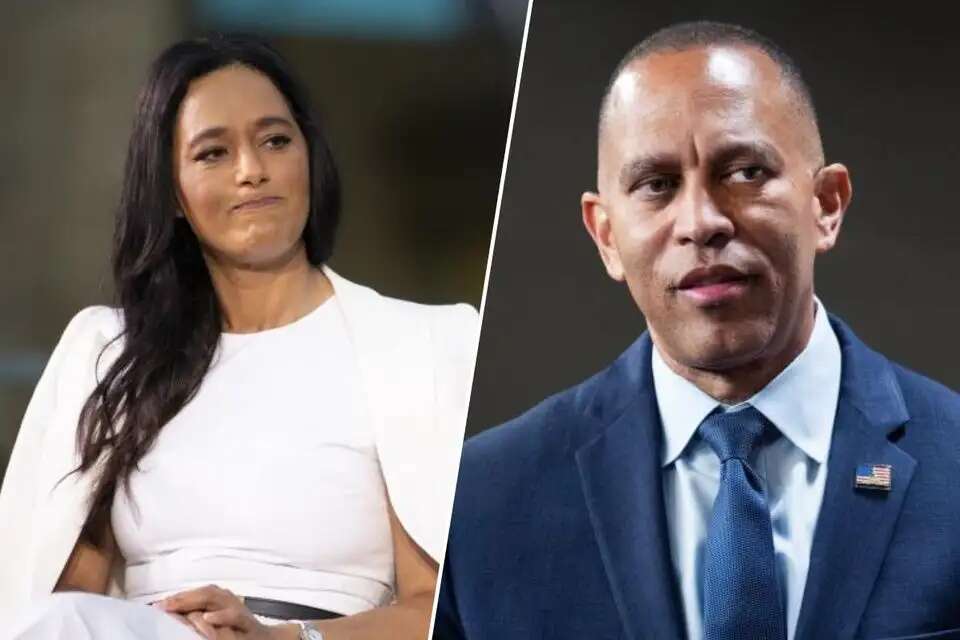
Palestinian journalist and author Rula Jebreal sparked an uproar in the US after calling House Minority Leader Hakeem Jeffries an "AIPAC monkey" and an "errand boy."
The remarks came during a discussion with commentator Wajahat Ali on "The Left Hook" podcast about US-Israel relations and the pro-Israel lobby. Jebreal, who was born in Haifa and raised in East Jerusalem, spent years working in Italian and American media, previously served as an MSNBC commentator and is currently a visiting lecturer at the University of Miami.
"His name is Hakeem. Hakeem is an Arabic name which means 'healer.' He's not a healer, he's a divider," she said.
She continued: "He is a bought and paid by AIPAC monkey, with all due respect, and I don't mean it in a racist way." Jeffries, she added, was "just basically an errand boy, and we're done and tired."
Ali immediately noted that describing a Black person as a "monkey" carries "terrible racial connotations," while saying that Jebreal appeared to have caught herself and clarified that she had not intended the remark with racial animosity.
Jebreal then sought to explain that she had been referring to the image of the three monkeys who see no evil, hear no evil and speak no evil. The explanation failed to quell the controversy, in part because the term "errand boy" can also carry racist connotations when directed at a Black person.
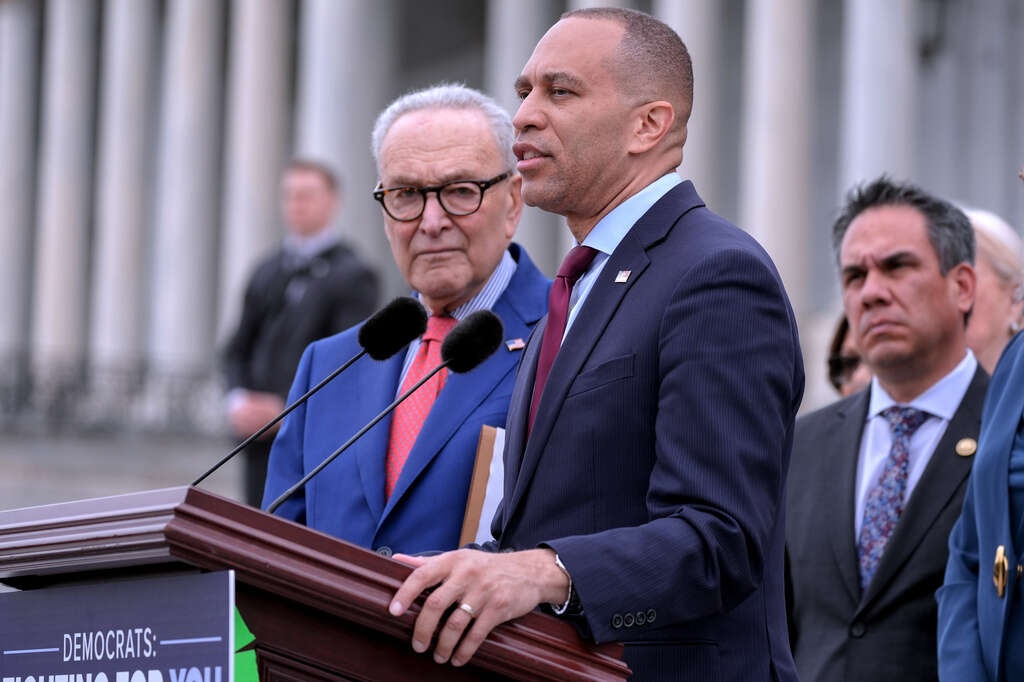
The Congressional Black Caucus rejected her clarification. "To be clear, there isn't a non-racist way to call Leader Jeffries, a Black man, a 'monkey' or 'errand boy,'" the caucus said, also criticizing Ali for providing a platform for the remarks.
Democratic Rep. Ritchie Torres of New York wrote: "Calling a Black man a 'monkey' is racist. Full stop." He added that if Ali and Jebreal had been associated with the far right, the far left would have had no difficulty condemning them for using racist language to dehumanize a Black man.
Democratic Rep. Shontel Brown of Ohio likewise described the remarks as "vile racism."
Jebreal later apologized, though she did not retract her criticism of Jeffries. "I am disgusted and horrified that Hakeem Jeffries is taking money from AIPAC amidst Israel's genocide in Palestine," she wrote. "That said, a term that I used to describe him was inappropriate and offensive and should never have been used. "I apologize unconditionally." Jeffries himself has not responded.
Portraying him simply as an instrument of AIPAC, however, obscures a more complicated record. Jeffries is among the Democratic Party's supporters of Israel and has described the US commitment to Israel's existence as a Jewish and democratic state as "ironclad." He condemned the Oct. 7 massacre and has called for the release of the hostages and the defeat of Hamas.
At the same time, he has called for reducing civilian casualties in the Gaza Strip, expanding aid to Palestinians and advancing a two-state solution. His voting record reflects that tension: Jeffries supported the Israel aid package passed in April 2024 and, in July, opposed an effort to cut the $3.3 billion in annual US military assistance allocated to Israel.
On the other hand, he voted against legislation that would have forced the Biden administration to deliver a shipment of bombs it had delayed, and against sanctions on the International Criminal Court even though he described the proceedings against Israeli leaders as "shameful and unserious."
Last Thursday, he also voted against legislation intended to penalize universities participating in commercial boycotts of Israel. In each case, he voted with the majority of his party.
In July, Jeffries also proposed gradually shifting the US-Israel security relationship from grants toward weapons sales, while preserving Israel's qualitative military edge and continued cooperation on missile defense systems.
AIPAC itself has faced a growing image problem in recent years. In an AP-NORC poll conducted in June, 15% of Americans expressed a favorable view of the organization, compared with 25% who viewed it unfavorably. Another 59% said they did not know enough about AIPAC to form an opinion.
Ahead of the midterm elections, progressive critics have accused AIPAC of pouring vast sums into Democratic primaries to defeat critics of Israel, turning support for Israel into a litmus test and obscuring its involvement through political action committees with generic names that make no reference to Israel.
The criticism comes primarily from Democrats, but versions of it have emerged from both ends of the political spectrum, where the lobby is sometimes portrayed as a conduit for foreign interference.
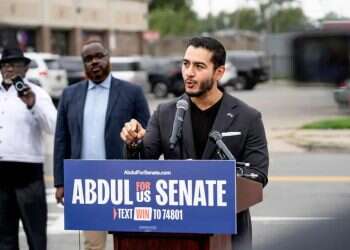
In Michigan, progressive and staunchly anti-Israel Senate candidate Abdul El-Sayed made AIPAC a central issue in the Democratic primary after the lobby and affiliated groups spent close to $30 million supporting his pro-Israel rival, Rep. Haley Stevens, who narrowly lost the race. El-Sayed also claimed, without evidence, that Stevens' vote in favor of aid to Israel was the "quid pro quo" for that spending.
On the right, libertarian Republican and Israel critic Thomas Massie, who was recently defeated in his primary, introduced legislation that would require organizations whose activities principally advance the interests of a foreign country to register under the Foreign Agents Registration Act, explicitly targeting AIPAC.
AIPAC rejects those accusations, stressing that it is an American organization funded and operated by American citizens and that it acts in accordance with US law.