With about a week to go before Israel's elections, arguments over Prime Minister Benjamin Netanyahu, October 7 and the military draft for ultra-Orthodox Jews are raging in the United States as well.
I met with dozens of Israelis expats in two communities, the New York Parliament on Long Island and the Riviera Parliament in Miami, where the political debates sounded remarkably familiar. Many have lived in America for decades, but they still have family and friends in Israel, and in some cases grandchildren serving in the Israel Defense Forces. Some participants asked not to be identified, so their names have been withheld.
They are part of a community of hundreds of thousands of Israelis living in the US, but anyone who wants to vote must fly back to Israel. With the exception of official state representatives stationed overseas and their families, Israel does not allow its citizens to vote from abroad. And even on the question of whether to make the trip, there is little agreement.
'For Israel to survive and remain strong'
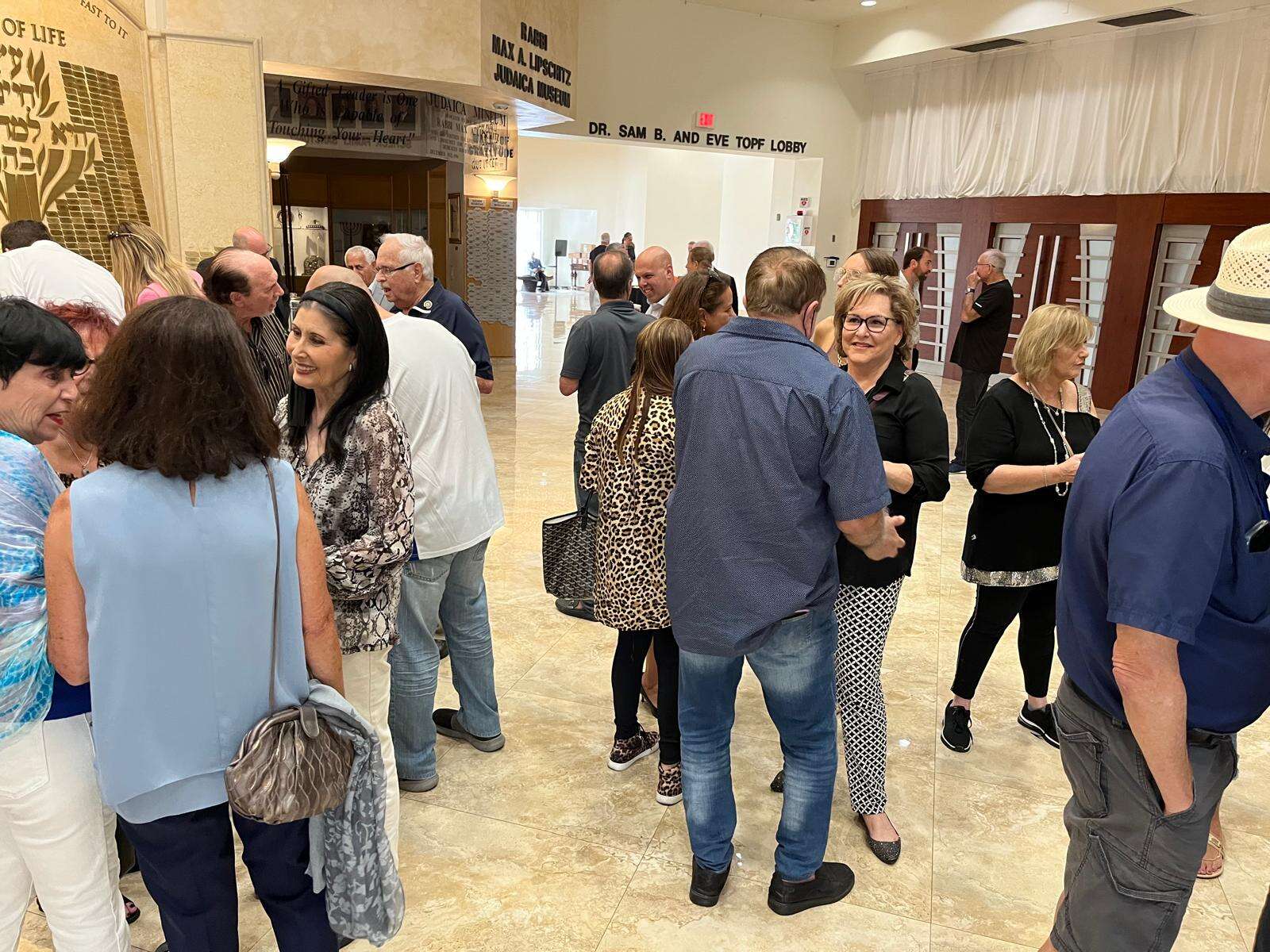
Just as in Israel, Israelis here love talking politics. Members of the New York Parliament know one another well, and some of their exchanges sounded like the latest round of arguments that have been going on for years. Founded 13 years ago, the community has about 300 Israeli male members. Several dozen, mostly between the ages of 30 and 50, attended the gathering.
After October 7, 2023, they also mobilized to help. Alon Feldbrandt, one of the community's organizers, led an emergency operations center in Queens, where parliament members and others joined forces to purchase tourniquets, protective vests and helmets and ship them to Israel.
Over roughly a year and a half, hundreds of tons of equipment were sent. At Ben Gurion Airport, a network of volunteers was waiting to deliver the supplies to soldiers at military staging areas.
What matters most to them, one participant explained, is "for Israel to survive and remain strong." Some members of the community, he said, are less familiar with the intricacies of Israeli domestic politics. Another spoke about antisemitism and "the fear of speaking Hebrew on the subway and in the city streets."
But when the conversation turned to what Israel should do, disagreements quickly surfaced. Netanyahu enjoyed considerable support in the room. When one member called for a show of hands, about half of those present raised their hands in his favor.
"Bibi is the only one of them who had the balls to stand up to Biden in America," one participant said, referring to former US President Joe Biden. As for former IDF Chief of Staff Gadi Eisenkot, he added, "Can you imagine Eisenkot speaking at the UN? He talks like a third-grader."
Another participant explained his support for Netanyahu with a dose of cynicism. "Politics is a profession. You choose someone hoping he's the best you can get. The biggest con artist, the biggest liar, that's the person who should lead the country. In this case, Netanyahu is the best."
Another participant went so far as to claim that the October 7 massacre was an "inside betrayal" intended to bring Netanyahu down, immediately acknowledging that the allegation sounded far-fetched.
The conspiracy theory has evidently made its way to Long Island as well. The prime minister's son, Yair Netanyahu, was among its most prominent promoters on social media, even though Netanyahu himself told the Knesset Foreign Affairs and Defense Committee that "there was a serious intelligence failure, but there was no betrayal."
'Wipe Gaza off the map'
Other preferences on the Right were also voiced. "I'm voting for Ofer Winter," one participant said, referring to the former IDF brigadier general. "You really want to support someone the establishment tried to screw over, because he has a vested interest in showing the establishment what he can do."
Another viewed National Security Minister Itamar Ben-Gvir as a possible successor to Netanyahu, saying he had "become more moderate recently."
And one man had no interest in discussing the post-Netanyahu era. "Bibi must not be replaced. He'll remain a thorn in everyone's side until the Almighty takes him," he declared.
The fiercest argument broke out when the conversation turned to Gaza and the Palestinians. "If it were up to me, Gaza would be wiped off the map in 48 hours," one participant said.
Another declared, "After October 7, they don't deserve anything." He listed the opportunities for peace that the Palestinians had rejected over the years before concluding, "Anyone who still clings to this notion that the Palestinians want peace needs to change their medication."
Views far outside the Israeli consensus were also heard in the room. "What have you given them? Look at the picture from a Palestinian's perspective. Have you given them a state? Let them live. They have no rights," one participant said. Another shot back: "We gave them an airport, work permits. We even saved that piece of garbage."
He was referring to the medical treatment in Israel that saved the life of Hamas leader and October 7 massacre mastermind Yahya Sinwar, years before the attack.
The first participant went even further. "I argue that October 7 happened because of us. You locked them up, strangled them and gave them no political solution." Someone on the other side of the argument demanded, "Why is that our responsibility in the first place?"
Another member maintained that "this has nothing to do with Israel, territory, borders or rights." In his view, Israel was facing a much broader confrontation with Islam, in which the Jewish state was "simply the first in line."
Another participant asked the group whether they would press a button that would bring peace with the Arabs and allow them to live together in a single state. "I wouldn't press it," came the answer. "You're racists," the questioner fired back.
'Let them get jobs, let them join the army'
The debate over drafting ultra-Orthodox Jews into the military could have taken place in any Israeli living room. "Anyone who isn't studying, who's just hanging around doing nothing, should go get a job or join the army," one participant said. Another asked, "Why only the ultra-Orthodox? Why not Arabs?" A third replied that he did not want Arabs serving in the IDF at all. "I don't want Arabs enlisting and then turning against us with the skills we taught them."
In Miami, the picture was different.
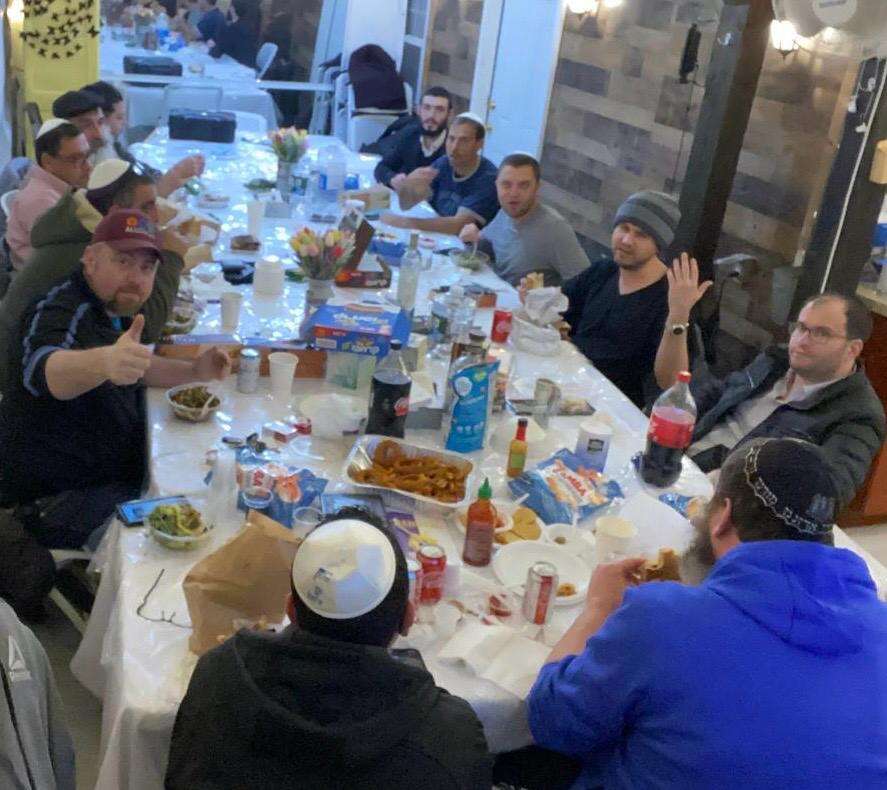
The Riviera Parliament is a group of men and women ages 60 and older, several dozen of whom attended the meeting. The group has been operating for about 22 years. According to its president, real estate businessman Ofer Tamir, the umbrella organization to which it belongs, the Israeli Parliament Organization (IPO), has about 650 members.
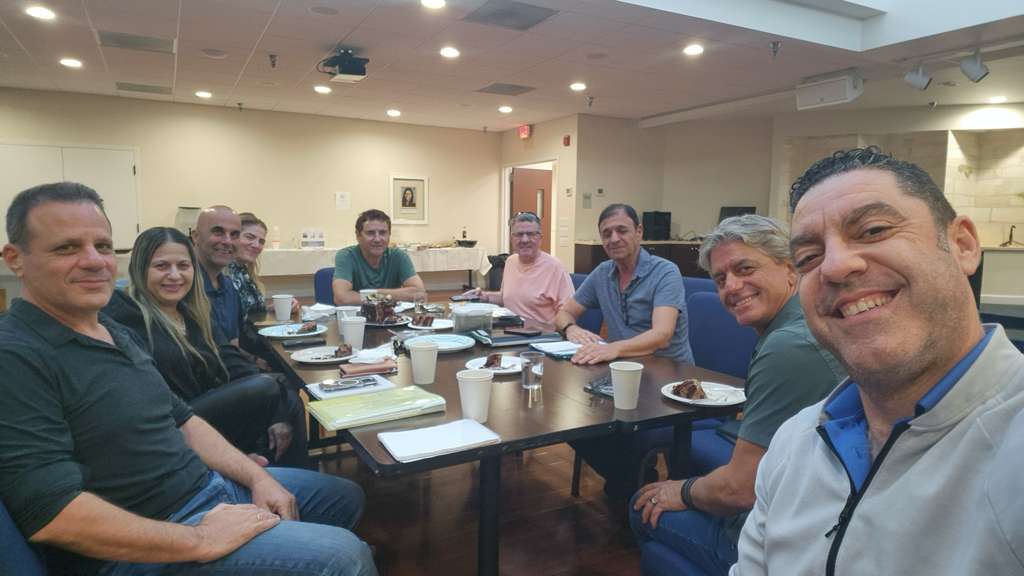
Here, the debate began before anyone even got to the question of whom to vote for. "I don't know whether it's right for Israelis like us, who live here, to travel there to vote," one participant said.
Another responded emphatically. "When we came here, what did they call us? Yordim (Israelis who left Israel). What do they call us today? Ambassadors. What happened? Did we change? No."
He argued that Israel still regarded them as Israelis when it came to their obligations, yet denied them the ability to vote from where they lived. "Our voice carries weight. And that's why I think that, ultimately, we should be allowed to vote, too."
For him, the answer lay in what the community had done since the outbreak of the war. "I personally know what I've done and how much we've contributed. What haven't we done together with the federation?"
The Greater Miami Jewish Federation raised about $30 million for an Israel emergency fund, part of roughly $900 million raised by Jewish federations across North America.
Tamir was among those who spearheaded the establishment of an Israeli division within the Greater Miami Jewish Federation, with the aim of strengthening children and grandchildren's ties to Israel.
He described it as an unprecedented step among Jewish federations in North America. First, however, the organizers had to overcome mutual suspicions between Israelis and local American Jews. "On one side was the perception that Israelis aren't involved and don't contribute. On the other was the feeling that all anyone wanted from them was money."
One woman offered a deeply personal perspective. "I would very much like to take part in the elections now," she said.
But she was wary of allowing people who had lost touch with everyday life in Israel to vote. "I have four grandchildren serving in the IDF, and there are people here whose children haven't spent half a second in Israel. So I don't want them influencing my children's lives."
She leaves the decision to her children. "I vote only for whoever my children tell me to vote for. I don't live there." According to her, family members who previously voted for Netanyahu now intend to support Eisenkot. "They think it's time for a change."
For those who do want to vote, there is also the financial calculation.
One participant decided against flying to Israel with his wife because business-class airfare was simply too expensive: approximately $25,000 for two tickets. "At that price, you really have to think twice about whether it's worth it," he said. When I asked whether he was at peace with his decision, he replied, "No, I'm not at peace with it."
Another participant, an outspoken Netanyahu supporter, found a solution with a left-wing friend: Both would remain in America, effectively canceling out each other's votes.
'We've lost our way'
Meanwhile, the Israeli parliaments in the Miami area are holding elections of their own. In a poll already conducted by the organization's parliament in Boca Raton, a city north of Miami, Gadi Eisenkot's Yashar! party received 44.4% of the vote, Likud 20.6% and former Prime Minister Naftali Bennett's Beyachad (Together) party 14.3%.
At the Riviera Parliament, members will cast their ballots in a local mock election on Israel's election day itself.
Tamir described how much the symbolic vote means to members, even though their ballots will not count toward the actual election results. "Coming to the polling station and putting the ballot in the box, you have no idea how important that is to them."
He said members in Boca Raton were "more liberal," while the results at the Riviera Parliament "will be a little different." In the previous five Israeli elections, he said, their results had been "an exact match, a carbon copy of Israel's." For him, the political picture is far more varied than the assumption that "all Israelis in Miami are right-wing."

Here, too, Netanyahu was at the center of the debate. "On the one hand, Benjamin Netanyahu is probably the most talented and the sharpest of all the statesmen around today. On the other hand, he is causing tremendous division and hatred in the State of Israel," one participant said.
He held Netanyahu politically responsible for October 7 and suggested an alternative. "The ideal situation would be for him to resign. Then Likud could unite with others, say Eisenkot or Lieberman," he said, referring to Yisrael Beytenu leader Avigdor Lieberman. Others defended the prime minister. One even argued that "the division was created by the State Attorney's Office."
But even among Netanyahu's supporters, some acknowledged that "Bibi has been sitting in that chair for far too long."
One woman who supports the Right said she would actually prefer a national unity government, because, as she put it, "somewhere along the way, we've lost our way." She will not travel to Israel to vote this time, but she spends her days immersed in news from home. "I spend my whole day focused on Israel. I have nothing else. That's where we belong."