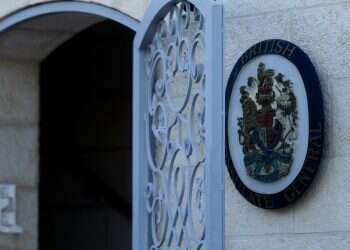
Israel's foreign ministry confirmed Tuesday that Britain's consulate in east Jerusalem would be closed, a direct response to British, French and Canadian plans to block imports from Judea and Samaria communities.
Britain will also be removed from a US-led coordination mission for Gaza, according to Foreign Minister Gideon Saar, who said that certain British officials and other nationals would additionally be barred from entering Israel.
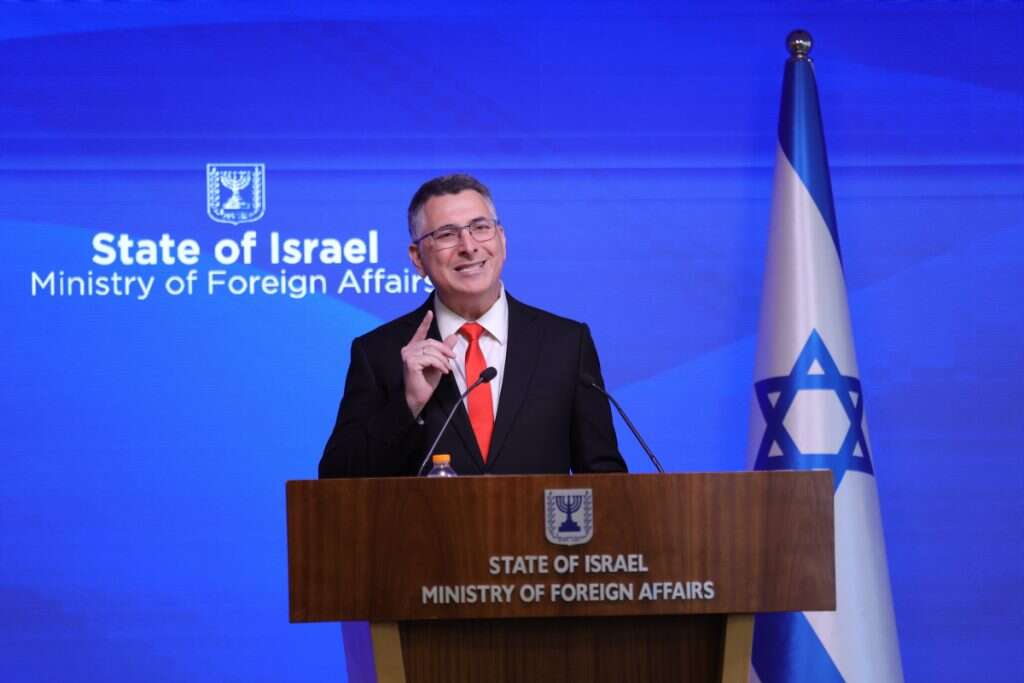
Saar characterized Britain's move in unusually harsh terms. "The British move is morally distorted, and constitutes blatant interference in the affairs of a sovereign state and its electoral process," he said, dismissing Foreign Minister Ed Miliband's comments as "outrageous lies."

The British consulate in east Jerusalem holds accreditation to the Palestinian Authority in the West Bank, a detail that lends the closure particular symbolic weight. Saar said that Israel's response had been coordinated with Prime Minister Benjamin Netanyahu. Israel's next election is scheduled for late October.
The renewed friction centers in part on Israel's E1 settlement project near Jerusalem. Before Saar's announcement, Finance Minister Bezalel Smotrich had called for Britain's ambassador to be expelled, while President Isaac Herzog accused Britain of interfering in Israel's elections; both Smotrich and National Security Minister Itamar Ben-Gvir are already under British sanctions.
JOIN US LIVE NOW: Press statement by Israel's Minister of Foreign Affairs @gidonsaar https://t.co/NtZGkN204Q
— Israel Foreign Ministry (@IsraelMFA) September 8, 2026
Trade measures
France introduced its own ban on West Bank products, citing the "frenzied expansion" of settlements and a "flare up of violence" as its justification. Britain, France and Canada were joined by the foreign ministers of ten additional countries, including Denmark, Norway, Poland, Spain and Sweden, in a statement reaffirming support for a negotiated two-state solution: "Together, we are resolute: the two-state solution must be protected, and we will take action in pursuit of a just and lasting peace." Given the small volume of settlement exports – mainly dates, citrus fruits, herbs and wine – the bans are largely symbolic and unlikely to significantly affect broader bilateral trade.

Miliband said Tuesday that simply condemning injustice was no longer sufficient, arguing that action was required to oppose settlement expansion, which he warned threatened the viability of a future Palestinian state. Canada's position has long favored a two-state resolution to the conflict, Foreign Minister Anita Anand wrote on X, adding, "Illegal settlements in the West Bank significantly undermine these objectives."