Just days before Joe and Talia Sanford, a couple who had spent the past five years living in New York, were scheduled to make aliyah with their two young children, a medical emergency upended their plans. Several days have passed since then, but the couple have not given up for a moment on their dream of coming home to Israel.
"We don't have words to describe how much we want to finally get to our real home, Israel," Joe said as the couple spoke with Israel Hayom. "Unfortunately, Talia's medical situation delayed our plans, so we won't be on the aliyah flight scheduled for two days from now. But as soon as this is over, we'll take the first flight offered to us and start our lives in Israel. Adir [their eldest son] has already learned to love amba and hummus."
Unlike many new olim, the Sanfords have already spent considerable time in Israel. "I'm originally from New York and Joe is from London, and we both grew up in Bnei Akiva," Talia said, referring to the religious Zionist youth movement. "We grew up in Zionist homes filled with a passion for Israel, so it was never a question of 'if,' but 'when.' Joe served as a combat soldier in the IDF Combat Engineering Corps and later worked as a security officer, while I had just arrived for a year in Israel to work as a counselor at a Jerusalem seminary.
"Since then, we moved to New York because of my graduate studies, and we planned to stay here for exactly five years," she said, noting that within hours, the Hebrew calendar date would mark exactly five years since their move. "In practice," Joe said with a smile, "it'll be five years and a little bit more."
'An atmosphere filled with hatred'
In New York, the couple live in the neighborhood where Talia grew up. "We pray at the same synagogue where I celebrated my bat mitzvah, and we see the same neighbors, but the atmosphere has changed. Since Oct. 7, 2023, we have felt a need to make aliyah."
Joe said antisemitism played a major role in their decision. "Our area itself hasn't been affected, but you can understand the general mood. In the building next to ours lives one of the most prominent activists who took part in one of the flotillas to Gaza and spread fake news against Israel."
Asked about New York City Mayor Zohran Mamdani's role in the situation, Joe said, "He hates Jews. This year was the first time we didn't go to the Fifth Avenue parade," referring to New York's annual Israel parade in the spring. "We were afraid. People here are looking to arm themselves, and that doesn't happen for no reason. The atmosphere has turned militant and hateful."
A small cafe on Lexington Avenue, between East 72nd and 73rd streets on Manhattan's Upper East Side, illustrates the situation particularly well. Cafe Aronne is a Jewish, kosher business that does not shy away from its identity. On the contrary, it displays it proudly in the front window facing the bustling street.
"On Simchat Torah, we had no idea what was happening," recalled Aaron, the manager of what is now the company's fourth US location. "On my way to synagogue, a woman stopped me and asked, 'Are you Jewish? Pray for the Israeli soldiers. What they did to you is worse than 9/11.' Slowly, we began to understand what had happened. Alongside sending aid to Magen David Adom, we put up an Israeli flag, the names of the hostages and stickers commemorating fallen IDF soldiers."
Leaving antisemitism behind
A month after the massacre, the idyllic cafe, which plays Israeli music for its customers, also found itself on the front line of hostility toward Zionism and Judaism. "All my employees quit at once, and they put phrases on the menu like 'a latte with the blood of a Gazan baby.' Someone spray-painted 'Free Gaza' on the window, and at another branch they wrote, 'Jews to the oven.' To say this is only against Israel would be to ignore reality. Hatred of Jews has spread here in New York as well.
"And Mamdani? I adore him," Aaron said, surprising me. "He is the catalyst who will make all the Jews move to the Land of Israel. My wife and I will do it too. If not now, then in a few years. The Jews have nowhere else but the State of Israel."

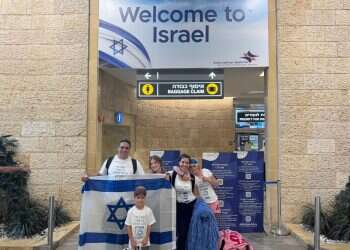
In recent years, talk of making aliyah has become increasingly common among members of North America's Jewish communities. They are well aware of Israel's security situation, yet many feel that attitudes toward Jews abroad are only deteriorating. "Antisemitism in New York has surged in a way we never thought we would see," Eitan and Elena Zanger told me at the airport. The couple made aliyah several days ago with their 3-year-old daughter, Serena. "Everyone feels it. You hear about incidents targeting Jews, you see violence against them, and you feel the atmosphere boiling over. It has also made us realize that if the day ever comes when we return to the United States, we won't live in New York. We'll only visit."
"Despite everything you hear about Israel, there's a family atmosphere there that you don't find anywhere else," Eitan said. "It's a place that fits our values better, and our future is there. Children can walk down the street by themselves without being afraid, and you can trust people to help you if you need it."
The family has settled in Beit Shemesh and is being helped by relatives already living in Israel. "We hope we'll feel part of the community and comfortable here, and more than anything, we're excited to begin the journey," they said. Serena nodded in agreement and added that she was excited to board the aliyah flight.
A growth engine for Israel's economy
Aliyah flights from North America throughout the summer, beginning in June, were organized by Nefesh B'Nefesh in cooperation with the Aliyah and Integration Ministry, the Jewish Agency for Israel, Keren Kayemeth LeIsrael and Jewish National Fund-USA.
The organizations hope those efforts will pay dividends as veteran olim and Israelis have simultaneously left for other countries, primarily against the backdrop of Israel's security situation.
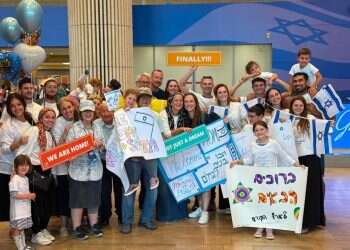
More than 2,300 new olim from North America arrived over the summer on 92 group flights. They included 480 families and 250 retirees seeking to begin anew in Israel. Among the new olim were 700 schoolchildren who began the academic year in Israel, including 80 entering first grade. Their ages were equally diverse, ranging from 5 months for the youngest immigrant to 98 for the oldest.
"The fact that thousands of families and young people are choosing to relocate their lives and build their futures here, especially at this time, is a Zionist shot in the arm and an enormous engine of growth for Israeli society and the economy," said Rabbi Yehoshua Fass, co-founder and executive director of Nefesh B'Nefesh.
Maj. Gen. (res.) Doron Almog, chairman of the Executive of the Jewish Agency for Israel, echoed that sentiment. "Behind every one of these new olim is a decision to be part of the future of the State of Israel," Almog said. "Our mission is to be there for them throughout the journey and help them turn that choice into a home."
"It is moving to see the large number of young olim and families who have chosen to establish their future in the home of the Jewish people," Aliyah and Integration Minister Ofir Sofer added. "In recent years, we have led significant processes and laid the groundwork to encourage aliyah and ensure the best possible integration of olim from Western countries and around the world, and it is amazing to see them here with us."

From New York to Givati
Of the new olim who arrived from North America this summer, 108 are future lone National Service volunteers and 183 are future lone soldiers.
Eitan Cohen, 19, who is making aliyah alone from New York, is one of them. "I grew up in a Zionist home, in a neighborhood where most people are Israeli. My parents left Israel and settled here, but Israel was always on my mind."
Cohen said that he, too, could not escape the antisemitism that has intensified in his country in recent years. "When you go into the city, you feel that it's dangerous. There have also been several antisemitic incidents in my neighborhood, but that's nothing compared with what happens in the city itself, where Jews are violently attacked and synagogues are vandalized."
Cohen had visited Israel several times and later studied at the Eli pre-military academy. During that period, he met a group of soldiers one Shabbat and realized that he wanted to make aliyah permanently and serve in the Israel Defense Forces. "Since Oct. 7, 2023, I had been thinking about enlisting. During a trip to a kibbutz, I ran into some soldiers, spoke with them and was impressed. That was when I decided this was what I wanted to do.
"I can move to Israel and not enlist, but if all my friends from the pre-military academy are doing it, what's the difference between me and them, the distance of a flight? I'm a Zionist. I need to protect the country I'm moving to, and I'll do everything I can to protect myself and my team along the way."
As he prepared to board the plane, I asked Cohen how his family had reacted to his decision. "My parents are a little worried, but they're very proud of me. My grandfather and uncle served in the Golani Brigade, and it's obvious to me that I'll go into a combat unit too. I'd like to serve in the Givati Brigade, but anywhere I can contribute is good.
"My message to anyone in a similar position is this: There will be people around you saying, 'No, give it up.' But if you know that making aliyah is the right thing for you, keep going down that path."