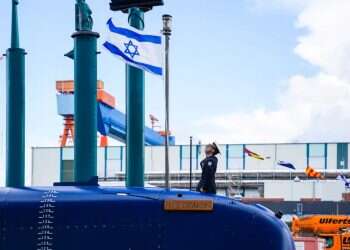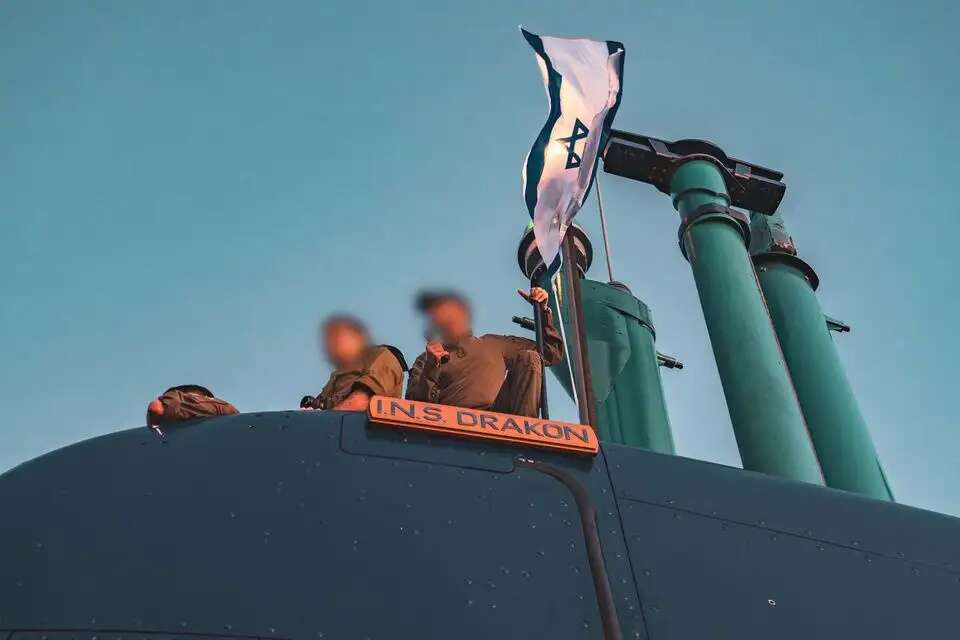
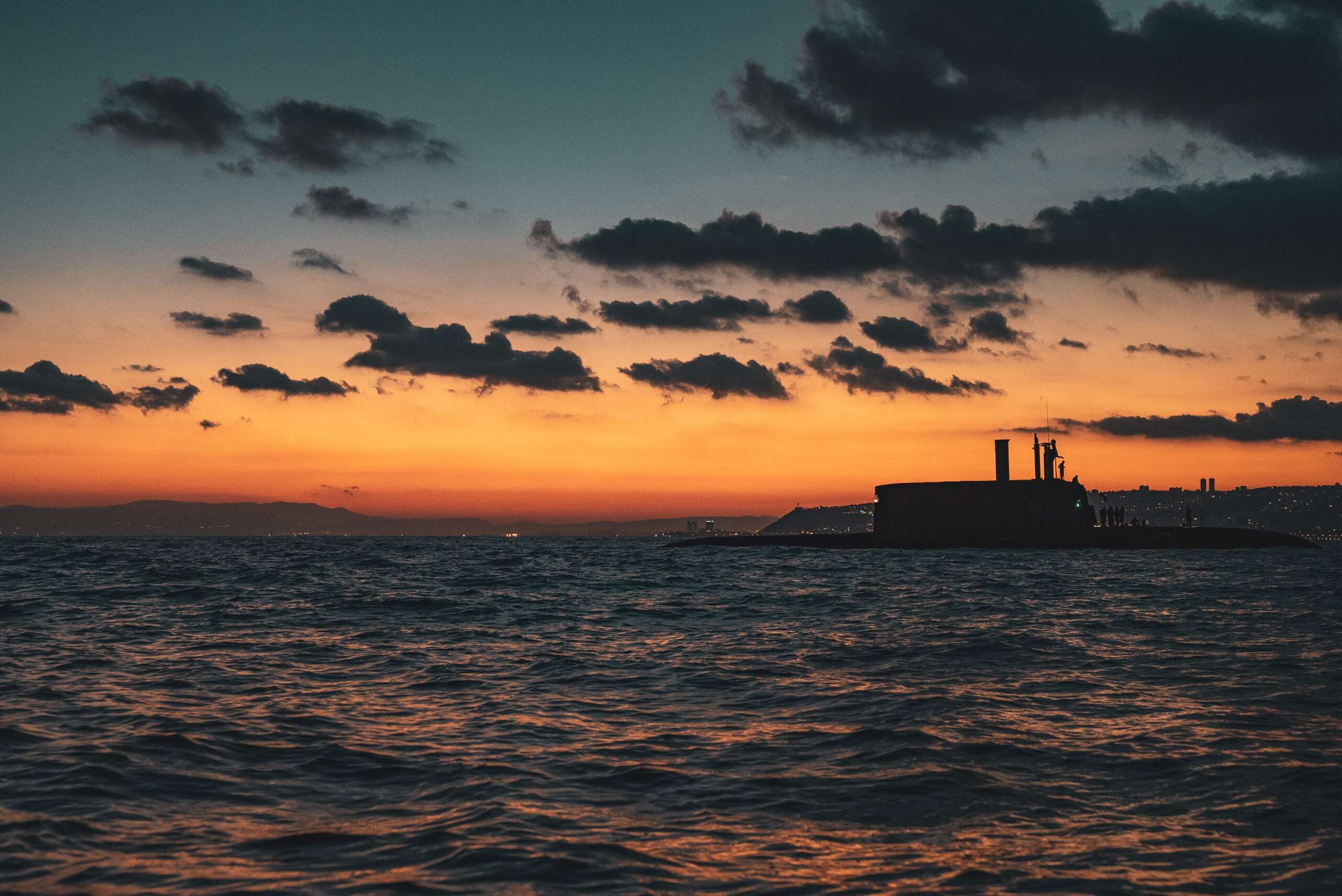
Just hours before it entered Israeli territorial waters for the first time, Israel Hayom was given access to INS Drakon, the Israeli Navy's most advanced submarine and, some would say, the newest, most expensive and most sophisticated war machine in the Israel Defense Forces.
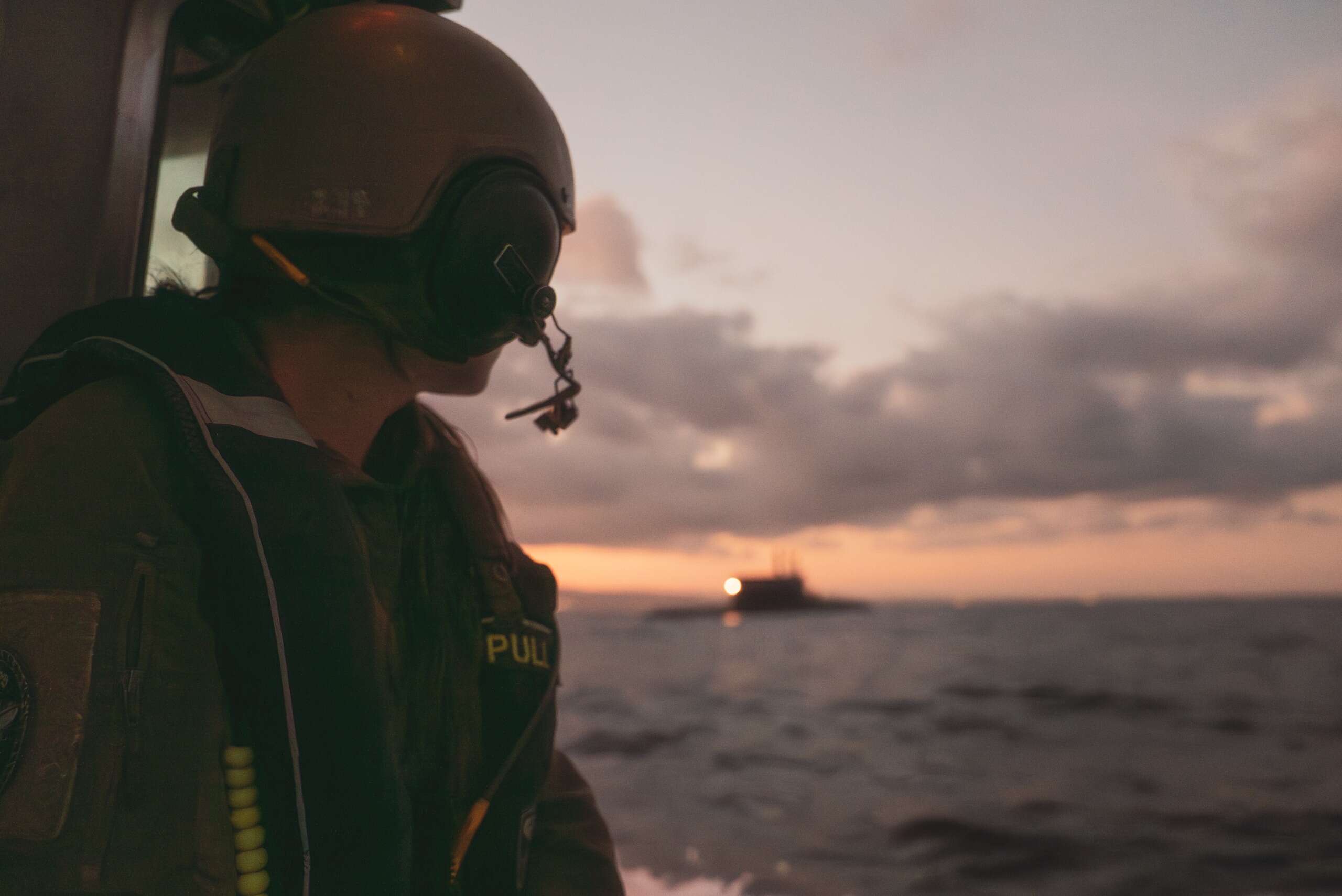
After a short, roughly 15-minute trip aboard a Tzir'a patrol boat with male and female personnel from the Navy's Snapir harbor-security unit, we approached the blue behemoth, which had emerged from the depths after some 24 days at sea. Its journey began at the port of Kiel in Germany and took it through the Kiel Canal, the English Channel, the Strait of Gibraltar and the entire length of the Mediterranean before reaching Israel's shores.
"It was a crazy voyage," said the submarine's commander, Lt. Col. A., 43, a father of four. "This is the first time I've cast off from one port knowing I'm not coming back to it, but instead sailing to my home port. It brings emotions to an entirely different level." Lt. Col. A. acknowledged that this was not the longest voyage he had taken part in and that he had previously participated in an even longer operation. Still, he said, "This voyage was very emotional, and I'm usually pretty indifferent."
'Nothing prepares you'
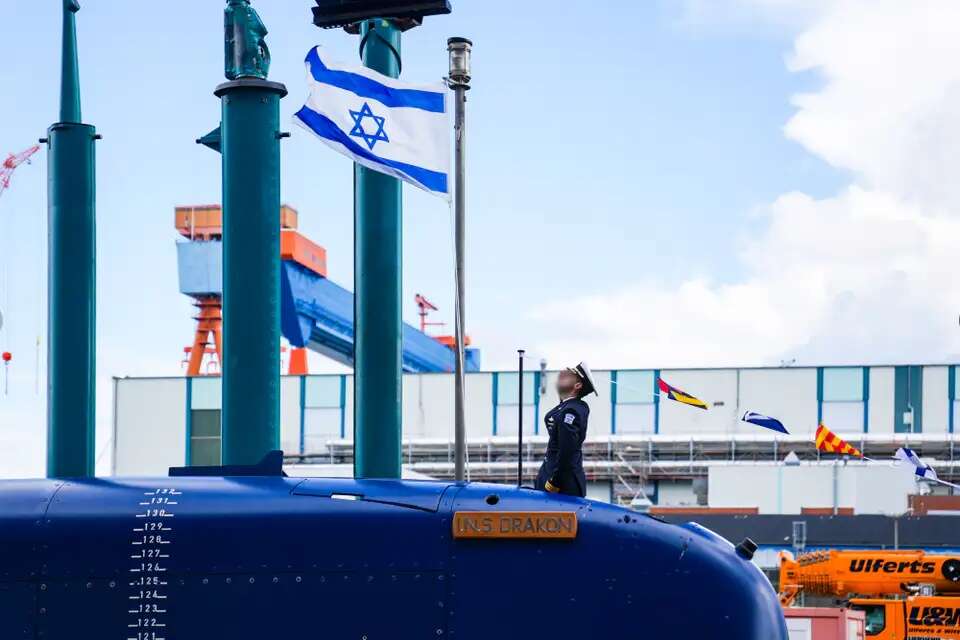
The submarine, under Lt. Col. A.'s command, surfaced for the first time at the site where INS Dakar sank in 1968 with all 69 crew members aboard. "Nothing prepares you for the feelings during a ceremony when you're standing above them, at the place where they sank," Lt. Col. A. recalled. "We surfaced, the crew changed into white ceremonial uniforms and we raised the flag. We held a ceremony that included the Yizkor memorial prayer, Kaddish, readings we had prepared, the names of the fallen, and we sang 'Hatikvah.' It was emotional."
The voyage, which began Sept. 1, was "not long at all," Lt. Col. A. said. The truth is that not everyone can serve aboard a submarine. Those selected to serve inside the sealed vessel beneath the sea undergo a rigorous screening process and lengthy training, preparing them both for their operational duties and for spending extended periods with 55 young men inside an enclosed vessel with no ability to communicate freely with the outside world. In some ways, it is more complicated than living in the "Big Brother" house. Yet because of the intensive screening and submarine training, crew members say friction is rare despite the long deployments.
INS Drakon has three decks. We were permitted to enter only the upper deck, which contains the galley, the crew's sleeping quarters, toilets and showers. Despite being a woman, I was also allowed into the engine room. "The Navy has moved beyond those superstitions," said Col. Y., 41, from central Israel, commander of the Navy's 7th Flotilla submarine unit, as we stood in the sweltering engine room.
The Navy describes Drakon as the IDF's most advanced war machine. For the sailors, however, one of the most significant improvements is more mundane: They now have two showers. Earlier submarines had only one for roughly 55 sailors and commanders during each voyage.
Inside the combat information center, Col. Y. explained that some sailors monitor sonar and can identify nearby vessels by their sounds. "We can hear, for example, a squeaking pump on a vessel and identify which vessel it is," he said.
'A special human fabric'
Every few months, submarine crews may also encounter another submarine nearby. They do not always know whose submarine it is, but in such circumstances they quickly maneuver away to prevent the vessels from drawing too close.
"Sailing for a month isn't difficult at all," Lt. Col. A. said. "There is a very special human fabric here, a kind of family. We watch movies, play PlayStation and Catan, and hold themed evenings. For example, when we passed Morocco, we held a Mimouna evening and made sfenj," he said, referring to the traditional Moroccan Jewish post-Passover celebration and its customary fried dough.
Although the submariners are cut off from the outside world, once every 24 hours they receive transmissions from headquarters. These include filtered news updates and information requested by the crew.
That means they will not necessarily be told about particularly difficult events taking place in Israel, but if a sailor supports a particular soccer team, headquarters will transmit the team's results at his request. "The submarine can receive transmissions anywhere. The more complicated issue is transmitting from sea. We have a maximum time interval within which we must report that everything is all right. When possible, we report more frequently."
Col. Y., commander of the submarine flotilla, met his personnel only when they approached Israel's coast. "I was excited to see the people. I wanted to see them safe and healthy. We are always concerned, and I was happy to see them," he said.
The commanders declined to elaborate on INS Drakon's capabilities because they are classified. In fact, we were not permitted to bring phones, earphones or smartwatches aboard. According to information-security officials, an enemy could potentially extract classified information about the submarine from data collected by such devices. "The submarine has new systems that no other submarine currently in the Navy possesses. They provide unique operational capabilities at greater ranges," Navy officials said.
Like its two predecessors, INS Tanin and INS Rahav, one of Drakon's key advantages is its air-independent propulsion, or AIP, system. The technology allows the submarine to remain submerged for extended periods without having to surface or raise a snorkel for air. Unlike Rahav and Tanin, however, INS Drakon is longer and larger and can therefore carry more.
Israeli Navy Chief of Staff Brig. Gen. Guy Levy also joined the tour of INS Drakon. "Drakon has a greater weapons-carrying capacity," Levy said. "It can sail longer and farther." For Levy, the voyage brought his career full circle. Twelve years ago, he commanded INS Tanin and sailed the submarine from Germany to Israel. "I remember establishing the first radio contact in Hebrew. It was emotional," he recalled.
'Some haven't seen their families for two months'
Levy woke early that morning in anticipation of meeting the sailors. "There are people here who haven't seen their families for two months or more," he said. "Those who have families go to their families. The younger ones go to their girlfriends, their families, to holiday meals."
Because of the submarine's special capabilities, Levy said INS Drakon's transit was the fastest of its kind and took several days less than that of INS Tanin, for example. "The submarine can operate far from Israel's shores, including in the Red Sea and other areas. It can gather intelligence and employ force," he said.
"I can't say what the submarine flotilla did during the war, but we operated, among other places, in the Red Sea and elsewhere. Over the past year, we have operated more." At present, Levy said, the Navy has a sufficient number of submarines, particularly given their quality.
Nevertheless, he added, "If the threat develops and we have new enemies, we will need more submarines," in what appeared to be a reference, among other countries, to Turkey.
One of the Navy's major concerns is that developments around the Strait of Hormuz and the Bab el-Mandeb Strait could make the maritime threat to Israel significantly more serious in the Mediterranean as well, a scenario for which the Navy believes it must prepare.