
Nearly three years after the Oct. 7 massacre, data from the US paints a complex picture: The number of antisemitic incidents has declined, but physical violence has reached a record high. Most American Jews feel less safe, and many are choosing to make their Jewish identity less visible. Yet at the same time, research points to a strengthening of Jewish identity and ties to Israel. The future of American Jewry, its security and its relationship with Israel will be at the heart of the second Israel Hayom Summit, to be held in New York on Nov. 11.
In New York, home to the largest Jewish community outside Israel, the question of how to live openly as a Jew has in recent years also become a matter of personal safety. Going to synagogue, sending children to school and even deciding whether to wear a Star of David or a kippah now come with an additional consideration: How safe is it to be visibly identified as Jewish in public?

Feeling less safe since Oct. 7
The latest figures illustrate the depth of the change. According to the Anti-Defamation League's latest annual report, 6,274 antisemitic incidents were recorded in the US in 2025. That was a 33% decline from 2024, but still the third-highest total since the ADL began tracking such incidents in 1979. Even as the overall number declined, physical assaults reached a record high, with 203 reported during the year.
Those figures are filtering into everyday life. According to an AP-NORC poll published over the summer, about six in 10 American Jewish adults said they felt less safe as Jews than they did before Oct. 7. Yet alongside this sense of threat, Jewish identity is not disappearing and, in some cases, is becoming stronger.
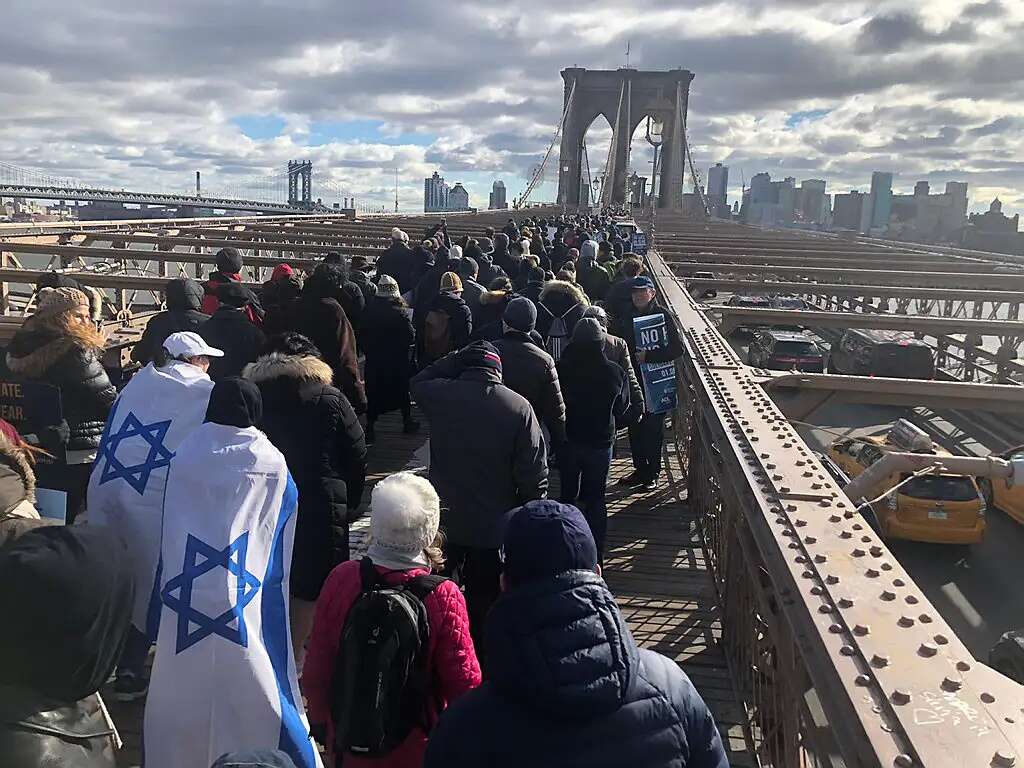
A 2025 follow-up study by UJA-Federation of New York found that nearly two-thirds of Jewish adults in New York, 64%, described themselves as somewhat or very attached to Israel. Sixty-two percent said Israel made them feel proud to be Jewish. The proportion who said they felt very attached to Israel rose from 31% in 2023 to 36% in 2025.
Expressing that connection, however, has become more complicated. In 2025, 47% of Jewish New Yorkers said they felt uncomfortable expressing their views about Israel in non-Jewish settings, compared with just 35% in 2023.
The challenge facing the younger generation
The younger Jewish generation faces a particular challenge. Masa Israel Journey CEO Meir Holtz said, "The younger Jewish generation is seeking a deep and meaningful connection with Israel. Our responsibility is to turn that connection into a genuine partnership, one built on choice, belonging and shared action, and one that strengthens both Israel and the Jewish world as a whole."

Ari Steinberg, chairman of the Wingate Institute and Israel's Basketball Premier League and CEO of Ashmoret, pointed to the parallel challenge facing young Israelis.
"The past few years have shaken the reality of Israel's younger generation and confronted society as a whole with unprecedented challenges," Steinberg said. "In this reality, education and sports give our children an anchor, hope, resilience, a sense of capability, values and faith in themselves. They are the foundation for building a stronger generation and a more cohesive society."
That tension, between security and identity, between Israel and American Jewry, and between parents and the next generation, will be among the central issues at the Israel Hayom Summit in New York. A year after its inaugural gathering, the summit will examine the state of the alliance linking Israel, the US and the American Jewish community.
Alongside diplomatic, security, economic and technological issues, a significant part of the discussions will focus on the future of world Jewry, confronting antisemitism and the question of how to preserve and strengthen the younger Jewish generation's connection to Israel.