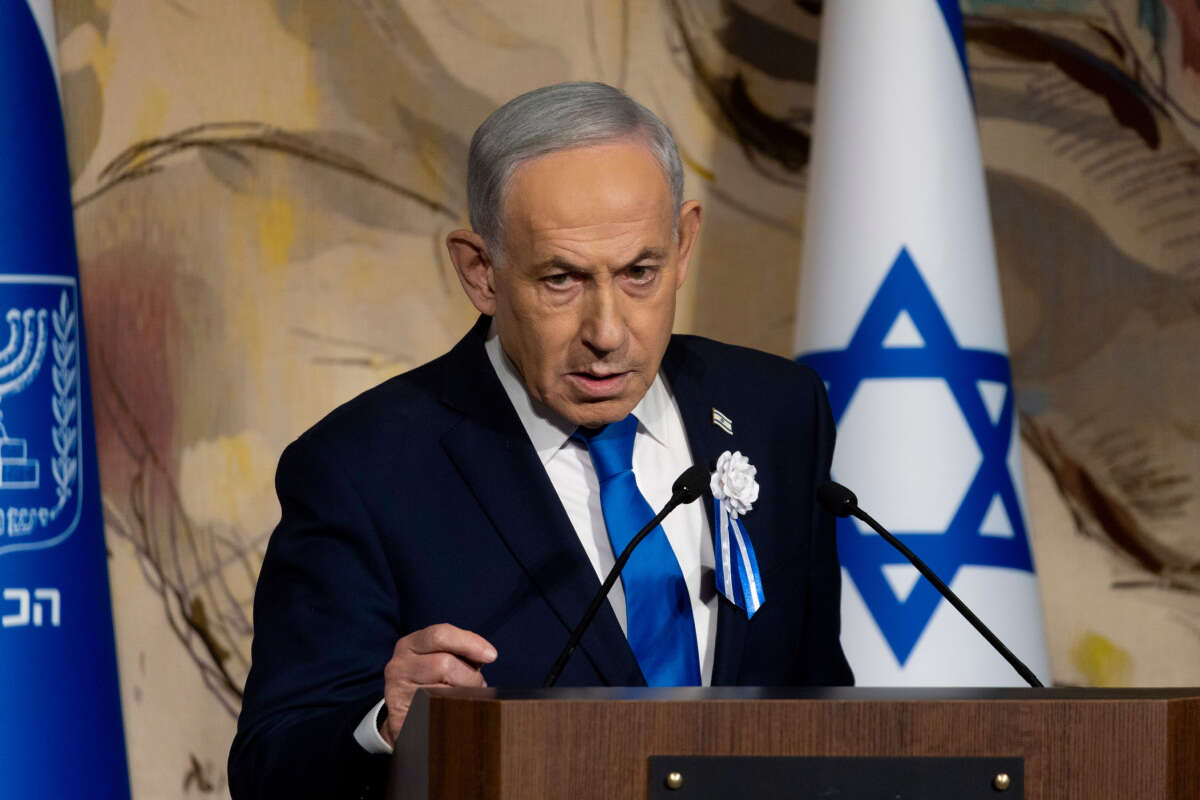
Prime Minister Benjamin Netanyahu said Wednesday that Israel is "facing moments of testing" and that the test heightens the need for political unity. He said he cannot share everything he knows, but that enough people "know what immense challenges lie ahead of us," a day after his Tuesday Knesset speech drew opposition and Yashar chairman Gadi Eisenkot canceled a negotiation meeting with the Likud.
Netanyahu made the comments as he took up the question of whether a unity government is feasible. Netanyahu said, "Yesterday I said why a national unity government is essential. Today I want to say why it is possible. It is possible because this nation knows how to come together in moments of testing. This is the need of the hour. This is the will of most of the people."
"I saw it yesterday in this chamber, in moments of unmatched emotion. I saw it when everyone cheered for Tali Gvili and Shira Shapira, who lost their heroic sons. I saw everyone rise and cheer for Israel's hero Elisha Madan, who after three years rose and stood tall, and the House shook with applause. We saw it throughout the entire war, when for three years this nation, in every part of the country, took ballistic missile fire and held firm in north Tel Aviv and south Tel Aviv, in the city, in the village, in the kibbutz. We saw it on the battlefield, in the armored personnel carrier, in the tank, in the air and ground crews, in the field corps, in the charity organizations. We saw it. Religious and secular, left and right, simply stood together and fought together, shoulder to shoulder. So this nation knows how to come together in a test."
Netanyahu then argued that Israel faces a test that, in his view, deepens the need for political unity. He said, "We are facing moments of testing. I can't share everything I know here, but there are enough people here who know what immense challenges lie ahead of us, and immense opportunities as well. And so I say, I believe that in moments like these we can, and must, come together. This is the will of the people. These are the moments of testing. I will continue to extend a hand until heart meets heart and hand meets hand, it is the call of the moment."
Eisenkot revealed on Tuesday that his party had scheduled a meeting with the Likud party. He then declared that he had canceled it following what he called the "bizarre speech" Netanyahu delivered at the Knesset in which he warned against having the Arab parties join any newly formed governing coalition.
Eisenkot's Yashar party said, "Unity is an important value for Israel. Israeli solidarity is a component of Israel's national security, and for their sake we will continue to act." It added, "The outgoing prime minister lashed out at Israel's citizens this evening in what became yet another sad reminder, for anyone who needed more proof, that Netanyahu does not want unity. As ever, when the choice is between the magnitude of the moment and the resilience of Israeli society on one side, and his political survival on the other, Netanyahu will always choose himself. At any cost."
Behind the scenes, contacts toward forming a government have continued. Eisenkot's circle has been examining a government with the participation of United Torah Judaism (Ashkenazi Haredi alliance) and the abstention of Ra'am (Arab Islamist party). Avigdor Liberman (Yisrael Beytenu party leader), by contrast, wants a coalition that includes the two Haredi (ultra-Orthodox) parties, without relying on the Arab parties. Over the weekend, Liberman dropped his opposition to adding the Haredim to the government. He made clear, however, that he still opposes forming a minority government (one lacking a Knesset majority).