

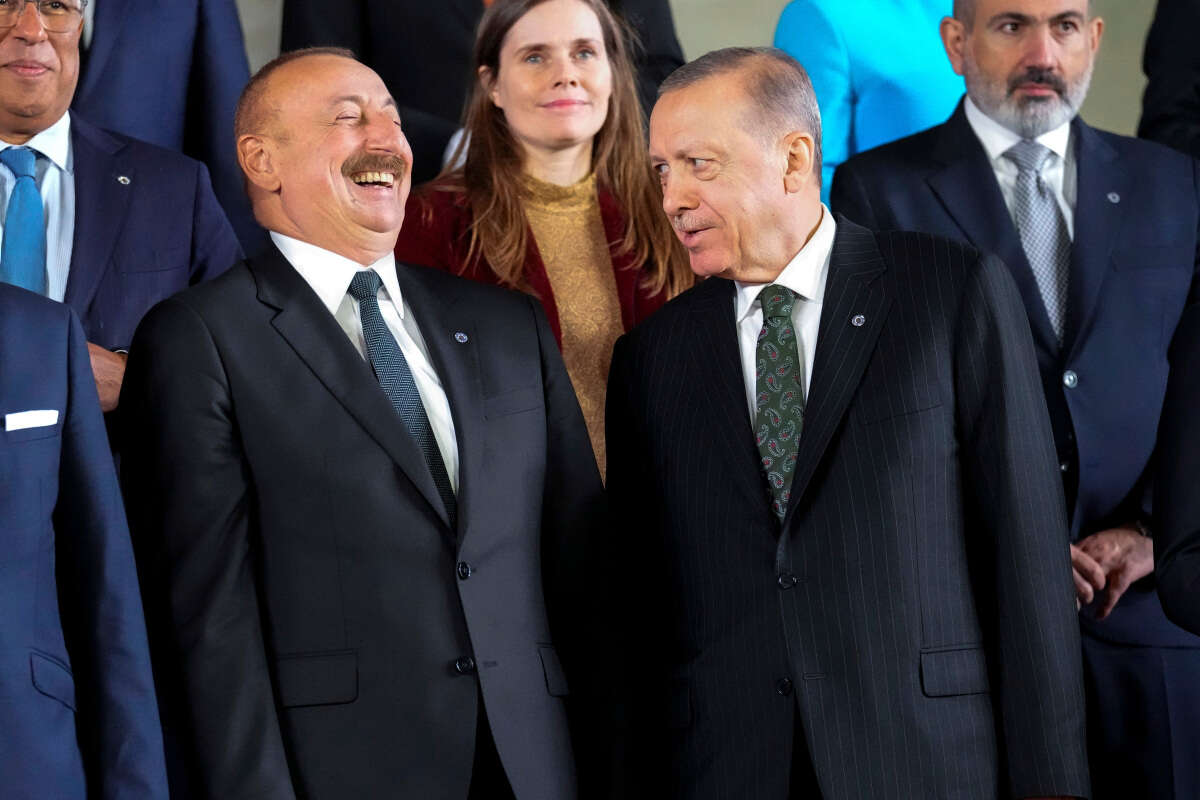
In 2009, Baku threatened Ankara with higher gas prices and export routes bypassing Turkey if it opened its border with Armenia. Armenian forces occupied Azerbaijani territory; the blockade gave Baku leverage. Seventeen years later, Azerbaijan controls Karabakh and has initialed a peace treaty, yet still demands Armenian constitutional amendments before signing. The border remains shut. Baku preserved its pressure on Yerevan, and with it Ankara's leverage over the peace.
October laid bare the hierarchy. Turkish politicians attacked Azerbaijan's restrictions on headscarves in schools; Ankara's hostility toward Israel clashed with Baku's partnership with Jerusalem; and Ilham Aliyev skipped a Turkic states summit despite Erdoğan's personal invitation. Behind these disputes stood one presumption: Ankara could turn cultural kinship into authority over Azerbaijani sovereignty. Its name was "One Nation, Two States".
The shared Oghuz roots and related languages conceal centuries of separate statehood and conflicting interests. At Chaldiran in 1514, Ottoman armies fought Safavid Iran, whose Turkic-speaking ruling establishment belonged to a rival imperial order. Russian conquests in the nineteenth century divided Azerbaijani-speaking communities between Russian and Iranian rule. The republic established in 1918 received Ottoman military assistance, fell to Soviet conquest in 1920, and recovered independence in 1991.
Heydar Aliyev popularized the slogan while his 1995 constitution designated Azerbaijani, rather than Turkish, as the state language. The 2021 Shusha Declaration institutionalized foreign-policy and defense coordination while expressly affirming independent foreign policies and noninterference. Turkish military support contributed substantially to Azerbaijan's 2020 victory; Israeli systems helped reverse the battlefield balance; Azerbaijani forces secured the outcome. Neither partner acquired authority over Baku's decisions.
Ankara has no formal veto over Azerbaijan. Baku gives it one by making Turkey indispensable to its peace with Armenia.
The agreement initialed in Washington in August 2025 recognizes the former Soviet republican borders as international boundaries, prohibits present and future territorial claims and bars domestic legislation from excusing noncompliance. Armenia's Constitutional Court has already upheld the bilateral border-delimitation framework. Baku nevertheless withholds its signature pending constitutional amendments absent from the negotiated text.
Azerbaijan demands additional protection against territorial claims that the treaty itself prohibits. Ankara, meanwhile, conducts its normalization with Armenia in close coordination with Baku. Turkish Foreign Minister Hakan Fidan has called for the peace agreement to be signed without delay, while maintaining that coordination. The Azerbaijani condition perpetuates Turkish involvement in a settlement that Baku and Yerevan have already negotiated.
The paradox is devastating: Azerbaijan preserves its leverage over Armenia by preserving Turkey's leverage over Azerbaijan.
A signed treaty would consolidate internationally recognized borders, establish enforceable obligations, and provide the foundation for permanent access to Nakhchivan. Turkey would benefit too. Reopened routes through Armenia would extend its commercial reach toward the Caspian and Central Asia. But Azerbaijani access need not depend on Turkish permission, nor must Turkish transit revenue confer political authority.
Armenia has already paid for confusing military advantage with lasting security. After the first Karabakh war, territorial gains hardened into an unresolved conflict while Yerevan deepened its dependence on Moscow. Azerbaijan reversed the military outcome in 2020 and 2023. Preserving another patron's authority after victory would reproduce the strategic failure of the defeated state.
Yerevan faces a parallel danger. The American-backed Trump Route for International Peace and Prosperity would connect mainland Azerbaijan to Nakhchivan through southern Armenia. Its planned development company gives the American side a 74% controlling stake and envisages exclusive land-use and development rights in designated areas for an initial 49 years. Armenian sovereignty, customs jurisdiction and border control remain intact, but the concession creates long-term operational commitments around infrastructure indispensable to its neighbors.
Armenia cannot unlock Nakhchivan while remaining locked out of Turkey. Transit must be reciprocal, enforceable, and connected to markets beyond Ankara's control. Otherwise, Armenia supplies the passage while Turkey retains the western gate. Baku gains a connection but leaves its wider utility dependent on another capital.
The alternatives already extend beyond Turkey. Azerbaijan's energy infrastructure crosses Georgia, while the planned Black Sea electricity connection with Georgia, Romania and Hungary offers another route to European energy markets. The Middle Corridor can reach Europe through the Black Sea. Brussels has announced up to €200 million in grants intended to mobilize as much as €2 billion in regional connectivity investment, alongside an EU-Azerbaijan partnership covering transport, energy and digital infrastructure.
Nor is Baku economically subordinate to Ankara. SOCAR's Turkish operations represent approximately $19.5 billion in investment. Turkey benefits from Azerbaijani capital, energy and transit; Azerbaijan benefits from Turkish markets and infrastructure. Their commercial interdependence is substantial. Its conversion into political deference is a choice.
That choice has already exported Ankara's liabilities into Azerbaijani foreign policy.
Azerbaijan inherited no responsibility for the Armenian Genocide, committed by Ottoman authorities before the modern Azerbaijani state existed. Yet Baku adopted Ankara's denial vocabulary and demanded that Israel reconsider its recognition. It assumed a historical burden that was never its own. Recognizing the genocide would acknowledge truth without inherited guilt, while reconciliation requires a shared record of the massacres and expulsions of both peoples, including Khojaly, Sumgait, Baku and Shusha. Territorial settlement cannot require historical amnesia.
In Cyprus, Baku defends the territorial integrity restored in Karabakh while supporting the Turkish-backed secessionist entity in the occupied north. At the 2025 summit of the Organization of Turkic States in Gabala, Azerbaijan accorded its leader presidential protocol. The European Union has challenged that policy. Baku acquires a dispute with the Republic of Cyprus, undermines the principle central to its own territorial claims, and receives no corresponding security benefit. Ankara's occupation becomes Azerbaijan's diplomatic liability.
South Asia reveals the commercial cost. Azerbaijan joined Turkey in supporting Pakistan during its 2025 confrontation with India, prompting Indian travel boycotts and cancellations. Yet India's foreign minister visited Baku in October 2026 to discuss expanding cooperation in trade, investment, energy and transport. The relationship offers direct access to a major Asian market and partnerships reaching the Gulf and Europe. Azerbaijan damaged it by adopting an alignment that served Ankara more clearly than Baku.
Ankara failed to sever Baku's ties with Israel. Azerbaijani energy and intelligence sustain a partnership rooted in shared interests concerning Iran; a sovereign Azerbaijan on Tehran's northern frontier strengthens Israel without becoming its battlefield. Deeper Turkish-Azerbaijani military integration must never expose Israeli technology, doctrine or operational knowledge to Ankara. Nor does Baku's role in the Turkey-centered Middle Corridor bind Jerusalem to it. That route competes with IMEC, connecting India through the Gulf and Israel to Europe, for capital, cargo and standards.
Israel, Greece and Cyprus already cooperate on defense, energy and critical infrastructure; Greece, Cyprus and Armenia renewed their trilateral defense framework in April 2026. Athens and Nicosia anchor both. Connecting Jerusalem with Yerevan, incorporating Baku as an independent partner, and securing Black Sea access through Georgia would extend this architecture from the Eastern Mediterranean to the Caspian.
Armenia gains western access beyond Ankara's veto and a way out of Russian dependence. Azerbaijan gains European and Mediterranean connections without forfeiting Turkish markets, cultural ties, or beneficial defense cooperation. An open border cannot purchase Armenian obedience; military assistance in Karabakh cannot purchase Azerbaijani sovereignty.
Baku must sign the peace treaty, end Ankara's practical veto over Armenian affairs, revise Shusha's political-coordination provisions and stop underwriting Turkish positions that damage Azerbaijani interests.
In Jerusalem and European capitals, the foundations of that independence are already taking shape through investment, protected technology partnerships and alternative infrastructure. Peace between Baku and Yerevan dismantles the isolation Moscow and Ankara have exploited, shifting the balance of power from the Caspian to the Eastern Mediterranean.
Shay Gal is Founder and Principal of Line of State, a strategic practice working with governments, institutions and decision-makers on strategy, risk, access and security in high-stakes environments. He is on X at @ShayGal84.


