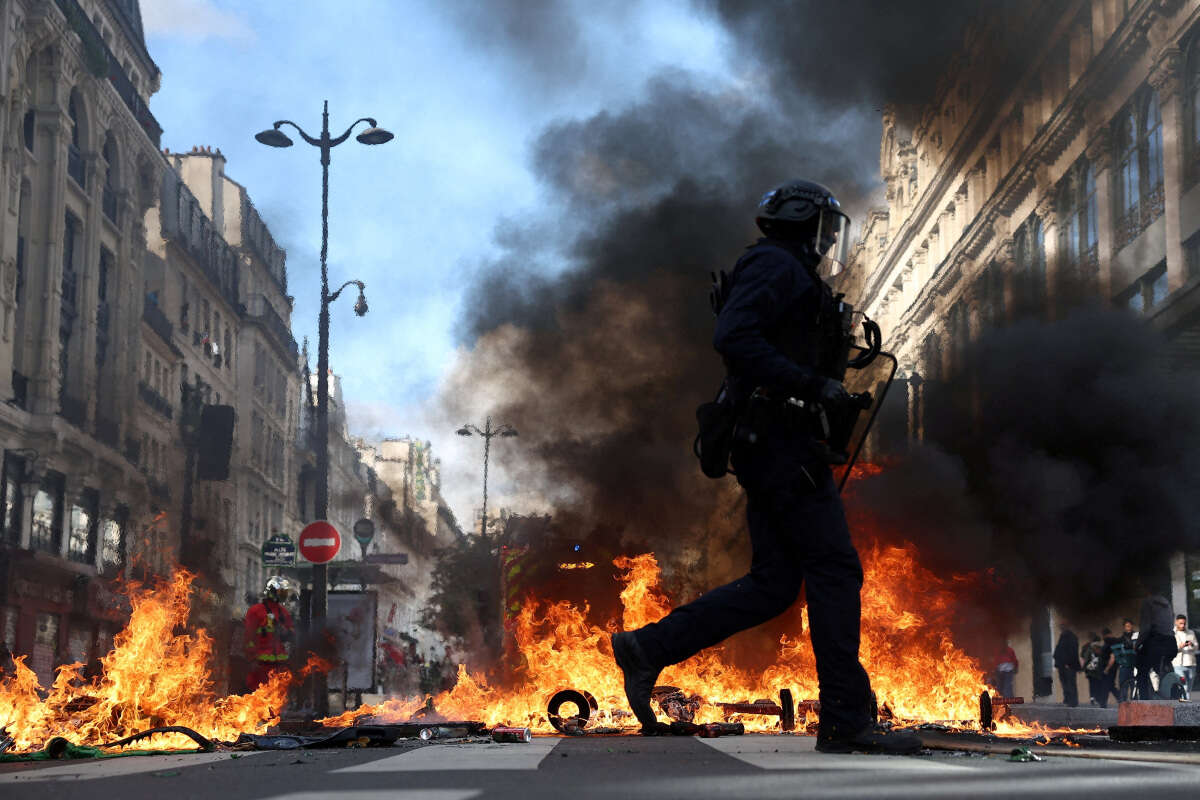
The riots in France are the most serious since the student uprising of May 1968, and they will worsen further unless the authorities take drastic measures and declare a state of emergency. They began as a wave of protests by secondary school students over shortages of teachers and educational facilities, and rapidly developed into one of the greatest crises France has experienced in recent decades.
The fracture runs very deep, and confidence in law enforcement has collapsed completely, despite the tens of thousands of police officers deployed in Paris and provincial cities. They struggled to contain the outbreaks of violence, looting, car burning, and attacks and arson targeting symbols of state authority.
The instructions given to police restricted the use of maximum force, amid grave concerns about large numbers of fatalities. The authorities also refused to describe the rioters as terrorists, while the clashes left hundreds of police officers injured.
There is no doubt that President Macron has lost control, and he bears the primary responsibility for the current situation. He preferred to concern himself with resolving the conflict in Ukraine or the Palestinian issue, displaying complacency and excessive arrogance while neglecting the pressing problems within his own country. He failed to take appropriate measures against the growing waves of immigration from the Maghreb countries and demonstrated helplessness in the face of demands from Islamist organizations. He also dismissed the distress of the Jewish community and rising antisemitism, despite all his empty promises to improve the situation. Over the past nine years, he has failed in every sphere, in both domestic and foreign policy.
In six months, he will leave the Élysée Palace in disgrace, with France bleeding, suffering from the high cost of living and energy, its economy severely damaged and its public finances collapsing, with the national deficit estimated at more than three thousand billion dollars and public debt now exceeding 120% of GDP.
Far-left leader Jean-Luc Mélenchon is exploiting the crisis to fuel anarchy among young people in the suburbs, most of whom are immigrants. There are fears that he will intensify the protests to win Muslim support and secure a place in the second round of the presidential election, scheduled for next April.
Meanwhile, far-right leader Marine Le Pen is succeeding in strengthening her position and now leads all the polls ahead of the presidential election.
The political paralysis is severely damaging France's standing in Europe and on the international stage. It will also affect conflicts in the Middle East and relations between Paris and Jerusalem.
Macron has no geopolitical assets left, and France's diplomatic capacity is at its lowest ebb. In the coming weeks, we will know whether a domino effect will spread violent protests across Europe.