


Before the end of his second term, which officially concludes on May 13, 2027, Emmanuel Macron is striving by all means to erase his negative image in French and international public opinion and hopes to leave the political scene with geopolitical, diplomatic, and economic successes. To achieve this, he has decided to strengthen cooperation with the Arab and Muslim world, and particularly with Saudi Arabia. This final mission before his definitive departure from the Élysée Palace seems impossible, however, because after a long decade in power, Macron, a former investment banker, leaves behind a staggering public debt of $4.196 trillion. It is worth noting that the GDP per capita in France is $52,083, while the gross domestic product stands at $65,303 for a German and $69,804 for an Israeli.
How do you make France's voice heard in the Middle East and encourage wealthy investors? Well, you sell part of your assets to foreigners…
Saudi Crown Prince Mohammed bin Salman (MBS) has just completed an official visit to Paris. France, a self-proclaimed "champion of human rights and press freedom," readily grants pardons when it comes to signing trade contracts with Arab countries. The Saudi prince's responsibility in the heinous assassination of journalist Jamal Khashoggi in Istanbul in 2018 is conveniently overlooked.
MBS has become familiar with France; he acquired the sumptuous Louis XIV château, a 23-hectare enclosed estate, for €275 million… During his last visit, he signed numerous contracts in several sectors, including nuclear energy, aeronautics, urban and maritime transport, armaments, development of artificial intelligence (AI), and he is planning to create in France three gigantic theme parks… More than 500 French companies operate in Saudi Arabia and trade between the two countries has reached $12 billion.
France's diplomatic relations with the Arabian Peninsula began with the opening of a consulate in Jeddah in 1839, the first French representation in the Middle East. Relations were severed in 1956 during the Suez Crisis and renewed six years later. General de Gaulle's decision to impose an arms embargo on Israel was made during King Faisal's historic visit to Paris from June 2nd to 6th, 1967. During his second visit in 1973, just before the Yom Kippur War, President Pompidou provided him with Mirage fighter jets…
To develop trade with the Arab world and in the face of the Strait of Hormuz crisis and the economic strangulation of Iran by the United States, France is striving to play a role of diplomatic influence in the region and to associate MBS with geopolitical and strategic initiatives, steps which are clearly against the interests of the State of Israel.
After co-chairing an international conference in New York with MBS in July 2025 to recognize the urgency of creating a Palestinian state, Macron is considering reviving this initiative within the framework of the next UN General Assembly.
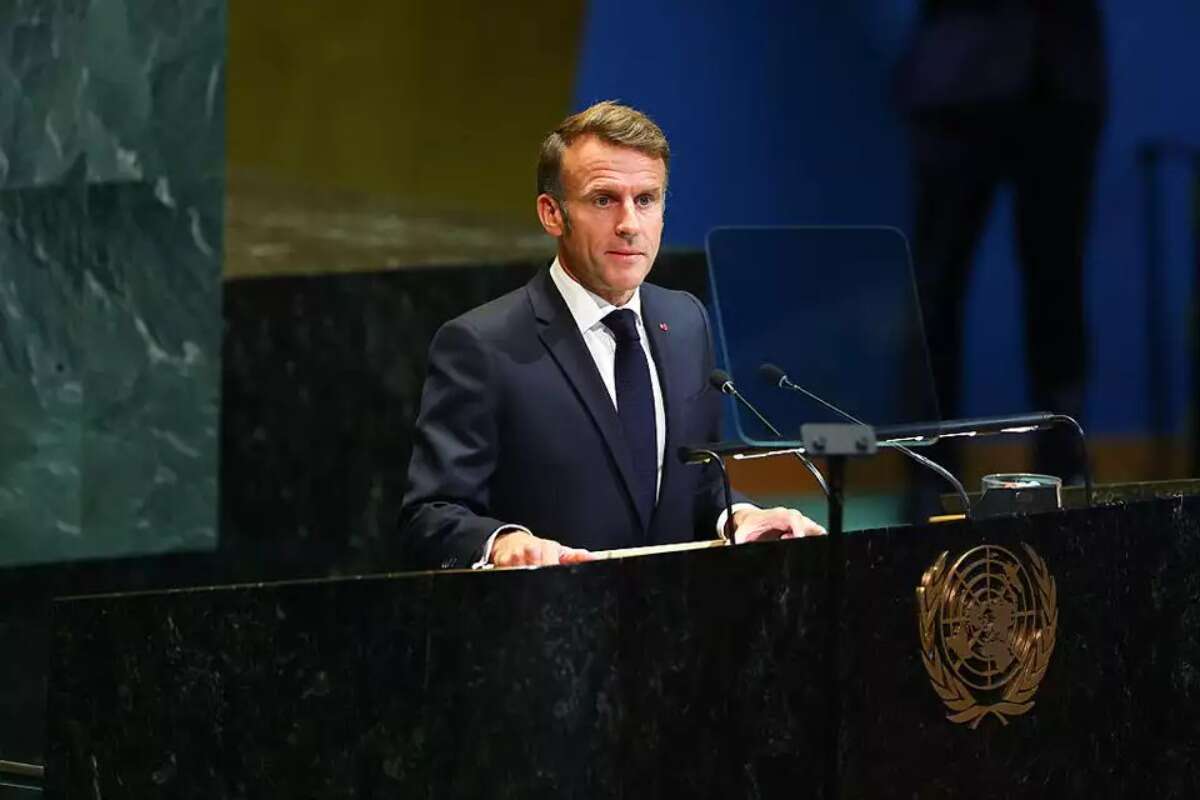
He wants to accelerate the second phase of the roadmap for Gaza despite the prevailing tension and daily provocations from Hamas. Is the disarmament of the Islamist organization no longer an absolute priority for him?
On August 22, 2026, 102 former French and British diplomats published an op-ed in the newspaper Le Monde demanding concrete action from Paris and London in response to the critical situation in Gaza and the West Bank. Under the title " Palestine is disappearing before our eyes," they called on France and the United Kingdom, as permanent members of the UN Security Council, to act together to uphold international law. They described "settler violence in the West Bank and East Jerusalem," which they allege is supported by the Israeli army, as "ethnic cleansing." While condemning the massacres committed by Hamas on October 7, 2023, they reiterated that "nothing justifies the systematic destruction of Gaza."
Since Hamas took power in Gaza, these same diplomats had been in favor of opening a "direct and frank" dialogue with this terrorist organization. The double standard persists. Bias dominates the minds of Westerners. Double standards are applied to judging the Israeli-Arab conflict.
Despite and in spite of the refusal of Israel and the United States to involve France in the solution to the conflict with Hezbollah and to sponsor security negotiations with Lebanon and Syria, Macron will host a preparatory meeting on September 17 with a view to strengthening and supporting the Lebanese army and its internal security forces.
French policy in the Middle East has not changed since the Sykes-Picot Agreement of 1916. Perceived as the "power of the Levant," France no longer has the leverage or the resources to play the role of mediator. All of Macron's attempts to act unilaterally to achieve his ambitions are clearly counterproductive. They risk sabotaging the American plan and, above all, the normalization process with Saudi Arabia, Syria, and Lebanon.


