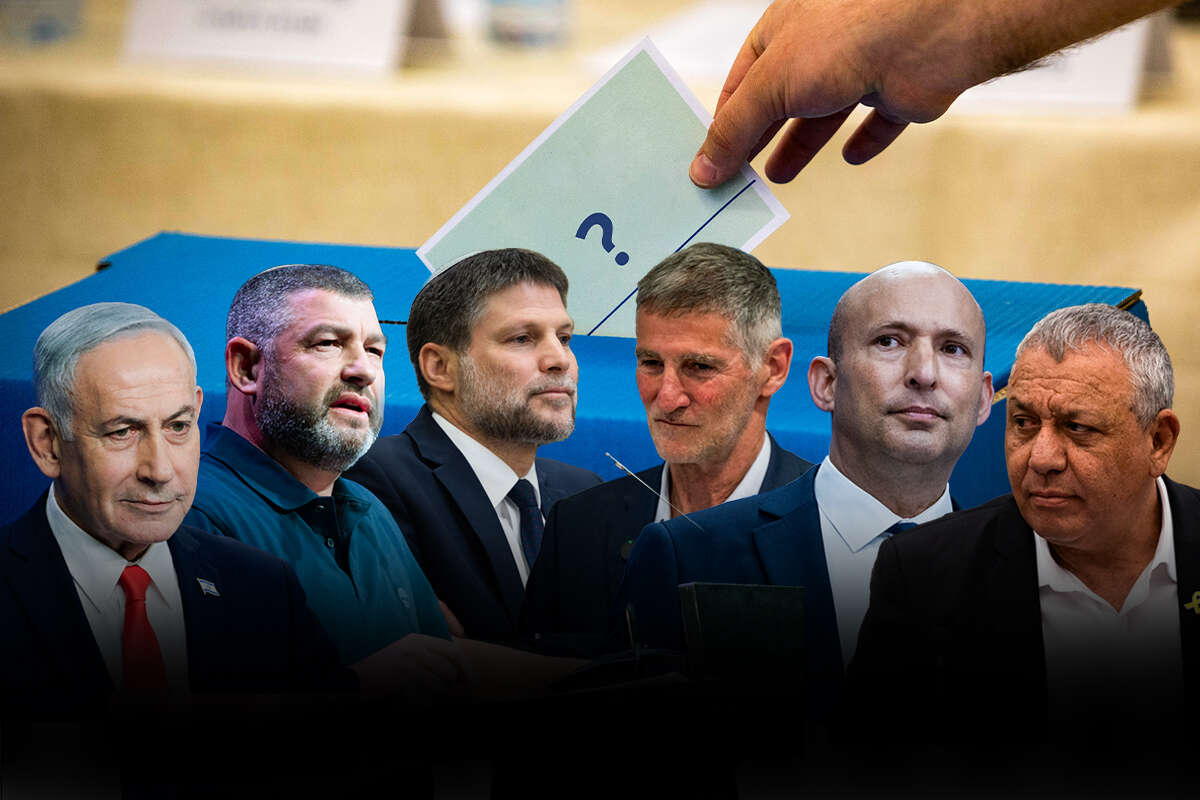
This is the first time since 1988 that the Knesset has completed its full term. This proves that despite the terrible massacre of October 7, 2023, and the daily war we wage against Hamas, Hezbollah, and Iran, governmental stability has persisted, unlike in the past when the country endured five successive parliamentary elections in less than four years. It is also astonishing to note that Benjamin Netanyahu is breaking all longevity records in a democratic country. After 16 years in power, at the age of 78 and with a trial underway, he is still running for another term. Is politics an aphrodisiac? How can we accept democratic erosion? A gradual weakening of power leading to autocracy?
Israelis are a highly politicized society, yet in this new election campaign, as in previous ones, we are witnessing a personalization of the parties. It's reminiscent of a show business competition or a job search.
Looking at the lists of candidates, we can be pleased to see new, young faces, including many women, and competent and dedicated technocrats with extensive experience in public service. This demonstrates that Israelis desire radical change, fresh blood to improve living standards, find effective and rapid solutions in all areas, and reduce inequality.
As a result, it's clear that ideologies and political programs have faded away. Unfortunately, we are also witnessing verbal violence, a cacophony of televised commentary, heated debates and empty messages on social media, and meaningless, populist, and unrealistic promises.
With the trivialization of democracy and the erosion of grand ideas, politics has become a mediocre spectacle. Television personalities and commentators no longer conceal their opinions, while politicians are capable of playing the fool to attract attention. Some journalists and columnists dare to manipulate information without scruple, campaign strategists, many of whom come from America, set the tone, while the people, yearning for a better future, watch this charade as mere spectators, utterly bewildered. Alas, with the use of artificial intelligence (AI), the distinction between the important and the insignificant, the essential and the trivial, the false and the true, has become blurred.
There is, as indeed throughout the world, a leadership deficit. Here, everyone aspires to become, overnight, Minister of Defense or Finance, or even Prime Minister. Ego triumphs, and megalomania prevails over modesty and competence. Young political upstarts and charlatans are far more numerous today than true leaders, true statesmen, those who possess a vision of a better world, with the charisma, audacity, experience, and quiet strength that work tirelessly for the interests of citizens and the affairs of state, not for their own private and family future.
In a context of heightened uncertainty since October 7, 2023, hope has been shattered and weariness has taken hold, indifference has spread, and so many remain undecided. Yet, the challenges and threats are still there, at our doorstep, ever-present. The socio-economic situation remains precarious, and the divide between left and right, religious and secular, Arab and Jewish is profound, at the very moment when Islamic unrest in our region is devastating and unfolding on all fronts.
The Israeli problem also lies in the proliferation of small, capricious, and pivotal parties that cling to power.
Israel has been at war since its rebirth in 1948, and as a result, a large portion of Israel's leadership comes from the military. The ongoing conflict with the Arabs has given military leaders the privilege and the ability to become the authority and a model for governing affairs. However, in a democracy, the people do not represent a disciplined army, soldiers who obey orders without protest.
Certainly, we refuse to become a military regime or a theocratic state, but we also note that we are the only democratic country where former generals, as well as rabbis, often dictate the course of action according to a sectarian conception that is very limited in time and space, without taking into consideration all the diplomatic aspects, geopolitical and economic issues.
A military leader or senior security official who has left the service must also understand the difference between soldiers and agents who obey orders and supporters who follow their leader with genuine sympathy. In a democratic country, it is dangerous to blindly follow one's leader like a herd. The cult of personality only works in totalitarian regimes.
In this alarming context, it is therefore imperative and urgent to radically change the current electoral system and remove certain rabbis who use religion for political, sectoral, and budgetary purposes. The goal is to be able to make bold decisions and launch reforms without blackmail or coercion.
Unfortunately, we pay the price of political negligence every day. It is eating away at us from all sides, and we risk losing control and sliding into decadence. It is therefore crucial that we quickly take our destiny back into our own hands.
Israel is a Jewish state where several minorities live, and it is our duty to ensure absolute equality and total security for all citizens. In return, everyone must assume their civic responsibility and contribute to the national effort.
Certainly, Israel is not currently in decline, and the overwhelming majority of Israelis are happy to live in their homeland, but the political landscape and its plans must already undergo profound changes on all fronts. A grand political vision must be rebuilt, the essential goal of which is to bequeath to future generations a Jewish and democratic state, livable, militarily and economically powerful, coexisting with our Arab neighbors, and above all, respected by the international community.