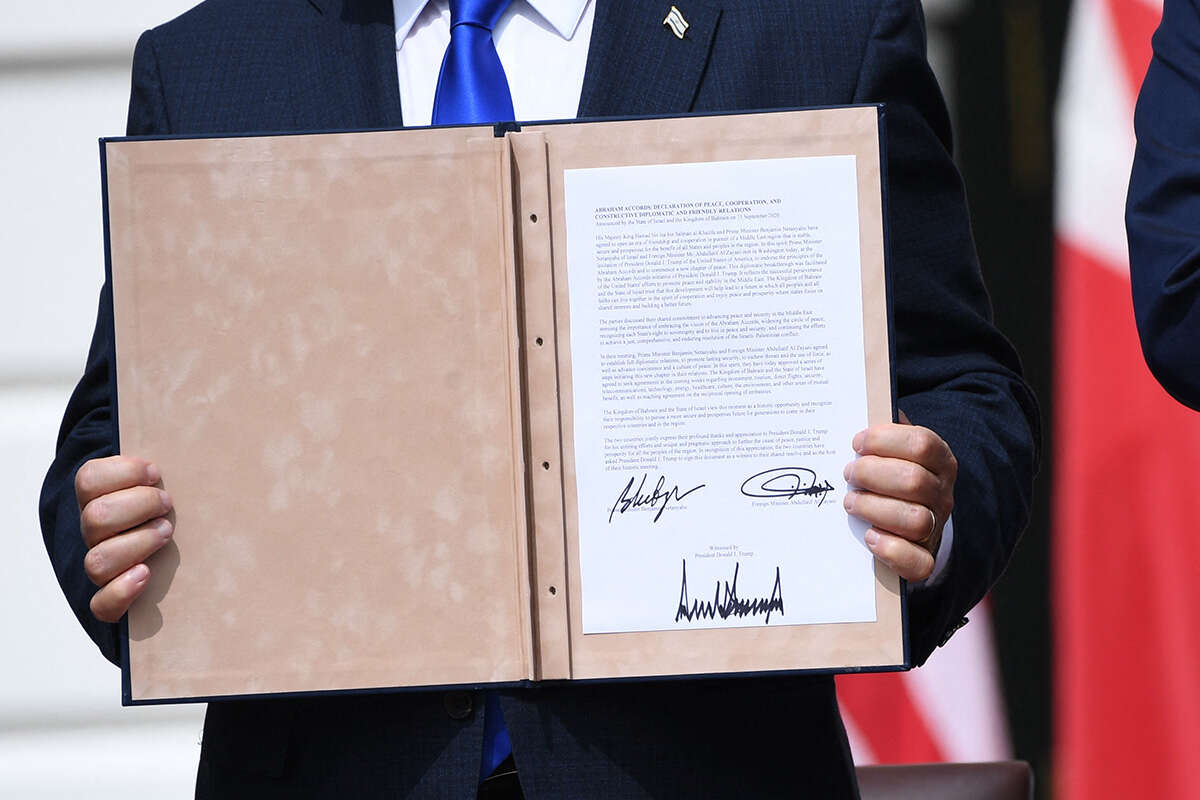
Several days have passed since the dramatic, earth-shattering revelation that a leader of one neighboring country advised another neighboring country to sign some sort of sham agreement with Israel in order to lull it into a false sense of security and then launch a surprise attack. The report received extensive media coverage, and the reactions were, naturally, various expressions of shock and concern. The underlying report said officials from one country had urged another to reach an agreement with Israel as a tactical measure while preparing for a future military confrontation. The identities of the countries remain under military censorship.
I, too, insignificant little me, was shocked and appalled. Almost like that girl I once was, back when the Middle East was still new to me, who could not understand how the man in the keffiyeh could spout clichés about peace in English, incite terrorism in Arabic, and still get photographed with world leaders on the White House lawn; who could not understand how people were being blown apart on buses while elsewhere people were receiving prizes. As a child, I thought there must surely be something I was missing, some dramatic, closely guarded detail that defied ordinary logic and somehow, almost supernaturally, justified this circus.
Don't keep yourselves in suspense. There was no such thing. So thoroughly was there no such thing that even if someone took a putty knife to the floors of the censorship authorities' basements, they would not find a shred of evidence justifying the Israeli obsession, born more or less alongside the state itself, with making peace with our enemies.
Is it really far-fetched to assume that even back then, when peace fever was burning almost as fiercely as the fuel tanks of Jerusalem's No. 18 buses, there were reports resembling this week's revelation about the true intentions of Arab leaders, but the censor did not permit them to be published? How much are our worldviews really based on facts if we are unaware of most of them? And how meaningful is our choice of leaders if the issues that truly matter are never discussed at all?
Make no mistake: Dreams matter. Those who do not dream do not achieve. The question is how much that dream rests on fragments of reality. I can dream of an NBA career and invest time and energy in pursuing it. But when, even on my tallest day, I do not clear 1.60 meters (5 feet 3 inches), if I start making decisions on that basis and organizing my future and my daily schedule around it, including five hours of basketball practice, I am disconnecting myself from reality and neglecting my children. And that is the less frightening part of the story.
The depth of the problem becomes clear when we remind ourselves that the beliefs we hold, such as the possibility of a "New Middle East," shape the way we interpret reality. A murderer in a suit and costume can suddenly appear to be a man with answers; tanks maneuvering in Sinai can look like a family fun day for the division's wives and children; and demonstrations along the Gaza border fence opposite Israeli communities near the Strip can be recast as a leisure activity for teenagers.
And so, regrettably, we have reached a point where the citizens of this country are forced to endure an exhausting campaign of gaslighting, training us to be shocked and outraged when a false belief we never held in the first place is violated. I do not know even 10 people who would be surprised to discover that countries around us might sign agreements they do not genuinely intend to honor and then attack us when the opportunity suits them.
The question is how this deep understanding shapes Israeli politics and affects the positions taken by those who aspire to lead the country. At present, there seem to be almost no people in the political system capable of saying clearly that peace in its photogenic form will never exist here, that everyone wants to kill us all the time, and that our foreign and domestic policy, including our national priorities, must be managed accordingly.
There is a very simple answer to the question, "Will we forever live by the sword?" The answer is yes. But if we truly want to live by the sword rather than die by it, we would do well to shed all the posturing and games of make-believe, along with the confusion that leads a man who once headed an army to describe the well-known principle, "If someone comes to kill you, rise early and kill him first," as a slogan.
Those for whom a basic survival instinct, one that ought to serve as the motto of an army whose very name proclaims its defensive mission, is merely a slogan may one day find themselves calling out the "Shema Yisrael" prayer outside safe rooms so that those barricaded inside will know they are not Hamas Nukhba terrorists.