

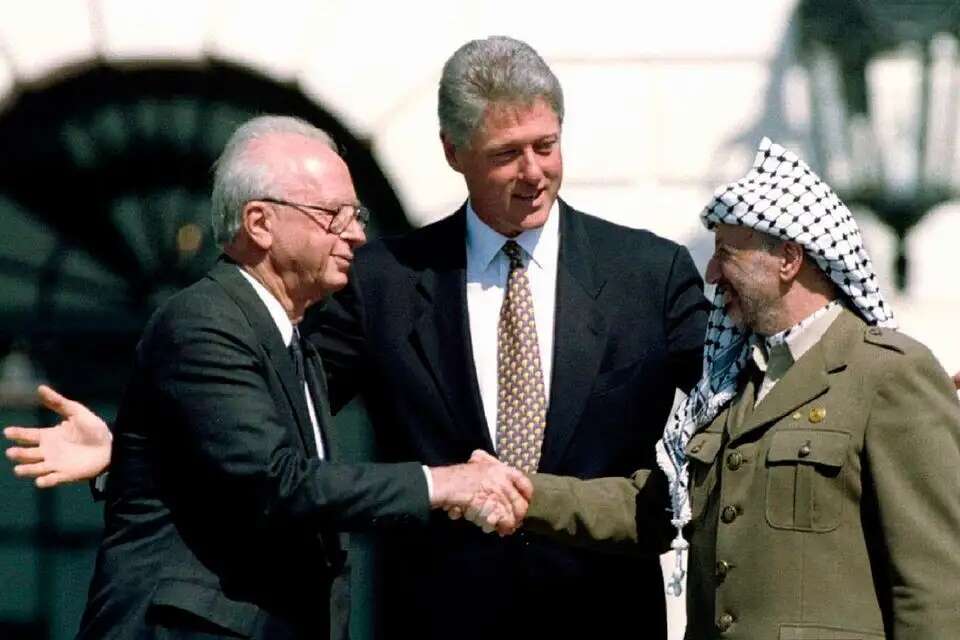
A single, simple question was raised last week during a meeting of the Knesset Foreign Affairs and Defense Committee's Subcommittee on Judea and Samaria: Who is monitoring violations of the Oslo Accords?
And, as in the famous song, all the soldiers, all the cannons and all the experts stood there pale-faced, unable to provide an answer. It even seemed as though they had never looked for one.
Those celebrated agreements, signed 30 years ago to the cheers of jubilant crowds and hailed as the State of Israel's great hope, have become a double-edged sword for the country. Yet no one is bothering to address the basic question: Who is examining the violations of the accords?
Any reasonable person, and anyone who has ever signed an agreement of any kind, can say exactly which clauses were violated and by whom. They know whether a tenant brought in a dog despite the landlord's prohibition, whether a divorced parent failed to take the children on the days agreed upon, or whether a company failed to meet its obligations to an employee.
The Oslo Accords are admittedly complex and intricate. Some of the finest legal and policy minds of the time worked on them. Yet even feeding their hundreds of pages into an artificial intelligence program could give the average reader a fairly accurate picture of a reality in which it appears that only one side is honoring the agreements, and that this is the side risking its life by doing so. It is the side that, in the words of the prime minister at the time, would cease to have a Jewish state if it laid down its weapons.
Weapons suited for war, training designed to prepare forces to seize territory and communities, construction in violation of the agreements, the takeover of open land, and above all, the daily reality of complete insecurity for the Jewish residents of Judea and Samaria, who live under a constant threat of terrorism emanating from the same areas that were neatly divided into Areas A, B and C. Today, those letters mainly stand for lawlessness.
Political positions no longer matter, nor does the question of whether signing the accords was right or wrong. What matters is asking a simple question: Did the State of Israel examine what actually happened to the agreements on which it based part of its security doctrine for years? Which commitments were fulfilled, which were violated, who sounded the alarm in real time, and what consequences did those violations have for the security of Israeli civilians?
Representatives of the Defense Ministry, the Coordinator of Government Activities in the Territories, the Israeli body responsible for coordinating civilian affairs in Judea and Samaria and the Gaza Strip, and the National Security Council sat before the subcommittee and used countless words to tell its chairman one thing: We do not know. The responsibility rests on their shoulders, on those of the political decision-makers, and on those of the Knesset members who waited until the final moments of the parliamentary term to hold this critical discussion.
But no less responsibility lies with those who decide which issue is supposedly the most urgent one to shout about at any given moment: what the Knesset did or failed to do, what people should demonstrate over, who was photographed holding which cup, and what, under no circumstances, we are permitted to forgive.
The same media that remained silent while the foundations of the previous failed security doctrine were laid over decades are silent now as another disaster takes shape before our eyes.
We left the committee meeting stunned, knowing that the foundations had once again been laid for the commission of inquiry that will be established after the next massacre, provided anyone is left to establish it.


