The United States intensified its financial pressure on Iran on Tuesday, slapping anti-terrorism sanctions on the head of its central bank and barring anyone around the world from doing business with him.
The move deals a further blow to European hopes of salvaging the 2015 Iranian nuclear deal in the wake of President Donald Trump's withdrawal from it last week.
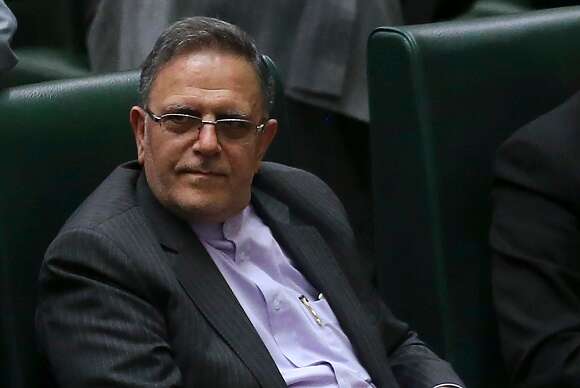
Valiollah Seif, the governor of the Central Bank of the Islamic Republic of Iran, was named a "specially designated global terrorist," as was senior official Ali Tarzali, who works in the central bank's international division.
The U.S. Treasury Department accused the men of secretly funneling millions of dollars through an Iraqi bank to help Iran's terrorist proxy in Lebanon, Hezbollah.
Although the sanctions technically do not extend to the bank itself, they could significantly increase Iran's isolation from the global financial system. Seif, whose role is equivalent to the Federal Reserve chairman in the U.S., oversees major financial decisions in Iran. Any transactions that involve his signature could run afoul of the sanctions, creating a strong disincentive for governments or businesses considering deals involving Iran's central bank.
"The United States will not permit Iran's increasingly brazen abuse of the international financial system," Treasury Secretary Steven Mnuchin said. "The global community must remain vigilant against Iran's deceptive efforts to provide financial support to its terrorist proxies."
Typically, when the U.S. slaps sanctions on individuals, it prohibits American citizens and companies from doing business with them. In this case, the U.S. has chosen to impose "secondary sanctions" as well, also preventing non-American citizens and companies from doing business with the sanctioned individuals. This means that anyone in any country who does business with Seif or Tarzali could be penalized by the U.S.
The latest move comes as Trump's administration works to construct a global coalition to place enough pressure on Iran that it comes back to the negotiating table to redraw the nuclear accord.
However, the European members of the accord, who have criticized Trump over his withdrawal, have yet to commit to that effort. To the contrary, Britain, France and Germany are working to salvage the existing accord. Their top diplomats met Tuesday in Brussels with Iranian Foreign Minister Mohammad Javad Zarif in a bid to keep Iran from bailing out.
Whether the deal can survive without the U.S. depends on whether Iran continues to receive sufficient economic benefits by way of business with the Europeans. Not only is Trump reimposing sanctions on Iran, he is also threatening to take the dramatic step of punishing European businesses that do not wind down their dealings with Iran. This has left the Europeans in the undesirable position of having to decide whether to call his bluff.
The new sanctions on the central bank officials appear designed to strengthen Trump's hand and create another way in which anyone doing business in Iran could risk being cut off from New York, the heart of the global financial system.
"Trump can use this in his arguments with Europe to deter business with Iran," said Behnam Ben Taleblu, an Iran sanctions expert at the hawkish Foundation for Defense of Democracies. "All of this is another arrow in the quiver."
The sanctions are expected to be followed by additional U.S. actions in coming weeks, as the Trump administration works to dismantle the main banking conduits exploited by Iran and its Revolutionary Guards to convert Iranian rials into euros or dollars. Those Western "hard currencies" can be used to fund extremist elements, such as in Lebanon and Syria.
Seif, a career banker, became the head of Iran's central bank in 2013 under President Hassan Rouhani, who shepherded the nuclear deal.
Seif frequently visits Washington to attend meetings of the International Monetary Fund, and helped guide Iran's economy through the web of previous sanctions placed on that country.
When sanctions on Iran were lifted in the aftermath of the 2015 accord, Seif was prominent in complaining that Iran was still being kept out of the global financial system and was not receiving the economic benefits it had been promised in exchange for curtailing its nuclear program.
At a meeting of the Council on Foreign Relations in Washington in 2016, Seif said Iran achieved "almost nothing" from the deal.
The Treasury said Seif undermined the central bank's credibility by routing millions of dollars from the Quds Force, the black-ops unit of Iran's Revolutionary Guards, to al-Bilad Islamic Bank, based in Iraq. Those funds were then used to "enrich and support the violent and radical agenda of Hezbollah," the Treasury said.
Al-Bilad Islamic Bank and its CEO and chairman, Aras Habib, have also been hit with U.S. sanctions, as has Muhammad Qasir, a Hezbollah official said by the Treasury to be a "critical conduit" for transferring funds to Hezbollah.
U.S. officials were reaching out Tuesday to central banks in other countries in the Middle East and Europe to inform them of the sanctions and encourage them to immediately freeze assets the bank has overseas.
Although it is rare to sanction central bank officials, the U.S. has done so before. In 2015, the U.S. targeted the governor of Syria's central bank, and earlier this year, the Trump administration ordered sanctions on the deputy governor of Russia's central bank, Alexander Torshin.