The greatest election marathon in the world has come to an end with a historic yet disappointing victory for the incumbent Indian Prime Minister Narendra Modi, aged 73, who was re-elected to lead the world's largest democracy for a third consecutive term.
However, contrary to optimistic forecasts, Modi secured a slim majority of 294 out of 543 seats in the lower house, failing to replicate his success from 2019. Modi, who had set a goal of crossing the 400-seat threshold under the slogan "Abki Baar, 400 Paar" ("This time surpassing 400") and who had turned Indian politics into a one-person show in recent years, received a reminder that meticulous planning in governing the country is not the sole key to his continued rule.
The surprising election results also left their mark on the markets. Over the last 48 hours, stock exchanges in Asia, including the Indian Nifty 50 index, were in the red. Many investors are concerned about the narrowing of Modi's room for maneuvering in forming a coalition and implementing significant reforms.
A decline was also observed in voter turnout compared to previous elections. The reasons for this likely stem from the extreme heat wave that hit the country during the voting period and the sense that nothing could stand in the way of the Modi juggernaut's clear victory. After a decade in power and fulfilling most of his promises to voters, Modi left little room for the possibility of change.
Disgruntled in-house rivals
Modi's campaign emphasized the importance of preserving and expanding his achievements. From the ruling party, little has remained but the orange color representing it, and at the forefront of the election campaign stood Modi's figure. The party's platform reflected a similar spirit, dubbed the "Modi Guarantee."
Furthermore, Modi employed various tactics to ensure his victory, such as recruiting famous candidates, including movie stars, to get rid of veteran candidates in key areas; attacking the Opposition's strongholds in the south through outreach to the Christian minority; and repeating a mix of populist messages that proved effective in the past, primarily focused on economic development, strengthening Hindu nationalism, and reinforcing the voter base in the party-controlled areas in the northern states. Modi added to this a sophisticated strategic ground game and, organizational commitment, and tactical flexibility – everything needed to achieve the goal.
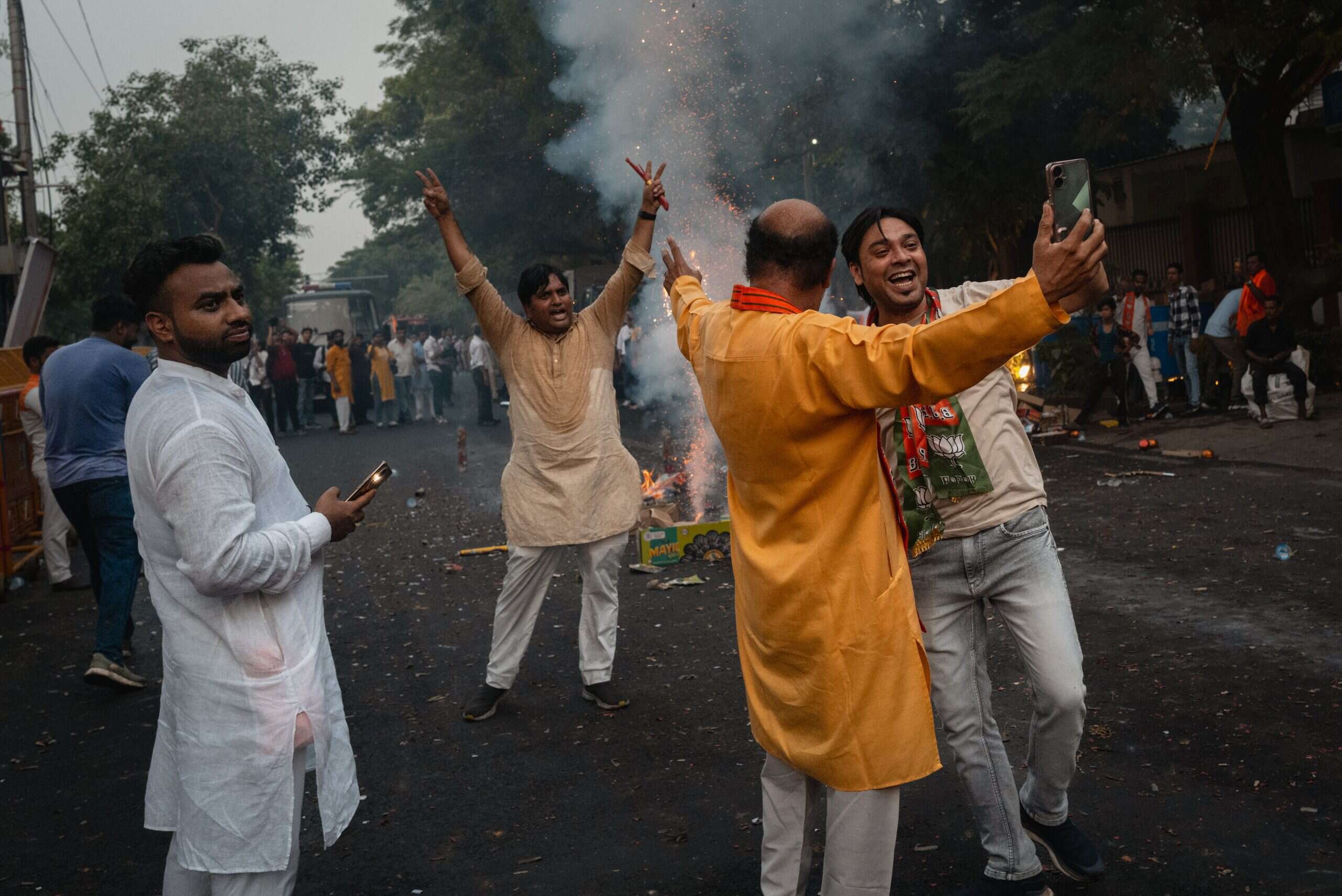
Modi's clique may have won, but it also had to eat some humble pie. For a decade, the "Modi cult" managed to create quite a few bitter in-house rivals who did not look kindly upon the adoption of Vladimir Putin's authoritarian methods in the land of Buddha. Long periods in power, coupled with an authoritarian and meticulous leadership style, led members of Modi's BJP party to adopt a very independent stance, causing internal tension with the party's various strongholds – chief among them the RSS, the umbrella organization of the Indian right-wing from which Modi had emerged.
Approaching the elections, this line became more rigid. J.P. Nadda, the BJP's president, said about the relationship between the bodies: "The party can go it alone. The RSS is a cultural-social organization, and we are a political organization. We manage our affairs our way."
Words are one thing; reality is another. The party's power is rooted in the RSS's ability to convert its influence into electoral power. These internal tensions and an alienating attitude towards party members marked as potential rivals and pushed to the sidelines are just some of the cracks that opened up during Modi's ten years in power.
The privileged vs. the tea seller
For years, the Opposition seemed frozen, having failed to present an alternative to voters. In the current campaign, the messages focused on "saving democracy" out of concern over Modi's moves to change the constitution if he managed to secure the necessary majority in parliament.
The leadership crisis and rebellions within the Congress Party led it to make necessary changes. One of the party's problems was that, against Modi, the opportunistic tea seller from Gujarat, it fielded Rahul Gandhi, the privileged activist and grandson of former Prime Minister Indira Gandhi and great-grandson of India's first Prime Minister Jawaharlal Nehru.
On the Indian Left, they understood Gandhi's relative leadership weakness. To create a counterweight to the support for Modi, in March 2023, the Congress Party joined other parties to form a united front against the Right. This move proved its effectiveness, if only as a means to weaken the absolute power of the Right in the country.
A wake-up call for the party
Winning three consecutive elections is a challenging task for any politician, and Modi knew this, too. During his tenure, he pushed through a series of reforms that benefited the lower classes and rural people, from generous welfare programs to subsidies for services and basic goods. However, among India's urban and educated citizens, a sense emerged that the party was dealing with issues that did not really concern them, such as unemployment rates and soaring fuel prices.
Indeed, an analysis of the latest electoral map shows that the agricultural reform Modi's government tried to advance in 2020, which it was forced to abandon due to public pressure, left its mark. For example, in states that were at the center of the protest, Modi's party lost its footing and struggled to gain a numerical advantage.
In the ruling party, they knew that the triple victory would not be easy. Therefore, despite the relative disappointment, it is important to remember that Modi managed to win and positioned himself as one of the strongest leaders in the world. In the state of chaos and disorder, the BJP succeeded in imposing order that paved the way for the desired victory and the path to shaping the next hundred years in one of the world's most important powers.
The disappointment over the failure to expand the majority in the lower house could serve as a wake-up call for the conservative and antiquated party. If it manages to appease and accommodate the dissenting voices within, the future of Indian politics will continue to be very orange.
The author is an expert on India's foreign and security policy, an advisor to security companies, and a senior researcher at the Jerusalem Institute for Strategy and Security (JISS).