Israel Hayom is a media organization founded on the belief that the Israeli public deserves better journalism—more balanced, more accurate, and more reliable. Journalism that speaks rather than shouts. Journalism that is trustworthy, objective, and matter-of-fact. A different kind of journalism, offered free of charge. The first print edition was published on July 30, 2007, and in 2010 Israel Hayom became the Israeli newspaper with the highest weekday readership. The newspaper’s publisher is Dr. Miriam Adelson. Its Editor-in-Chief is Omar Lachmanovitch, and its founding editor is Amos Regev. Israel Hayom’s Hebrew and English websites, as well as its Android and iOS applications, provide around-the-clock news coverage, exclusive content, breaking news and updates, analysis and commentary, video, podcasts, and live broadcasts. The digital platforms of Israel Hayom include news and opinion channels covering culture and entertainment, lifestyle, technology, sports, business and consumer affairs, health, military affairs, food, Judaism, tourism, and automobiles. In 2021, a new Hebrew-language website and mobile application were launched to provide users with a fast, up-to-date, secure, and convenient experience. The content of the newspaper’s print edition is also available online through a daily digital edition and can be received via newsletter. “The Israel Hayom Clique,” the publication’s exclusive benefits club, offers website users discounts and special promotions on products and services. Israel Hayom welcomes feedback, criticism, and suggestions for improvement from its readers. You can contact the organization by email at hayom@israelhayom.co.il

Wednesday Jul 15, 2026
NEWSLETTER
www.israelhayom.com
  • Home
  • News
    • Israel
    • Israel at War
    • Middle East
    • United States
  • Opinions
  • Jewish World
    • Archaeology
    • Antisemitism
  • Lifestyle
    • Food
    • Travel
    • Fashion
    • Culture
  • Magazine
    • Feature
    • Analysis
    • Explainer
  • In Memoriam
www.israelhayom.com
  • Home
  • News
    • Israel
    • Israel at War
    • Middle East
    • United States
  • Opinions
  • Jewish World
    • Archaeology
    • Antisemitism
  • Lifestyle
    • Food
    • Travel
    • Fashion
    • Culture
  • Magazine
    • Feature
    • Analysis
    • Explainer
  • In Memoriam
www.israelhayom.com
Home News Israel Israel at War Gaza War

How Israel can win against Iran in its own dangerous game

Strategists in Jerusalem are working to prevent a scenario that Tehran desires most: a war of attrition. The key: securing a US pledge.

by  Ariel Kahana
Published on  10-11-2024 07:53
Last modified: 10-11-2024 16:22
How Israel can win against Iran in its own dangerous gameAP/Ebrahim Noroozi

Iranian Protesters unveil a digital countdown showing 8411 days until Israel is destroyed in Tehran, Iran, Friday, June 23, 2017 | Photo: AP/Ebrahim Noroozi

Share on FacebookShare on Twitter

The world watches with bated breath, wondering how Israel will respond to Iran's second missile salvo. Behind closed doors in Jerusalem, a crucial strategy is taking shape – one aimed at preventing Tehran's preferred scenario: a war of attrition. Such a conflict would unfold in a predictable, yet dangerous pattern: Israel retaliates, Iran launches more missiles at Israel and potentially other regional countries, Israel counters, and the cycle continues ad infinitum.

Israeli leadership, keenly aware of this trap, is reportedly considering a response of overwhelming force. According to Israel Hayom, the goal is clear: to strike Iran so decisively that the Islamic Republic will think twice before engaging in a protracted conflict with Israel.

It's worth noting that Iran's strategy of wearing down Israel and other US allies in the region is not merely a choice, but a necessity. Militarily, it's the only card left in Tehran's hand. Iran neither desires nor possesses the capability to deploy ground forces against Israel, given the vast geographical distance and intervening countries. Moreover, while Israel boasts one of the world's most formidable air forces, Iran's air capabilities are comparatively limited.

Israel's trump card in this high-stakes game is its unparalleled air defense system. For years, Iran had counted on its network of proxy organizations to provide a protective umbrella against Western strikes. However, a year into the current conflict, this strategy lies in tatters: Hamas is reeling, Hezbollah is on the back foot, and the various militias in Iraq and Yemen amount to little more than an irritant for Israel. The result? Iran finds itself unexpectedly exposed.
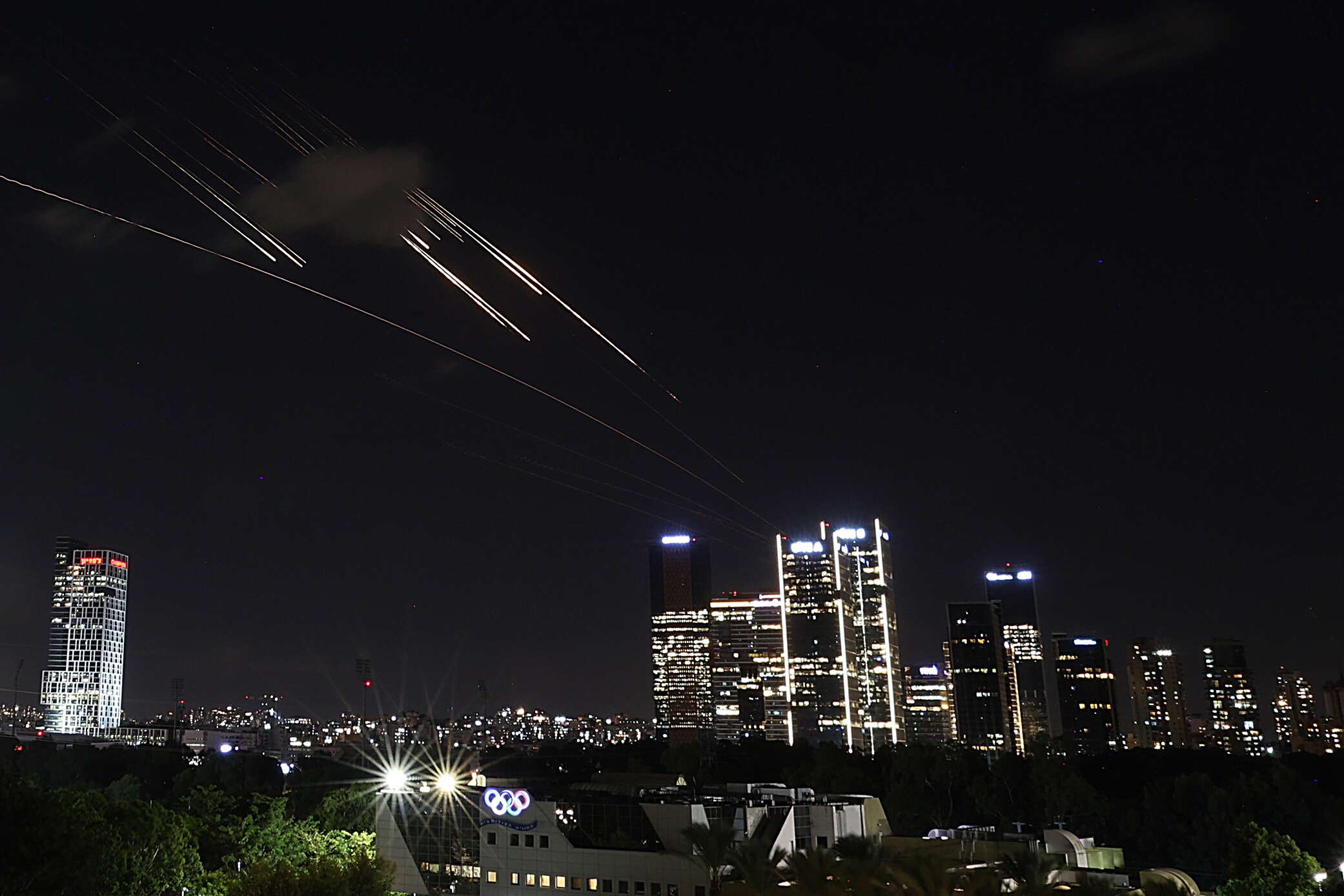
The Iranian barrage on Israel on Oct. 1, 2024 (KOKO) KOKO

Behnam Ben Taleblu, a senior researcher at the Foundation for Defense of Democracies (FDD), offers valuable insight into Iran's evolving strategy. "April was a watershed moment," he explains. "Since the first missile attack, we've seen Israel decisively seize the initiative, escalating the situation to its advantage. Iran, caught off guard, has found its military options severely limited."

Ben Taleblu, who has spent years studying Iran's missile capabilities, emphasizes the murky nature of the information landscape. "Concrete data on Iran's missile arsenal is scarce," he notes. "But estimates suggest they possess around 3,000 short and medium-range ballistic missiles – the largest such stockpile globally." These weapons, crucially, can reach Israel.

The second Iranian attack, in Ben Taleblu's assessment, showed marked improvement. "They doubled the missile count and employed more advanced systems," he observes. "While they didn't use the hypersonic missiles they've boasted about, they did deploy more maneuverable variants."

Oded Eilam, drawing on his experience as a former senior Mossad official, offers a more conservative estimate of Iran's capabilities. "Their arsenal likely numbers around 2,000 missiles," he suggests. "It's substantial, but their production capacity is constrained, with some lines dedicated to supplying Russia."

Even assuming the higher estimate of 3,000 missiles, questions linger about their operational readiness. Sources reveal that in the aftermath of the first attack, Iranian leaders initially doubted Israel's claims of successful interceptions. The reality of their failure took time to sink in, prompting a period of intense analysis and testing.

Learning from these setbacks, Iran deployed more advanced Fateh-2 missiles in their second strike. However, Eilam estimates their stockpile of these advanced weapons is limited to between 400 and 800. With 200 already expended in a single attack, Iran's reserves of truly effective missiles may be running low.

This raises a critical question: can Iran sustain a prolonged ballistic exchange with Israel? The numbers suggest their capacity for attrition warfare may be more limited than they'd like to admit.

Eilam is unequivocal in his assessment of the strategic balance: "Iran faces a significant disadvantage against Israel. They lack a single Arrow missile and there isn't a single shelter in Tehran. They're vulnerable in terms of maintaining operational continuity or recovering from an attack – precisely the opposite of Israel's capabilities."

To break the cycle of escalation, Eilam proposes a bold strategy. "Israel should consider a severe, but targeted strike," he argues. "Hit the nuclear program – even if we can't destroy it entirely. Target weapons depots and missile factories. Strike symbols of regime power, like the Revolutionary Court in Tehran. The goal is to send a message that resonates with every Iranian citizen, even without access to the internet."

Crucially, Eilam emphasizes the importance of coordination with Washington. He suggests securing a US commitment: if Iran dares to launch a third strike against Israel, the American response would target Iran's oil industry – the regime's economic lifeline.

This approach, Eilam contends, offers the best chance of deterring a war of attrition. But even if Iran miscalculates and strikes again, he believes the strategic math remains in Israel's favor. "They can inflict pain, certainly," he acknowledges. "But they're exposed in ways they never anticipated. The regime isn't built for multi-front warfare, and their overriding concern is survival."

Eilam's final assessment is sobering: "If Iran, against all logic, opts for a war of attrition, Israel's response must be overwhelming. Collapsing the oil industry on Kharg Island would be a potential endgame. At that point, the regime's fate would be sealed."

Tags: Gaza WarIranIsrael

Related Posts

This is what Hamas' disarmament would look like

Hamas rakes in millions, prepares for war

by Lilach Shoval

Direct taxation, control of markets and smuggling are helping Hamas swell its coffers. Funds from abroad are funneled into the...

Hasbara in crisis: How the October 7 massacre is being forgotten Arab Networks

1,000 days of war: Gaza border residents warn Hamas will return

by Shirit Avitan Cohen

The plan to establish humanitarian shelters near Rafah is stirring anger and concern in Gaza border communities. Officials warn: "Any...

Terrorist who held Omer Shem Tov captive in Gaza eliminated

Terrorist who held Omer Shem Tov captive in Gaza eliminated

by Lilach Shoval

Sabai Zahir Abd al-Hamid Abu Hasna, a Nukhba terrorist who took part in the Oct. 7 massacre and was involved...

Menu

Analysis 

Archaeology

Blogpost

Business & Finance

Culture

Exclusive

Explainer

Environment


Features

Health

In Brief

Jewish World

Judea and Samaria

Lifestyle

Cyber & Internet

Sports


Diplomacy 

Iran & The Gulf

Gaza Strip

Politics

Shopping

Terms of use

Privacy Policy

Submissions

Contact Us

About Us

The first issue of Israel Hayom appeared on July 30, 2007. Israel Hayom was founded on the belief that the Israeli public deserves better, more balanced and more accurate journalism. Journalism that speaks, not shouts. Journalism of a different kind. And free of charge.

All rights reserved to Israel Hayom

Hosted by sPD.co.il

  • Home
  • News
    • Israel at War
    • Israel
    • United States
    • Middle East
    • Sports
  • Opinions
  • Jewish World
    • Archaeology
    • Antisemitism
  • Lifestyle
    • Food
    • Travel
    • Fashion
    • Culture
  • Magazine
    • Feature
    • Analysis
    • Explainer
    • Environment & Wildlife
    • Health & Wellness
  • In Memoriam
  • Subscribe to Newsletter
  • Submit your opinion
  • Terms and conditions

All rights reserved to Israel Hayom

Hosted by sPD.co.il

Newsletter

[contact-form-7 id=”508379″ html_id=”isrh_form_Newsletter_en” title=”newsletter_subscribe”]

  • Home
  • News
    • Israel at War
    • Israel
    • United States
    • Middle East
    • Sports
  • Opinions
  • Jewish World
    • Archaeology
    • Antisemitism
  • Lifestyle
    • Food
    • Travel
    • Fashion
    • Culture
  • Magazine
    • Feature
    • Analysis
    • Explainer
    • Environment & Wildlife
    • Health & Wellness
  • In Memoriam
  • Subscribe to Newsletter
  • Submit your opinion
  • Terms and conditions

All rights reserved to Israel Hayom

Hosted by sPD.co.il