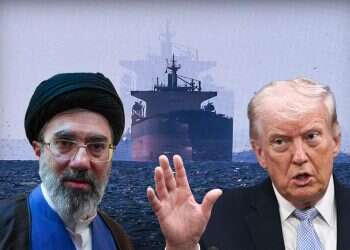
US President Donald Trump announced that the US military would launch "Project Freedom", an operation to escort vessels trapped in the Persian Gulf during the war out of the Strait of Hormuz. Earlier, Israel Hayom reported that US Central Command chief Adm. Brad Cooper had presented the president with the option of such an operation.
Israel is also monitoring developments. Prime Minister Benjamin Netanyahu held security consultations Sunday evening. A hearing in his trial that had been scheduled for this morning was postponed due to what was described as a "security-diplomatic schedule." In addition, a cabinet meeting planned for this evening was canceled.
"For the good of Iran, the Middle East, and the United States, we have told these Countries that we will guide their Ships safely out of these restricted Waterways, so that they can freely and ably get on with their business," Trump wrote in a post.

Trump added that if the process is interfered with in any way, it will have to deal with it by force, and that "the movement of the ships is intended solely to free people, companies and countries that have done nothing wrong. They are victims of circumstance."
This morning, Ali Abdollahi, commander of Iran's Khatam al-Anbiya Headquarters, responded to the US president's tweets and vowed that full control of the strategic strait remained in Iranian hands.
"All commercial ships and oil tankers in the area must refrain from any movement that has not been coordinated with the Iranian military deployed in Hormuz," he said, adding that "any US intervention will pose a danger to the region and to the security of ships in the area."
Some 20,000 sailors are stranded as a result of the crisis in the Strait of Hormuz aboard about 2,000 vessels that have been unable to cross the strait, according to figures from the International Maritime Organization. Trump said the move was a "humanitarian gesture by the US, Middle Eastern countries and especially Iran," although it was unclear whether Tehran had agreed to the operation.
"Many of these Ships are running low on food, and everything else necessary for largescale crews to stay on board in a healthy and sanitary manner," Trump wrote.
He added that he was aware that his representatives were "having very positive talks with Iran, and these talks may lead to something very positive for everyone." Earlier, Al Jazeera reported that, as part of a 14-point Iranian proposal, Tehran was demanding a complete end to the war within 30 days, the removal of the US naval blockade on Iranian ports, the lifting of sanctions, the release of frozen assets and the withdrawal of US forces from the region.

Under the same proposal, Iran had allegedly agreed to freeze uranium enrichment for 15 years and either transfer its stockpile of enriched uranium to another country or dilute it, but refused to dismantle its nuclear infrastructure.
The Fars News Agency rejected Al Jazeera's report Sunday evening regarding the details of the Iranian framework conveyed to the US. According to Fars, Al Jazeera was referring to a US proposal from 20 days ago that had "since been updated several times," and that included a 15-year freeze on uranium enrichment, arrangements for 60% enriched uranium and a gradual opening of the Strait of Hormuz, terms that "Iran firmly rejected at the time."
According to the agency, the US has since updated its proposal three more times, and in the latest nine-point proposal currently on the table, the terms reported by Al Jazeera are not included at all "because the American side knows Iran will not accept them."
The report further said that, in the latest development, Iran had responded by presenting its 14-point proposal, which clarified its red lines, and that the proposal "does not include consent to freeze enrichment for 15 years or to open the Strait of Hormuz." The Iranian Foreign Ministry spokesperson said earlier that the US side had sent a response to Iran's written proposal, and that Tehran was now reviewing it.