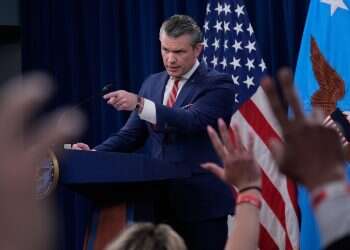
President Donald Trump announced overnight Tuesday that the Project Freedom – the American operation to escort ships through the Strait of Hormuz – will be suspended for a brief period, citing what he described as major progress toward a full and final deal with Iran. Trump made clear, however, that the American blockade on Iran would remain "fully in force," and that the pause was intended to determine whether a deal with Tehran's representatives could be completed and signed.
In a post on Truth Social, Trump wrote, "ased on the request of Pakistan and other Countries, the tremendous Military Success that we have had during the Campaign against the Country of Iran and, additionally, the fact that Great Progress has been made toward a Complete and Final Agreement with Representatives of Iran, we have mutually agreed that, while the Blockade will remain in full force and effect, Project Freedom (The Movement of Ships through the Strait of Hormuz) will be paused for a short period of time to see whether or not the Agreement can be finalized and signed."

The announcement marks a tactical shift in the American effort around the strait, but not a withdrawal from its pressure policy toward Iran. Earlier, Trump had presented the Freedom Project as a move designed to help neutral countries whose ships had been trapped in the Strait of Hormuz, even though they were not parties to the conflict. According to Trump, after countries from around the world asked the US to help release the ships and crews, Washington told them it would make "its best efforts" to bring them out safely. Now, according to Trump, that same move has been temporarily frozen at the request of Pakistan and other countries to allow diplomatic contacts to run their course.
During the day, Trump also delivered sharper remarks from the Oval Office. He said Iran was in a position of weakness following the American campaign. "They don't like playing games with us – they don't like it at all," he said. "I think you've already seen that. We basically wiped out their military in about two weeks." He stressed that the goal of the pressure was to prevent Iran from obtaining nuclear weapons. "We can't give these people nuclear weapons. They will use them," he said.
Secretary of State Marco Rubio presented Project Freedom as a new phase following the conclusion of Operation Epic Fury. According to Rubio, the president had already briefed Congress that the broader military phase had ended, and that the current effort was a "defensive operation" intended to ensure the safe movement of ships and civilian crews. Rubio said that nearly 23,000 civilians from 87 countries had been "abandoned to die by the Iranian regime" after being stranded for more than two months aboard commercial vessels.
.@SecRubio: "Operation Epic Fury is concluded. We achieved the objectives of that operation. We're not cheering for an additional situation to occur. We would prefer the path of peace. What @POTUS would prefer is a deal... that is, so far, not the route that Iran has chosen." pic.twitter.com/blkqn3Bqdm
— Rapid Response 47 (@RapidResponse47) May 5, 2026
At the Pentagon, Defense Secretary Pete Hegseth and Chairman of the Joint Chiefs of Staff Gen. Dan Caine made clear that Iran was continuing to fire on and harass ships and American forces, but that Washington still viewed these as actions "below the threshold" of resuming full-scale combat. Caine described the incidents as "low-level harassing fire" and said the decision on the threshold for resuming hostilities was a political one.
The Fars News Agency, which operates on behalf of the regime, posted on Wednesday morning, "Trump retreats again by halting Operation Project Freedom."