1.
In honor of the arrival of summer, and just before the Harvest Festival of Shavuot, we begin reading the fourth book of the Torah, Numbers, or Bamidbar. In Genesis, we encountered the roots of the nation. In Exodus, we read of the people's birth from the house of bondage and the receiving of the constitution in the covenant at Sinai. In the third book, Leviticus, the clauses of the covenant were detailed, the commandments and the afflictions. And so, we arrive at the story of the long road through the wilderness, from Egypt to Jerusalem. Not only the Sinai Desert, but also the wilderness of the nations, the valley of the shadow of death that we crossed for thousands of years until we returned home.
The wilderness represents departure from order. Wandering brings difficulties, crises, dangers and challenges. In the Bible, the word "mashber," crisis, referred to the birthing stool on which a woman in labor knelt to give birth. In the dialectic of history, we needed crises in order to grow from them and shed the old slave consciousness, so as to be born anew as a free people with the consciousness of free men.
2.
If Deuteronomy is our book of the state, long before Plato's Republic, dealing with our entry into the land and the arrangements of government, law and administration, then Numbers is the book of exile, dealing with our mode of existence without a land, a test no other nation managed to survive. The promise of existence in exile and return to the land is found at our very beginning, in the Covenant Between the Parts made with the founder of the nation: "Your descendants will be strangers in a land not theirs, and they shall serve them, and they shall afflict them" (Genesis 15:13). Existence in exile would be difficult, but an end was set to the darkness: "and afterward they shall come out with great possessions ... and the fourth generation shall return here" (Genesis 15:14, 16). At the end of the historical reckoning, we would return home to the old homeland.
The first commandment we received as a people while still in Egypt was the sanctification of the new month (Exodos 12), the fixing of time. We have already seen that, in profound ways, this meant liberation from the laws of drift and decay that govern an ordinary nation, non-subjugation to the regular laws of history, meaning entry into the dimension of eternity. Only afterward could we receive the Torah. The Sinai covenant was not the end of the process, but rather the entry into the land and the establishment of a kingdom that would preserve "the way of the Lord, to do righteousness and justice," as was said of Abraham (Genesis 18:19). Thus, Moses was also told in Egypt that after receiving the Torah, "and I will take you to Me for a people" (Exodus 6:7), the next stage would come: "and I will bring you into the land" (Exodus 6:8). These are the basic components of our existence as a people: Torah and land.
3.
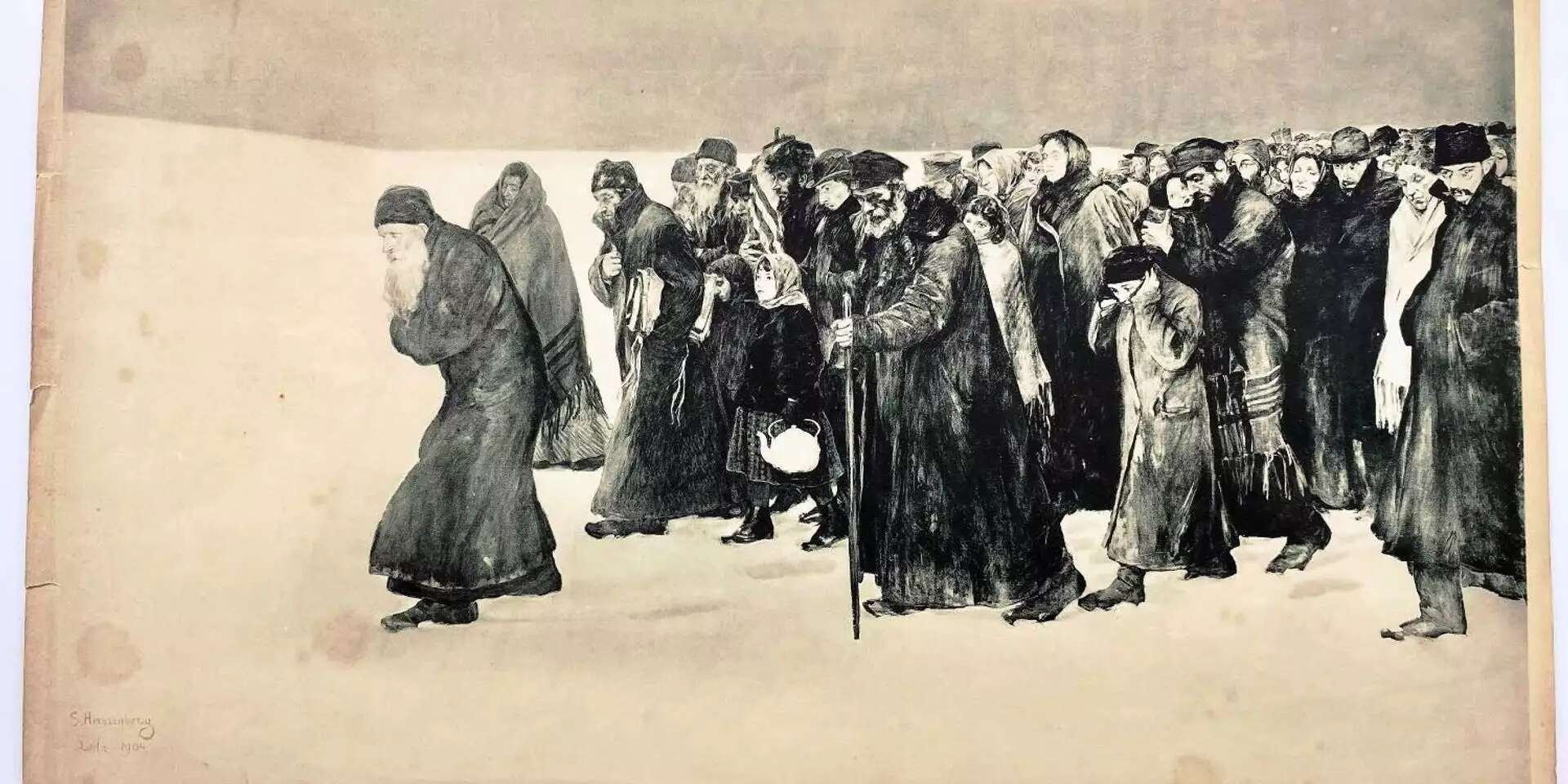
And yet, for most of our years as a nation, we existed without sovereignty, and for a long period also without a land. This is a dangerous existence and a familiar recipe for disappearing from history, because in our wanderings through the world we were without a national home, subject to the mercy of foreigners and to their malice. And not only physical harm, but spiritual harm as well. More than the murders, the pogroms and even the Holocaust, over many centuries the largest part of the nation disappeared through assimilation, whether forced or voluntary. Still, despite everything, we survived in the wilderness and managed to return home. The Book of Numbers touches on this national mode of existence, unique to us.
In the Haftarah, the prophet Hosea, who lived in the eighth century BCE, offers an image: "The number of the children of Israel shall be as the sand of the sea, which cannot be measured or counted" (Hosea 1:10). The people may not have multiplied like sand, but they acquired the quality of the sand of the sea, which stands against the sea's attempts to flood it. At the beginning of the 20th century, in light of the integration of Jews into modern nation-states, Rabbi Meir Simcha Hakohen of Dvinsk saw these prophetic words as a promise and a hope: even if Jews were distant from Torah and commandments, "nevertheless, the nations will not push them away, that they will be like sand, which is a barrier against the waves of the sea," with all the individuals "gathering into the collective against the will of assimilation."
The fourth book of the Torah, Don Isaac Abarbanel said at the end of the 15th century, tells of "the order of the people's leadership, how it was in the wilderness in their journeys and encampments, and all the hardship that befell them on the way, and the reason for which they were delayed in the wilderness." Abarbanel, who led the exiles during the expulsion from Spain, knew well the people's journeys and the hardships that befell them. In the meantime, the national deposit had to be safeguarded until we returned to Zion.
4.
At the beginning of the book, we read of a census taken in the second year after the Israelites' departure from Egypt, and toward the end of the book there is a second census in the 40th year. That is why it is called "Numbers". The purpose of the census was the establishment of an organized army ahead of the entry into the land, "for the Torah does not rely on a miracle, that one should pursue a thousand," as Nachmanides, in the 13th century, noted.
"The Lord spoke to Moses in the wilderness of Sinai, in the Tent of Meeting, on the first day of the second month, in the second year after they had come out of the land of Egypt, saying: Take a census of the whole congregation of the children of Israel, by their families, by their fathers' houses, according to the number of names ... all who are able to go forth to war in Israel, you shall count them by their hosts" (Numbers 1:1-3).
The first Hebrew army was founded in the second month after our departure from Egypt, the Hebrew month of Iyar. Between the national birthday in Nisan and the giving of the Torah in Sivan, the national body was built in Iyar. Since then, national events have been concentrated in this month: the establishment of the state (1948), Jerusalem Day (1967), the San Remo Conference (1920), which gave Britain the mandate over the Land of Israel in order to establish a national home for the Jewish people, Lag B'Omer, associated with the Bar Kokhba Revolt for Israel's freedom (132-135 CE), the beginning of the construction of the First Temple in the days of Solomon (10th Century BCE), and more.
5.
How does one inherit the land? Through settlement, dunam after dunam, and also through conquest of the land and its restoration to its lawful sons. Settlement is the default option, and Jews lived in the land in larger or smaller numbers even under foreign rule. That was not enough, because the goal was the establishment of a state. Toward the end of the book, Moses outlines these two directions: "You shall dispossess the land and dwell in it, for I have given you the land to possess it" (Numbers 33:53). Not only to dwell in the land, but to dispossess and inherit it. Individuals cannot pass on an entire land as an inheritance. For that, one must establish a kingdom or a state that applies its sovereignty over the land and can thereby pass it on as an inheritance to future generations.
The central condition for the existence of sovereignty is the ability to use force, meaning security arms in general and an army in particular. Here, already at the beginning of the fourth book, we have another expression of the idea that the Torah of Israel is not a religion in the ordinary sense, but a national constitution. The known religions address the private individual and offer his moral Improvement . In Israel, by contrast, we became a people before we received the Torah, and even after receiving it, we see, chapter after chapter, that the central core of Israelite faith does not depend on the individual, but on his connection to the collective. The fixed formula of the blessings of our sages is phrased in the plural: "Who has sanctified us with His commandments and commanded us." Even regarding prayer, a religious act by any definition, there is a fundamental difference between an individual and the many. What may be said in a minyan (ten people) may not always be said by an individual.
6.
In the 12th century, Rabbi Samuel ben Meir, known as Rashbam, Rashi's grandson, observed, regarding the beginning of the book: "Since from now on they need to go to the Land of Israel, and men aged 20 are fit to go out in the army of war ... therefore the Holy One, blessed be He, commanded at the beginning of this month to count them." A Jew sits in northern France, deep in exile, a thousand years after the destruction of Jerusalem, and speaks of a Jewish army preparing to conquer the Land of Israel. Year after year, Jews read about the army mustered by Moses and Aaron, and were filled with hope that all this was not a parable and not a dream, but would happen, if not today then tomorrow, even if that tomorrow would wait a thousand years. We saw it with our own eyes.