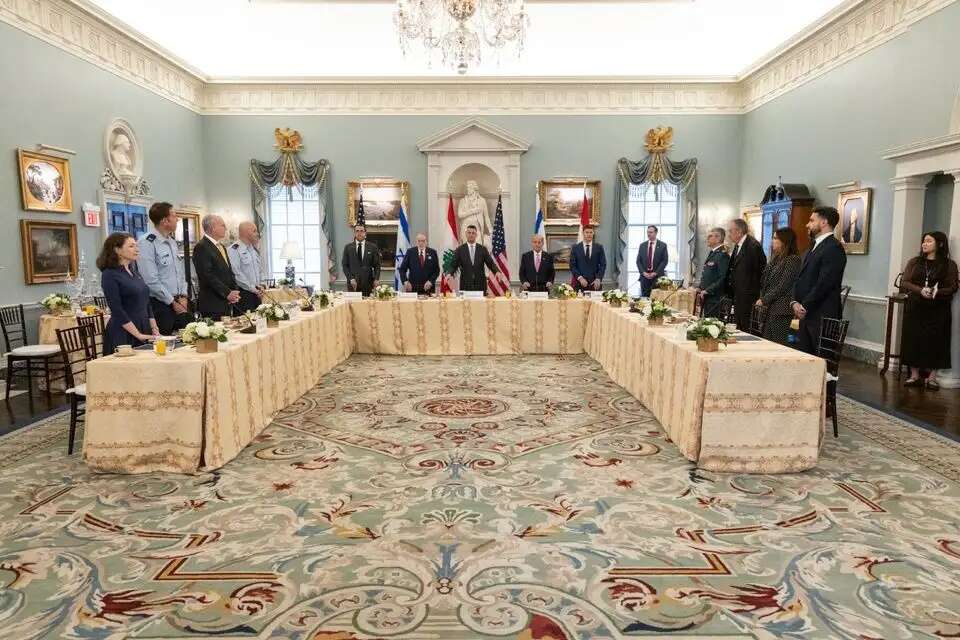
The third round of direct talks between Israel and Lebanon, mediated by the US, ended in Washington, DC, on Friday. The round, which lasted two days, was held at the US State Department headquarters.
In a statement, the State Department said that two days of "very productive" talks between Israel and Lebanon had taken place on May 14 and 15, in what appears to be another significant stage in the US effort to advance a security and political arrangement between the countries.
The statement said that following the talks, the ceasefire that began on April 16 would be extended by 45 days in order to allow talks between the countries to continue. The State Department will reconvene the political track of the negotiations on June 2 and 3. At the same time, a security track will be launched for the first time at the Pentagon on May 29, with the participation of military delegations from both countries.
On the Israeli side, Israel's Ambassador to Washington Yechiel Leiter attended the meeting, along with two senior military representatives: Brig. Gen. Amichai Levin, head of the Israel Defense Forces' Strategic Division, who received approval from Defense Minister Israel Katz to take part in the meeting, and acting IDF attaché in Washington Arik Ben-Dov.
Leiter addressed the progress in the talks after they concluded, saying that after "two days of negotiations with Lebanese and American officials," he was looking forward to the next stages. "The peace talks were candid and constructive, and they are expected to move forward on two tracks: security and political," he said. Leiter added, "There will be ups and downs, but the potential for success is great. What will be of paramount importance throughout the negotiations is the security of our citizens and our soldiers."
The Lebanese delegation included former Lebanese Ambassador to the US Simon Karam, current Ambassador Nada Hamadeh Mouawad, Deputy Chief of Mission Wissam Boutrous, and the Lebanese military attaché in Washington, Brig. Gen. Oliver Hakmeh.
The Lebanese delegation just departed the State Department building: pic.twitter.com/CspyGAKmB9
— Hiba Nasr (@HibaNasr) May 15, 2026
On the Lebanese side, the delegation said it viewed the results of the talks as "significant diplomatic progress for Lebanon." The statement said, "The extension of the ceasefire and the establishment of a US-mediated security track provide critical breathing room for our citizens, strengthen state institutions and advance a political path toward lasting stability." The delegation further emphasized that "Lebanon will continue to participate constructively in the negotiations, while preserving its sovereignty and defending the security of its people."
According to the statement, Lebanon's position is based on four principles: "the full restoration of state authority over all Lebanese territory, in order to protect its borders, preserve its national sovereignty and ensure the security of its people"; "the safe and dignified return of displaced civilians to the south, supported by significant economic assistance and continued reconstruction efforts"; "the return of all Lebanese detainees and the repatriation of the remains of those killed"; and "a gradual and verifiable implementation process, supported by the US, to ensure that all commitments are fulfilled without compromising Lebanon's sovereignty." The statement concluded that Lebanon's goal is "to turn the momentum of the current ceasefire into a comprehensive and lasting agreement that will safeguard the dignity, security and future of the Lebanese people."
The US statement said Washington hoped the discussions would advance "lasting peace between the two countries, full recognition of each other's sovereignty and territorial integrity, and the establishment of genuine security along their shared border."