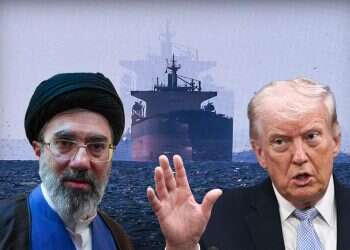
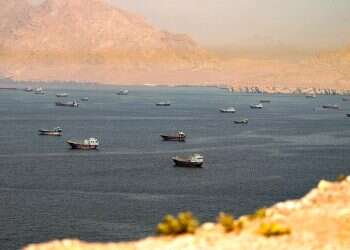
Iran has set up a new body to govern passage through the Strait of Hormuz, and launched an official X account for the Persian Gulf Strait Authority (PGSA) on Monday – even as an American source warned that President Donald Trump has only days left of patience with Tehran before he moves toward military action.
An American source told the Qatari network Al Jazeera that "President Donald Trump's patience has begun to run out as a result of the failure to achieve progress in negotiations with Iran." The source added that the Iranian regime has "days, not weeks" to offer Trump something that would break the diplomatic deadlock. According to the source, Trump is leaning toward military action unless something is delivered by Iran within days.
Meanwhile, a senior Iranian official speaking with Reuters said the revised proposal relayed to Washington through Pakistan includes a demand for a complete end to the war, the lifting of sanctions, the reopening of the Strait of Hormuz, and the release of all frozen Iranian assets.
According to the official, the US has so far agreed to release only 25% of those assets on a phased timeline, but has shown flexibility on other issues – including on the nuclear question. The official added, however, that Tehran is prepared to discuss that only "at later stages."
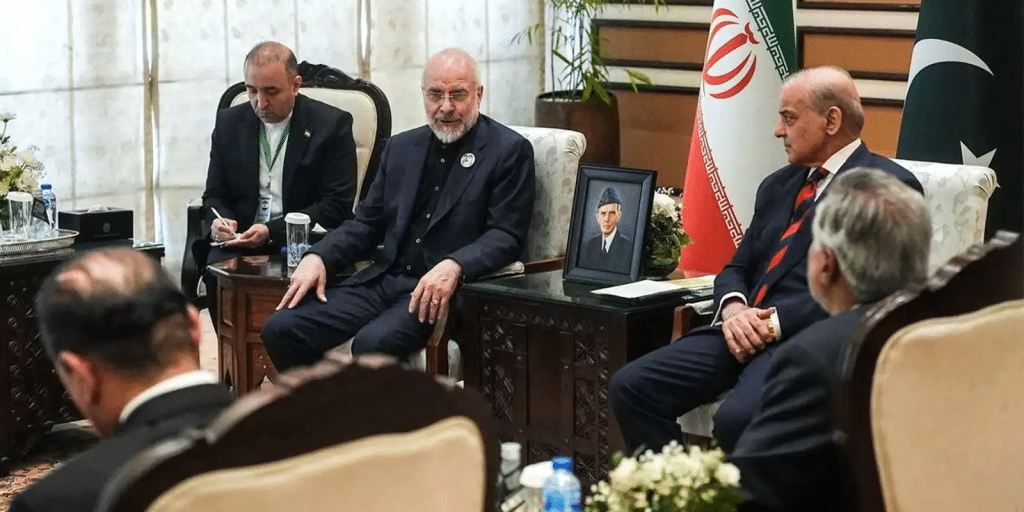
A Pakistani source told Reuters earlier Monday, "We don't have much time," adding that the two sides "keep changing their objectives."
"They'd better move fast"
Against that backdrop, The New York Times reported Sunday that the US and Israel are engaged in their most intensive preparations for resuming strikes on Iran since the ceasefire. Trump wrote on Truth Social that "for Iran, the clock is ticking – they'd better move fast, otherwise there won't be anything left of them." Iranian Foreign Ministry spokesman Esmail Baghaei responded, "Don't worry – we know very well how to respond."
The account for the new body that would "manage Hormuz" was launched by Iran's Supreme National Security Council (the regime's top security decision-making body), which posted on its official X account that the Authority would provide "real-time updates on Strait of Hormuz operations and the latest developments."
1/
نهاد مدیریت آبراهه خلیج فارس (Persian Gulf Strait Authority - PGSA) نهاد قانونی و مرجع نمایندگی جمهوری اسلامی ایران جهت مدیریت عبور و مرور از تنگه هرمز است.— PGSA | نهاد مدیریت آبراه خلیج فارس (@PGSA_IRAN) May 18, 2026
In its first posts, the Authority itself wrote that it is "the legal and authorized body of the Islamic Republic for managing passage through the Strait of Hormuz," and that "passage without authorization will be considered unlawful" – though it made no mention of tolls.
Since the outbreak of the war, Iran has declared it will manage the strait independently and charge transit fees, purportedly in coordination with Oman.
According to Iranian media, the new authority is the formal mechanism through which Iran intends to manage the strait. Vessels seeking passage will be required to submit ownership, insurance, crew, and cargo details in advance and to obtain a transit permit. Vessels linked to Israel will be blocked; American vessels and those from countries Iran designates as "hostile" will face severe restrictions or outright refusal.
Until the American blockade on April 13, Iran had allowed vessels from countries it considers friendly to pass through a corridor inside its territorial waters, around Larak Island, in coordination with the Islamic Revolutionary Guard Corps and in exchange for a toll.
Iranian Foreign Ministry spokesman Esmail Baghaei said Monday that "our technical teams and those of the Sultanate of Oman have met to coordinate on the issue of the Strait of Hormuz," and that "the new arrangements are intended to ensure safe passage and to uphold Iran's sovereignty and natural rights."
The new authority comes after weeks during which Iran attempted to establish operational control over the strait through an informal corridor inside its territorial waters, around Larak Island. Vessels from countries considered close to Tehran could pass through it in coordination with the IRGC, in exchange for payment of approximately $2 million per vessel.
In principle, charging a toll for passage through an international shipping lane is prohibited under international law. Even China, Iran's ally, expressed opposition – partly out of concern over a dangerous precedent for other straits important to it, such as the Malacca Strait. Over the weekend, the IRGC-affiliated Fars News Agency reported the launch of Hormuz Safe, which appeared to be an attempt to wrap the toll-collection scheme in the guise of an insurance service, thereby circumventing the international prohibition.
A Bloomberg report on the matter noted that "it is unclear how directly the insurance service is linked to the Revolutionary Guards or to the government's plans to consolidate a formal toll system," adding that "it is doubtful whether a Bitcoin-based insurance system would be workable at all" – in part due to the currency's high volatility and the threat of American sanctions.
The cryptocurrency payment mechanism was designed to allow Iran to collect funds outside the Western banking system and the SWIFT network (the global interbank messaging system used to transfer money internationally), from which it has been cut off due to sanctions.