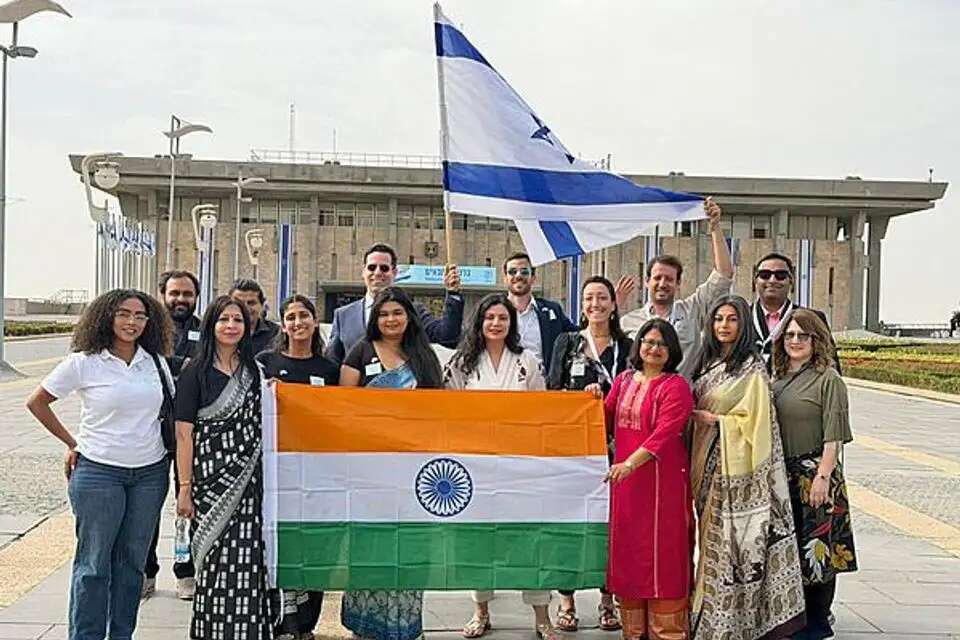
Indian Prime Minister Narendra Modi's visit to Israel this past February, days before the outbreak of the war with Iran, was another chapter in the tightening relations between the two countries. This month, a delegation of media figures, advisers and social media influencers also arrived in Israel, visiting the Nova site, Sderot, Yad Vashem and Jerusalem's Old City.
"Last night I was at a party opposite the hotel. There was a food festival there, people were dancing," said Anshul Saxena, a social media influencer and content creator with more than 1 million followers. "Just one month ago, there were bombs in every place we visited."
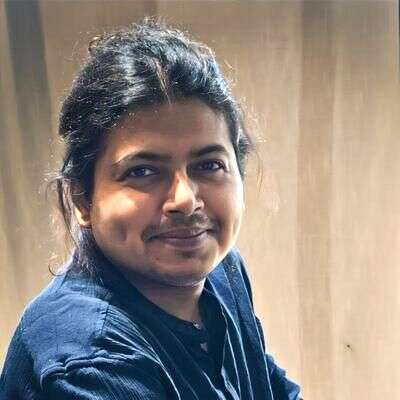
Saxena, who came with the delegation organized by the Israel India Friendship Club, is one of the most prominent pro-Israel voices in India, part of a wave of support that has been clearly felt on social media around the world. Asked whether the surge of Indian support for Israel in recent years was authentic or an organized campaign, as hostile audiences have claimed, he said: "I was one of those who supported Israel online in those days (after Oct. 7). I read every comment, followed every post. These were real people. Hamas supporters were shocked by that support."
The guests from India, who met in Israel with bereaved families and Diaspora Affairs Minister Amichai Chikli, repeatedly mentioned the terrorist attack in Pahalgam in the Kashmir region, which is at the center of a territorial dispute between India and Pakistan. On April 22, 2025, terrorists opened fire on a group of tourists and murdered 26 people. According to testimonies, the terrorists checked which of the victims were not Muslim and shot them.
"Hamas is not only a threat to Israel, it is also a threat to India," Saxena said. "Two months before the attack in Pahalgam, Hamas terrorists visited Pakistani Kashmir and took part in anti-India events alongside Pakistani terrorist organizations such as Lashkar-e-Taiba and Jaish-e-Mohammed."
"I could have been murdered in the attack"
"I was in Pahalgam two weeks before the attack," said Kavya Kirti, an independent journalist and former finance entrepreneur from Delhi with more than 275,000 followers. "I could have been one of those murdered. People were asked about their religion, they were asked to recite the shahada [the Muslim declaration of faith], they were checked to see whether they were circumcised. It was an outward expression of political Islam and, for the first time, it felt like an attack on Hindus."
It is hard to overstate the place that event, and the war that erupted in its wake, occupied in India's political life, especially within the ruling BJP party. New Delhi accused Lashkar-e-Taiba at the time and launched a military operation against Pakistan called "Sindoor," named after the red powder married Hindu women apply to their foreheads, a symbol of the widows left by the attack. The operation included the use of Israeli weapons, the result of years of tightening security ties.
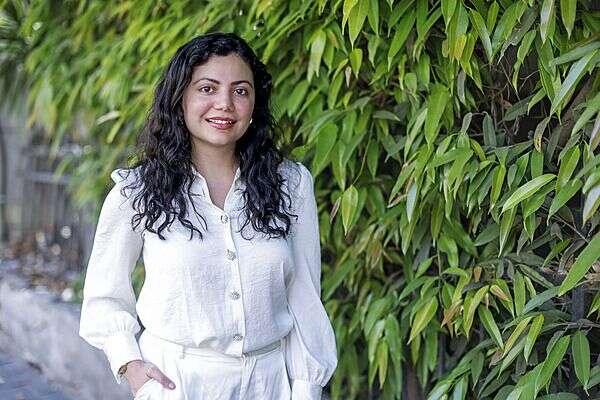
"We are both ancient civilizations that did not persecute anyone and were persecuted ourselves, and now we are both dealing with the same misconception," Kirti said, referring to Pakistan's claims regarding Kashmir and comparing them to claims against the Jewish people's historical right to the Land of Israel.
A partnership that defines a century
The advantage in economic relations between Jerusalem and New Delhi is sometimes portrayed as resting on Israeli entrepreneurship and Indian manufacturing power, although India, of course, aspires to more than that. "We receive excellent support from Israeli technology in agriculture," Saxena said. "Our farmers are learning Israeli methods, and that increases their income. Also, both of us are nations of startups. We can grow together."
The third side of the triangle is represented by the United Arab Emirates, which is expected to be a central hub in the India-Middle East-Europe Economic Corridor, known as IMEC, on which Israel has placed great hopes. "The UAE is a model of values India identifies with: an open economy, development, prosperity," Kirti said. "IMEC is the alternative to Chinese influence in the region," an important point for Delhi.
"The alliance between India and Israel is one of the defining partnerships of the 21st century," said Paushali Lass, a fellow of the Israel India Friendship Club. "Israel needs allies, and we have more than 1 billion friends in India. Two ancient peoples, two indigenous democracies, one shared future."
Despite covert ties, relations between Israel and India were especially cool until the 1990s, a result of India's closeness, as leader of the Non-Aligned Movement, to the Soviet Union and Arab states. Since the establishment of full diplomatic relations in 1992, the situation has gradually changed, but the real shift came with Modi. "With the previous governments, it was like a secret romance," Saxena said. "With Modi, it came out into the open, and it is growing."
Would the relationship survive a change of government in India?
"India does not act according to political swings," Kirti said. "Once someone extended a hand and we tested him over time, we do not forget that. This is not a matter of one government." She acknowledged that parts of the Indian left are critical of the relationship, but described them as marginal voices.
In any case, such an "upheaval" in India does not appear likely: The BJP's victory in May 2026, including its capture of West Bengal after 15 years of rule by its rivals, shows that the party, which suffered a blow in the 2024 general election, has regained momentum.